

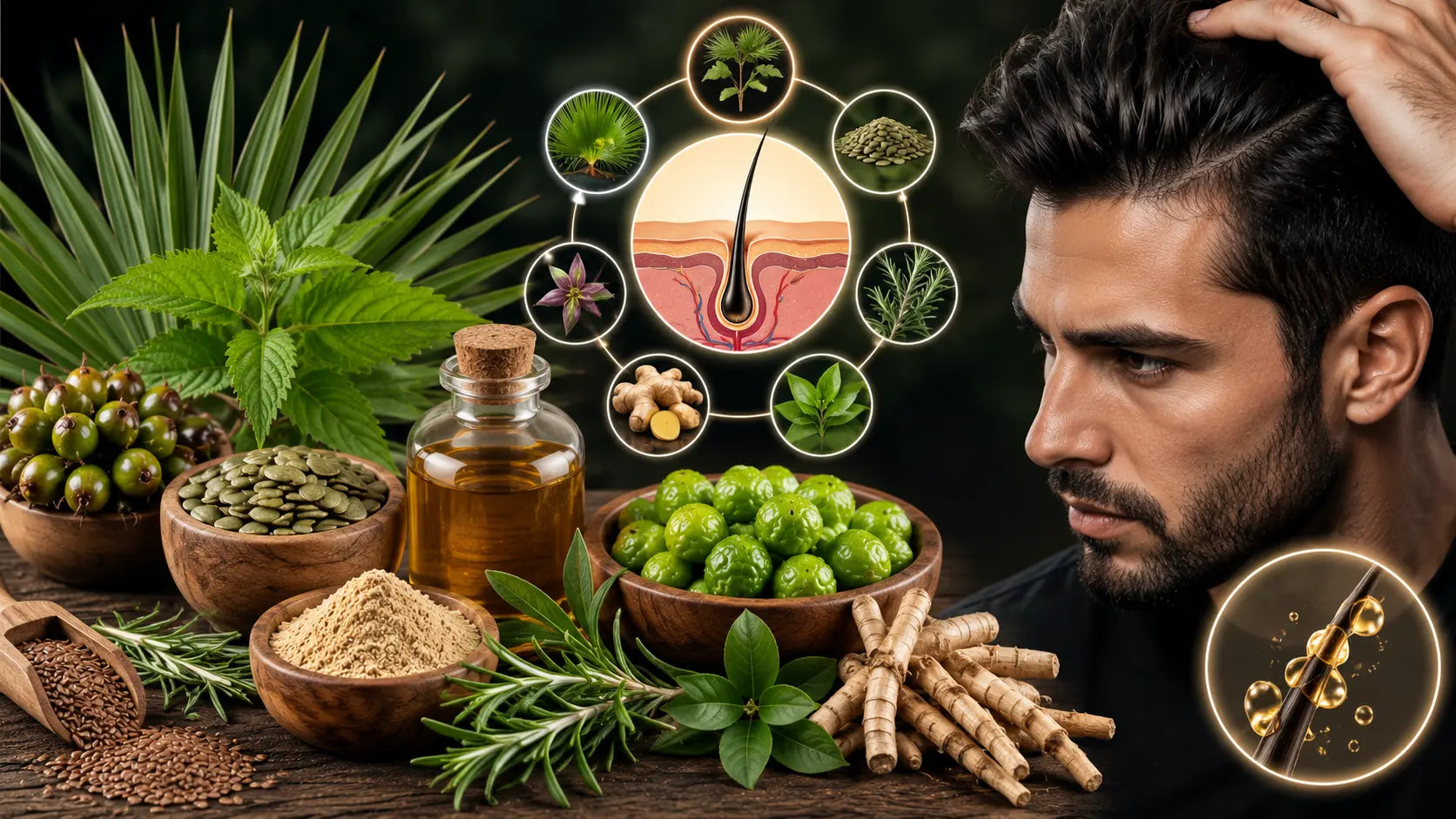

You have probably heard that DHT causes hair loss. Now you may be searching, which natural ingredients can actually help you to avoid its overproduction.
Let’s first understand what is DHT? It’s the hormone responsible for shrinking your hair follicles over time. Once it binds to genetically sensitive follicles, the process of thinning begins, and it does not stop on its own. The good news is that certain plant-based compounds have been studied specifically for their ability to interrupt that process, without the side effects that come with prescription options.
This article breaks down the best natural DHT blocking ingredients, how they work, which ones have real clinical evidence, and how to use them effectively.
Let's get into it.
Insight into the Best Natural DHT Blocking Ingredients
Hair loss conversations often jump straight to prescriptions. But if you are in the early stages of thinning or want to support scalp health long-term, natural DHT-blocking ingredients are worth understanding properly.
DHT (dihydrotestosterone) is the primary hormonal driver of androgenetic alopecia. When 5-alpha reductase (5-AR) converts testosterone into DHT and your follicles are genetically sensitive, they gradually shrink, producing thinner hair until growth stops.
What Makes an Ingredient an Effective DHT Blocker
An effective natural DHT blocker must do at least one of the following:
-
Inhibit 5-AR activity
-
Reduce DHT binding at the androgen receptor
-
Protect the follicular environment from androgen-related damage
Ingredients that meet one or more of these criteria with clinical evidence are worth your attention.
How Natural Ingredients Block DHT
The Link Between DHT and Hair Follicle Miniaturisation
When DHT binds to androgen receptors in the dermal papilla, it triggers miniaturisation. Due to this, each growth cycle shortens, the hair shaft becomes finer, and eventually the follicle stops producing visible terminal hair. This unfolds over years, which is exactly why early intervention matters.
How Plant-Based Compounds Inhibit 5-Alpha Reductase
Phytosterols, fatty acids, and polyphenols found in saw palmetto, pumpkin seed oil, and green tea have demonstrated 5-AR inhibitory activity in laboratory and clinical settings. They are not as potent as finasteride, but they work through the same pathway with a significantly lower risk of systemic side effects.
Why Natural Blockers Work Gradually But Safely
Natural blockers modulate rather than suppress DHT production. Research suggests this gradual action is part of their safety profile, making systemic hormonal disruption far less likely than with synthetic inhibitors. Consistent use over several months is necessary before visible improvement is realistic.
Top Natural DHT Blocking Ingredients
Saw Palmetto: The Most Researched Natural DHT Blocker
Saw palmetto (Serenoa repens) is the most studied natural DHT blocker available. Its liposterolic extracts and phytosterols inhibit both Type I and Type II 5-alpha reductase, with inhibition rates of approximately 32% and 38%, respectively, at therapeutic doses. It reduces scalp-level DHT without suppressing systemic hormone balance.
In a comparative trial by Rossi et al. (2012) involving 150 men, those taking 320 mg daily saw 38% improvement in hair count over two years versus 68% with finasteride, and without finasteride's sexual side effects. It is the only plant-derived DHT blocker with a head-to-head RCT against finasteride.
Pumpkin Seed Oil: Clinically Proven to Reduce Hair Loss
Pumpkin seed oil (PSO) has the strongest clinical trial data of any natural ingredient in this category. In a research study, it was observed that individuals taking 400 mg of PSO daily for 24 weeks saw a 40% increase in hair count from baseline versus 10% in the placebo group.
The mechanism is primarily attributed to PSO's phytosterols, particularly beta-sitosterol, which inhibit 5-AR and reduce DHT binding at the follicle. This trial was conducted exclusively in men, so evidence for female pattern hair loss remains limited.
Zinc: Regulating DHT Through Enzyme Control
Zinc acts as a natural cofactor in 5-AR enzyme function. At adequate levels, it may reduce the enzyme's efficiency in converting testosterone to DHT. A study found significantly lower serum zinc levels in patients with androgenetic alopecia compared to healthy controls, supporting the link between zinc status and DHT-related hair loss. If you supplement 15–30 mg daily, it shows good results. And if you exceed this, it competes with copper absorption.
Biotin, Nettle Root, and Green Tea: Supporting Ingredients
Biotin supports keratin structure but does not directly block DHT. If your diet already provides adequate biotin, supplementing more is unlikely to affect DHT-related thinning.
Nettle root contains lignans and sterols that may inhibit both 5-AR and DHT receptor binding, making it a common pairing with saw palmetto.
Green tea's EGCG has shown 5-AR inhibitory potential in vitro, though human hair loss data remains limited. These ingredients work best as amplifiers in a broader protocol, not as standalone solutions.
How to Use Natural DHT Blockers Effectively
Recommended Dosage and Daily Routine
Clinically supported dosages:
-
Saw palmetto at 320 mg daily
-
Pumpkin seed oil at 400 mg daily
-
Zinc at 15-30 mg daily
Most natural DHT blockers require a minimum of 12–24 weeks of uninterrupted use before you can accurately assess whether they are working for you.
Topical vs Oral: Which Delivery Method Works Better
Oral supplements affect systemic 5-AR activity. Topical formulations deliver active compounds directly to the scalp without broader hormonal impact. For early-stage thinning, combining both delivery methods tends to produce better outcomes than relying on either alone.
Pairing Ingredients for a Stronger Combined Effect
Saw palmetto and pumpkin seed oil work through complementary mechanisms in the same pathway, making them a logical pairing. Adding zinc supports enzyme regulation at the nutritional level. Green tea extract adds antioxidant coverage for the follicular microenvironment.
Limitations and What Natural Blockers Cannot Do
Why Results Take Longer Compared to Synthetic Options
Finasteride can reduce serum DHT by approximately 60–70% within weeks. Natural blockers, working through milder enzyme modulation, require months to show effects. Expecting visible regrowth within four to six weeks sets you up to abandon ingredients that would have worked with more time.
Stages of Hair Loss Where Natural Blockers Are Less Effective
Natural DHT blockers are most useful in early to mid-stage thinning, where follicles are miniaturised but not yet dormant. Once follicles have been inactive for years, DHT blockade is unlikely to reactivate them. If thinning has been progressing unchecked for a long time, you should start supplementing after consultation. And for a supplement, you can trust Jacked Nutrition DHT blocker.
Quality and Dosage Differences Across Supplement Brands
Saw palmetto standardized to 85-95% liposterolic content performs very differently from an unstandardised powder capsule. Underdosed products are common and account for a significant portion of reported failures. Always check for percentage standardisation on the label.
Choosing the Right Natural DHT Blocker for Your Hair Type
Best Ingredients for Early-Stage Thinning
If you are catching hair loss early, saw palmetto and pumpkin seed oil together give you the most evidence-backed foundation. Add zinc if your diet is low in meat, seeds, or legumes. Starting early gives these ingredients the best chance to preserve existing density before miniaturisation progresses.
Best Ingredients for Scalp Health and Follicle Strength
If your scalp tends toward inflammation or sensitivity alongside thinning, topical ingredients like rosemary oil, green tea extract, and nettle root are worth adding. These support the follicular environment through anti-inflammatory mechanisms without adding systemic hormonal load.
What to Look for on a Supplement Label
Check for saw palmetto standardised to 85–95% fatty acids and sterols; cold-pressed pumpkin seed oil; and zinc as bisglycinate or picolinate for superior absorption. Avoid proprietary blends that obscure individual ingredient doses. Dosage transparency is the most reliable quality signal a label can offer.
Your Next Step With Natural DHT-Blocking Ingredients
Natural DHT blockers are a legitimate, evidence-supported option for early-stage hair loss and long-term scalp maintenance. Saw palmetto and pumpkin seed oil have the strongest clinical backing.
Zinc adds meaningful enzymatic regulation. The gap between natural and pharmaceutical options is real, so being honest about that helps you make better decisions. For early-stage thinning, a consistent natural protocol is a practical starting point. For more advanced hair loss, clinical guidance is the smarter move.
Key Takeaways on the Best Natural DHT Blocking Ingredients
Saw palmetto and pumpkin seed oil are your most evidence-backed natural 5-AR inhibitors. Zinc is effective and often overlooked. No natural blocker matches finasteride in potency, but the tolerability advantage is significant. Quality and standardisation matter more than brand name. Give your protocol at least 24 weeks before evaluating results.
Final Recommendation for a Natural Hair Loss Routine
Start with 320 mg standardised saw palmetto and 400 mg pumpkin seed oil daily. Ensure zinc intake is adequate. Add a topical rosemary oil if scalp inflammation is a concern. Document progress with photos every four weeks and give it six months before deciding whether to escalate.
FAQs: Natural DHT Blocking Ingredients
Which Natural Ingredient Blocks DHT the Best?
Saw palmetto has the most clinical evidence, including a direct comparative trial against finasteride. Pumpkin seed oil follows with its 2014 RCT. Between the two, saw palmetto is the stronger primary DHT-blocking choice.
How Long Does Saw Palmetto Take to Work?
Most studies showing meaningful results used 320 mg daily for at least 24 weeks. Commit to six months before evaluating its effectiveness for your specific pattern.
Can I Get Enough DHT Blockers From Food Alone?
Pumpkin seeds, green tea, and zinc-rich foods contribute DHT-modulating compounds, but achieving supplement-level 5-AR inhibition through food alone is difficult. Food is a complement, not a replacement.
Are Natural DHT Blockers Safe for Women?
Most are safe at standard doses, but women who are pregnant or breastfeeding should avoid saw palmetto due to its hormonal activity. Women with hair thinning should also rule out iron deficiency or thyroid dysfunction before attributing loss solely to DHT.
Can I Use Multiple Natural DHT Blockers Together?
Yes. Saw palmetto, pumpkin seed oil, zinc, and green tea extract each work through slightly different mechanisms within the same pathway. Start with two core ingredients and build from there.
Do Natural DHT Blockers Work as Well as Finasteride?
No. Finasteride reduces serum DHT by 60-70% with substantially stronger evidence for regrowth. Natural blockers work more modestly. Their real advantage is tolerability: a much lower risk of side effects makes them viable for long-term maintenance.
Share:
L-Carnitine for Weight Loss: Does It Really Burn Fat or Just a Myth?