

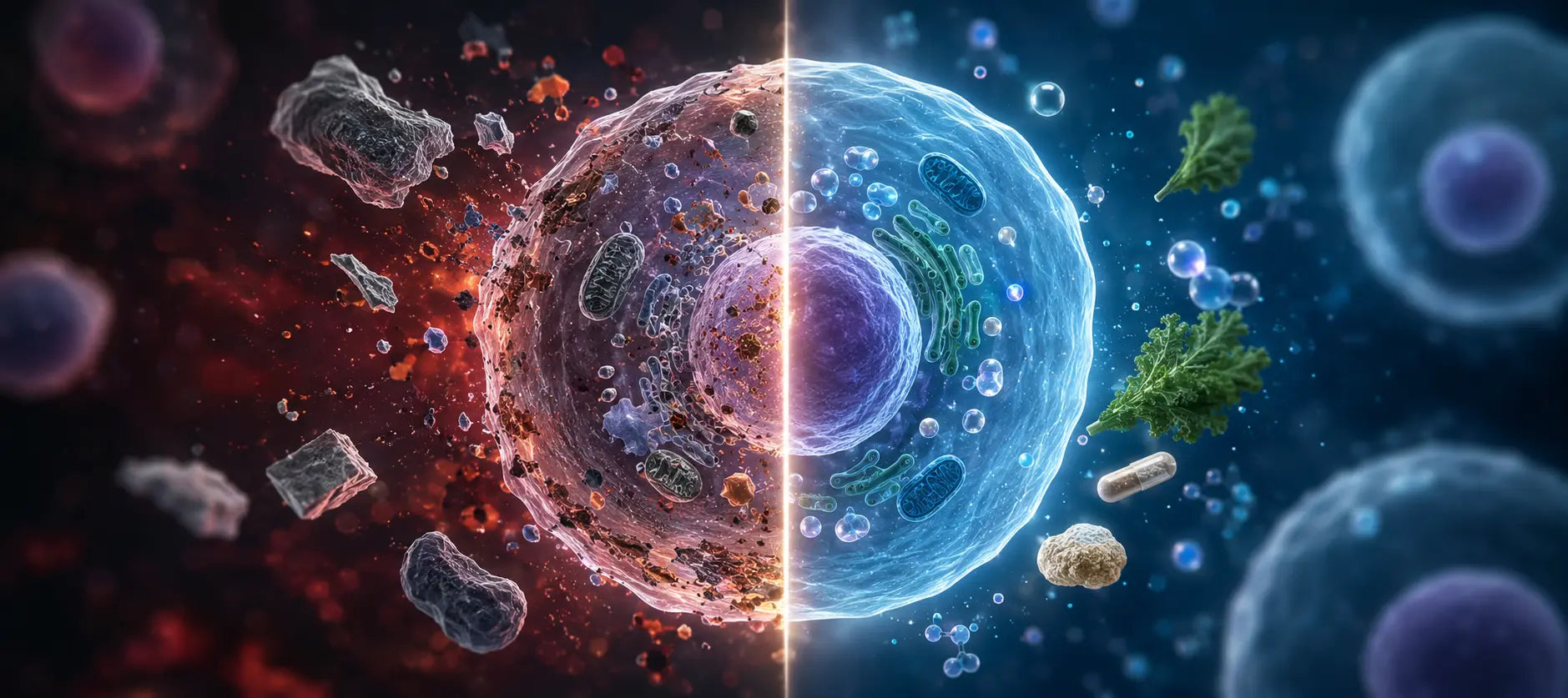

When most people picture getting in shape, they think on the surface: the number on the scale, the definition in the mirror, the weight on the bar. The usual fixes follow the same pattern cut carbs, add cardio, try a new pre-workout. But if you're hitting plateaus, fighting persistent fatigue, or struggling to recover despite doing everything "right," the issue may not be your work ethic at all.
It may be happening at a level you can't see.
At Jacked Nutrition, we'd argue that real physical performance isn't built in the gym alone it starts inside your cells. If your cellular foundation is compromised, willpower can only take you so far. Here's what's actually going on with cellular damage, and what the research suggests you can do about it.
Your Body Works in Layers
Your body doesn't operate in isolation. It functions more like a layered system, where outer performance is shaped by what's happening underneath lifestyle, environment, and genetics included.
Physical stress from overtraining, mental stress from a demanding job, and environmental exposures like microplastics or heavy metals don't stay contained to their source. Research suggests these stressors can act as hormone disruptors that affect the body broadly, not just locally. Stack enough of them together, and your system shifts into a defensive state directing energy toward managing stress rather than building muscle or burning fat.
What Cellular Damage Actually Looks Like
Two processes sit at the center of cellular degradation: oxidative stress and mitochondrial decline.
Oxidative Stress and Free Radicals
Think of oxidation as a kind of internal rusting. As your body processes oxygen and fends off external stressors, it generates unstable molecules called free radicals. In normal amounts, this is a routine part of metabolism your body handles it without issue.
Problems arise when free radical production outpaces your body's ability to neutralize it. When that balance tips, free radicals can damage cell membranes, proteins, and DNA, and research links this kind of oxidative stress to systemic inflammation.
Mitochondrial Decline
Your mitochondria are the structures inside your cells responsible for producing ATP, the energy currency your muscles rely on to lift, sprint, and recover. Chronic oxidative stress takes a disproportionate toll on these structures, and evidence suggests sustained oxidative damage can impair mitochondrial function over time.
For anyone trying to optimize performance, that's a meaningful setback. Reduced mitochondrial efficiency has been associated with lower energy availability, slower recovery, and a metabolic rate that doesn't cooperate even when sleep and training look fine on paper.
How to Support Cellular Health
The encouraging part is that your body has real capacity to adapt. Addressing the underlying stressors rather than just the surface symptoms is where most of the opportunity lies.
Prioritize antioxidant-rich foods. Antioxidants work by donating an electron to neutralize free radicals, interrupting the damage cycle before it compounds. A diet built around a wide variety of colorful, micronutrient-dense whole foods is the most reliable first step.
Reduce avoidable environmental exposure. You can't control outdoor air quality, but you can reduce close-range exposure to hormone disruptors swapping plastic food containers for glass, filtering drinking water, and choosing personal care products with fewer synthetic additives.
Make recovery a deliberate practice, not an afterthought. Supporting cellular repair means shifting out of a sympathetic ("fight or flight") state and into a parasympathetic one. Consistent, uninterrupted sleep, active recovery days, and practices like breathwork or meditation all play a role here.
Building a Cellular Support Stack
Protecting your biology at the cellular level takes more than a standard protein shake. Three categories of nutrients are worth focusing on:
|
Target Area |
Key Nutrients |
Role in Cellular Health |
|
Mitochondrial support |
CoQ10, alpha-lipoic acid (ALA), L-carnitine |
Supports ATP production in the mitochondria, which may help with daily energy availability |
|
Oxidative defense |
Vitamins C and E, zinc, selenium |
Function as antioxidants that help neutralize free radicals and protect cell membranes |
|
Cellular repair |
Omega-3 fatty acids, amino acids |
Support cell membrane integrity and may help reduce inflammation tied to recovery |
This is the kind of fueling protocol Jacked Nutrition is built around moving beyond basic protein toward nutrients that target the cellular level, where a lot of fatigue and stalled progress actually originates.
The Bottom Line
Cellular damage doesn't show up on a scale, but its effects fatigue, plateaus, slow recovery are very real. Oxidative stress and declining mitochondrial function are two of the most well-supported mechanisms behind that disconnect between effort and results. Supporting your cells with an antioxidant-rich diet, reduced environmental exposure, and genuine recovery isn't a quick fix, but it addresses the layer that surface-level changes can't reach. If fatigue or stalled progress persists despite consistent training and nutrition, it's worth discussing testing and a tailored plan with a qualified health professional.
Share:
How HPLC Testing Verifies Every Batch of Jacked Creatine
Inside Farmalabs: How Jacked Nutrition Built Pakistan's First Sports Nutrition Factory