

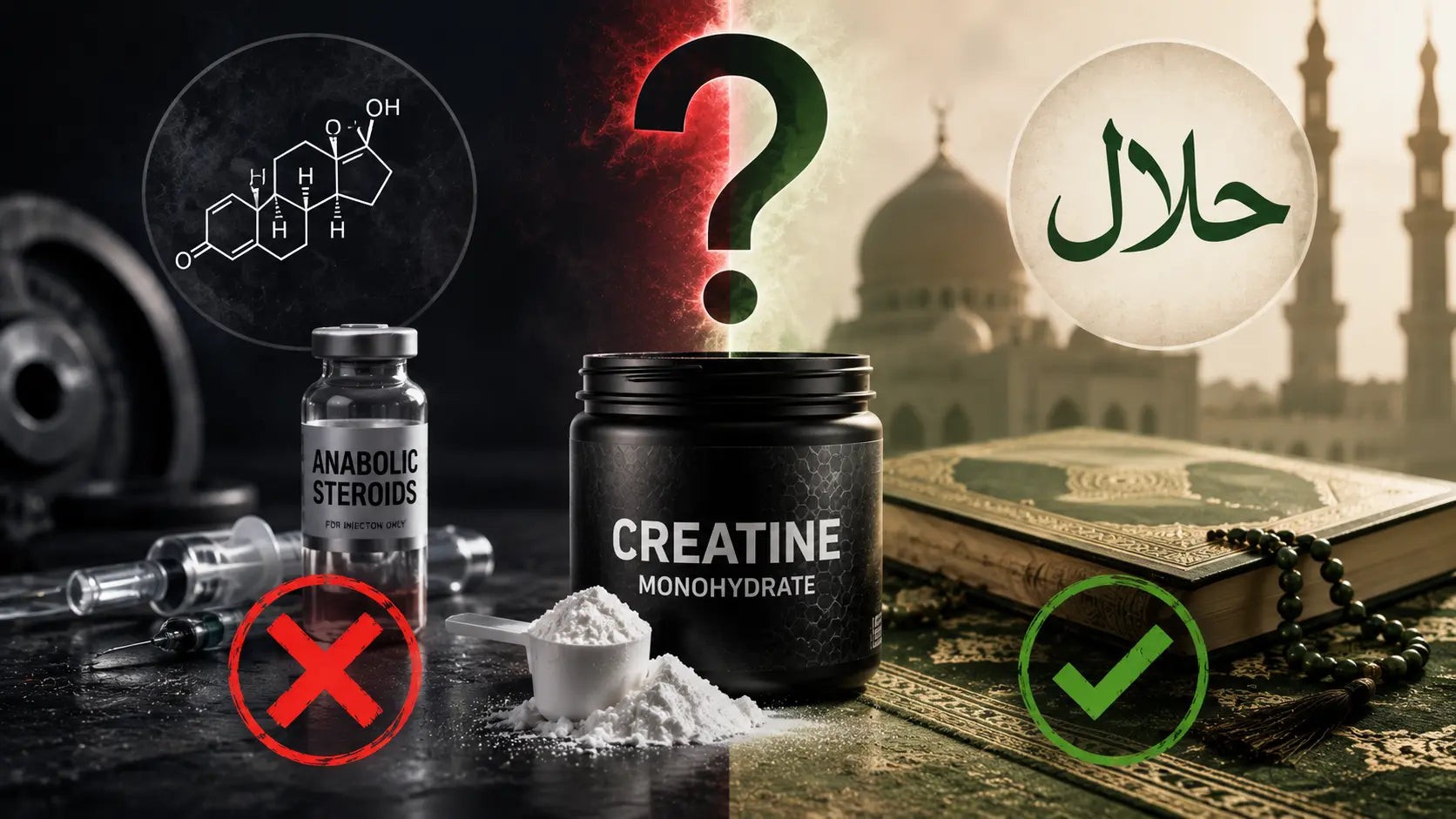

If you've spent any time in Pakistani gyms or fitness groups, you've probably heard both of these claims: "creatine is basically a steroid" and "creatine is haram”. None of these claims is true. But as these myths are so widespread, a lot of Muslim athletes in Pakistan aren’t enjoying the benefits of creatine, just because they are confused.
This article breaks down exactly what creatine is, how it differs from anabolic steroids, what Islamic scholars actually say about it, and how to pick a halal-certified option you can trust.
Creatine Myths Explained
Why Many People Think Creatine Is a Steroid
The confusion exists because of a historical context. Back in the 1990s and early 2000s, during Major League Baseball's steroid era, several players publicly credited creatine for their performance gains. It later turned out that many of them were using actual anabolic steroids. And they were using creatine just as a cover story. That association stuck in the public mind, and the rumour has been spreading ever since.
The second reason is simpler: creatine works. When people see rapid strength and muscle gains from creatine, they assume it must be doing something illegal. It isn't. It's just good science.
Is Creatine Halal According to Islam?
The consensus among Islamic scholars who have examined creatine is that it is permissible when the source is verified. Modern creatine monohydrate supplements are synthetically manufactured in laboratories from sarcosine and cyanamide. And no animal-derived materials are involved. When no haram substances are used in production, the compound is considered permissible under all four Sunni madhabs.
What Creatine Really Is
Creatine as a Natural Energy Compound
Creatine is not a drug. It is not a hormone. It is a naturally occurring compound that your body already produces every single day.
Chemically, it is synthesised in your liver, kidneys, and pancreas from three amino acids: glycine, arginine, and methionine. Once produced, around 95% of your total creatine is stored directly in your skeletal muscles, where it sits ready to be used for energy.
You can consider creatine as a battery backup. When your muscles need a rapid burst of energy during a heavy squat, a sprint, or an explosive set of push presses, creatine donates its phosphate group to regenerate ATP (adenosine triphosphate). It acts as your body's primary energy currency. Without enough creatine, that battery drains faster.
How Creatine Supports Muscle Performance
When you supplement with creatine, you are simply increasing the size of that battery. Your muscles can sustain harder efforts for longer before fatiguing. Over time, this allows you to train at higher intensities, lift more weight, and trigger greater muscle adaptation.
It does not inject hormones into your system. It does not tell your body to behave differently. It just gives your muscles more fuel to do what they already do.
Natural Sources of Creatine in Food and the Body
Your body makes creatine on its own, but food also contributes. Red meat and fish like salmon and tuna are among the richest dietary sources of creatine, with roughly 4-5g per kilogram of raw meat. The problem is that cooking destroys a significant portion of it, and eating enough to match a proper training dose would require impractical amounts of food.
That is exactly why supplementation exists.
Creatine vs Steroids: Key Differences
What Anabolic Steroids Actually Do
Anabolic-androgenic steroids (AAS) are synthetic variations of the male sex hormone testosterone. They bind to androgen receptors throughout your body, directly instructing your cells to increase protein synthesis and accelerate muscle growth at a hormonal level. They are controlled substances, illegal to possess without a prescription. They also carry documented risks, including liver damage, cardiovascular complications, and hormonal disruption.
Why Creatine Does Not Affect Hormones
Creatine has an entirely different chemical structure from testosterone and its derivatives. It does not bind to androgen receptors. It does not trigger any hormonal changes. Research states that creatine has a completely different chemical structure and is not an anabolic steroid.
It is also permitted by every major sports governing body, including the IOC and NCAA. No banned substance list anywhere includes creatine.
The Real Reason People Confuse Creatine With Steroids
The outcomes can look similar on paper: more muscle, more strength, faster recovery. But the mechanism is entirely different. Steroids override your hormonal system. Creatine refills your energy stores. Confusing the two is like saying aspirin is the same as opioids because both reduce pain.
Is Creatine Halal or Haram?
How Creatine Supplements Are Made
Modern, high-quality creatine monohydrate is synthetically produced in laboratories through a chemical process combining sarcosine and cyanamide. Both of these are synthetic compounds with no animal source. This synthesis produces a pure creatine molecule that is chemically identical to what your body naturally makes.
Because of this manufacturing method, well-made creatine monohydrate is also vegan-friendly and commonly holds kosher certification alongside halal certification.
The concern that sometimes arises stems from older extraction methods, where creatine was sometimes sourced directly from animal muscle tissue. That approach is largely obsolete in mainstream supplement manufacturing, but it is why you should always verify certification rather than assuming.
Islamic Views on Creatine Supplementation
Scholars across all four Sunni madhabs have converged on the same position: a synthetic compound with no animal-derived raw materials is halal and permissible. The Hanafi position, most common in Pakistan, is that synthetic compounds using no animal-derived ingredients are mubah (permitted). The same ruling applies under Maliki, Shafi'i, and Hanbali frameworks.
Multiple contemporary Islamic scholars and fatwa bodies, including sources at IslamQA and Darul Iftaa, have confirmed that synthetically manufactured creatine monohydrate is permissible when ingredients and production processes are clean.
The concern is not the creatine molecule itself. The concern is what else might be in your supplement.
How to Choose Halal-Certified Creatine
Here is what to check before you buy:
-
Halal certification on the label from a recognised authority. This confirms both the ingredient source and the manufacturing environment.
-
DRAP registration in Pakistan indicates the product has been formally assessed by regulatory bodies.
-
No haram additives should be included. Some flavoured creatine products contain alcohol-based flavourings or gelatin capsules. Check the ingredient list carefully.
-
GMP and ISO certification are also compulsory. These confirm the product is manufactured in a controlled, uncontaminated environment.
Jacked Nutrition's Micronised Creatine Monohydrate is Halal Certified, DRAP Enlisted, ISO and GMP certified, and manufactured at Farma Labs. So you can train without doubt.
Creatine Benefits and Safety
Proven Benefits for Strength and Muscle Growth
The research on creatine is some of the most consistent in all of sports nutrition. Over three decades of studies, across thousands of subjects. Here is what it reliably does:
-
Increases strength and power output during resistance training and high-intensity exercise
-
Supports muscle growth by improving training capacity and creating a positive environment for muscle protein synthesis
-
Enhances athletic performance in short, explosive efforts like sprinting, jumping, and heavy lifts
-
Boosts energy production during intense workouts by replenishing ATP faster
-
Reduces fatigue so you can push harder and recover between sets more effectively
Is Creatine Safe for Long-Term Use?
Yes. The long-term safety of creatine monohydrate is well-established in scientific literature. Research involving over twenty internationally recognised experts reaffirmed that creatine monohydrate supplementation is safe and effective across the lifespan.
At recommended doses (3–5g per day), there is no documented evidence of kidney damage, liver damage, or any other organ harm in healthy individuals. The kidney damage myth is one of the most persistent in sports nutrition. And one of the least supported by actual evidence.
If you have a pre-existing kidney condition, always consult a doctor before starting any supplement. But for the vast majority of healthy people, creatine is one of the safest compounds in the supplement world.
Health and Brain Benefits of Creatine Beyond Fitness
Creatine supports more than just your muscles. Your brain also uses creatine for energy, and emerging research shows supplementation can raise brain creatine levels and improve cognitive function impaired by aging or sleep deprivation, relevant during Ramadan training.
Conclusion
Creatine is not a steroid. It shares no chemical structure, no mechanism of action, and no regulatory classification with anabolic steroids. It does not affect your hormones. Creatine is not automatically haram. When synthetically manufactured using no animal-derived ingredients and when produced in a certified halal facility, creatine is considered permissible by Islamic scholars across all four Sunni madhabs.
If you have been holding back on creatine because of these myths, you have been leaving one of the most studied, most effective, and most accessible performance supplements on the shelf for no good reason.
Do your due diligence, choose a DRAP-registered and Halal Certified product, like Jacked Cretaine Monohydrate and train with confidence.
FAQs: Creatine, Steroids, and Halal Status
Is Creatine the Same as an Anabolic Steroid?
No. Creatine and anabolic steroids have completely different chemical structures, mechanisms of action, and legal classifications. Creatine is a naturally occurring energy compound found in your muscles and produced by your body daily. Anabolic steroids are synthetic hormones that manipulate your endocrine system. They are not the same thing in any meaningful sense.
Is Creatine Halal for Muslim Athletes?
Creatine monohydrate is generally considered halal when it is synthetically produced. Always buy halal certified from a recognised authority. And if you are buying in Pakistan, choose the DRAP-approved product. Jacked Nutrition's creatine carries all of these.
Can I Take Creatine During Ramadan?
Yes, you can use creatine during suhoor and iftar timings. Some research also suggests that creatine may support cognitive function during sleep disruption, which is relevant during Ramadan.
Does Creatine Affect Hormones?
No. Creatine does not bind to androgen receptors and does not influence testosterone, oestrogen, or any other hormone in your body. Its mechanism is entirely limited to the energy production pathway. There is no hormonal mechanism at work.
How Do I Choose a Halal-Certified Creatine Supplement?
Check for an official halal certification from a recognised authority printed on the label, not just a claim. In Pakistan, also look for DRAP registration, which requires regulatory review. GMP and ISO certification indicate the supplement is manufactured in a clean, controlled facility. Avoid products with long, unclear ingredient lists that might include alcohol-based flavourings or animal-derived fillers.
Share:
How Jacked Nutrition Ensures Supplement Quality Using Kjeldahl and HPLC
Unlikely Beginnings – The Prologue