

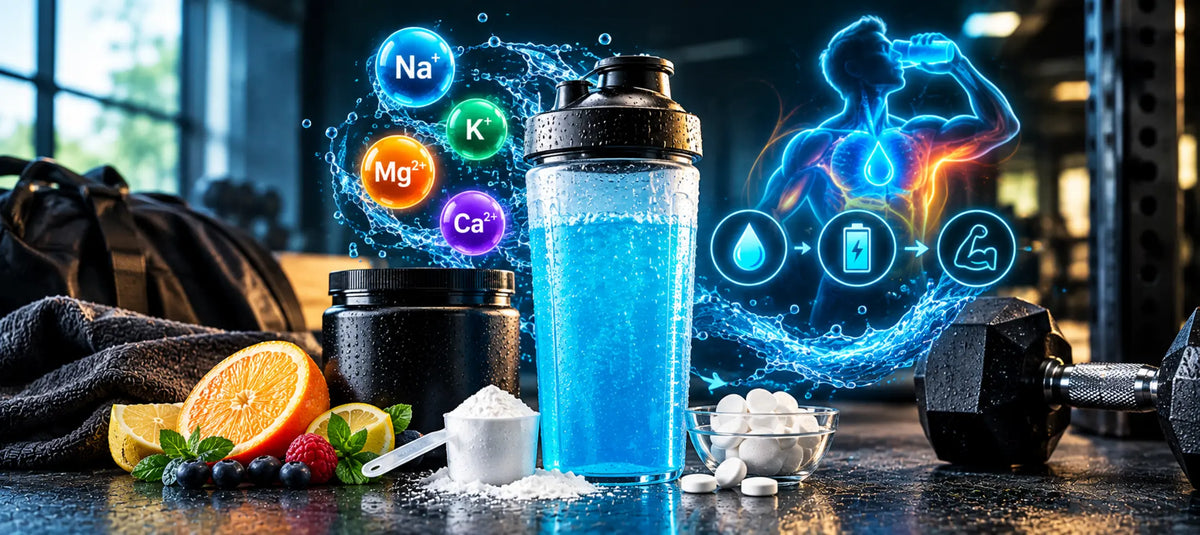

Electrolytes play a bigger role in your workout than most people realize. They control how your muscles fire, how your nerves send signals, and how well your body holds on to water. If you train hard and sweat a lot, understanding electrolytes can help you avoid cramps, fatigue, and flat performance. This is a core part of sports nutrition. It applies to anyone using supplements to support hydration, whether through a powder, capsule, or drink mix.
Let’s discuss what electrolytes do, why hydration depends on them, and how getting your supplement choices right can genuinely improve how you feel and perform.
Why Hydration Matters in Training Performance
Water makes up a huge part of your body weight, and it drops fast once you start sweating. Even a small dip in hydration can throw off your body's mineral balance before you notice anything is wrong. Good hydration habits, paired with the right supplement support, are one of the simplest upgrades any athlete can make.
Water Loss During Exercise Explained
You lose water through sweat, breath, and urine during exercise. In hot weather or with prolonged sweating, mineral loss can climb quickly. Along with that water, you also lose sodium and other minerals your body can't produce on its own. That combination is what makes plain water less effective without added electrolyte support.
Impact on Strength and Endurance
Staying on top of your hydration keeps strength and endurance steady, even when your body loses water weight and minerals during a demanding session. Your heart works harder to pump blood. Your muscles tire faster. According to the Mayo Clinic, even mild dehydration can reduce physical performance and increase perceived effort. Your body has to work harder when you're not properly hydrated, which is why hydration supplements can help.
What Are Electrolytes and Why Do They Matter?
So, what are electrolytes, really? They're minerals that carry an electric charge in your body fluids. Sodium, potassium, magnesium, and calcium are the main ones found in most electrolyte supplements. They control fluid movement in and out of your cells, and they help your nerves communicate with your muscles.
Sodium, Potassium, and Magnesium Role in the Body
Each mineral does a slightly different job, and each shows up in supplement labels in a specific compound form.
|
Electrolyte |
Common Supplement Form |
Main Role During Exercise |
|
Sodium |
Sodium citrate, sodium chloride |
Holds water in your bloodstream, supports nerve signals |
|
Potassium |
Potassium chloride, potassium citrate |
Helps muscles contract and relax properly |
|
Magnesium |
Magnesium glycinate, magnesium oxide |
Supports energy production and reduces cramping risk |
|
Calcium |
Calcium carbonate, calcium citrate |
Works with potassium for muscle contraction |
When one of these runs low, the others can't fully compensate. That's why a balanced blend matters more than loading up on a single mineral. It's the basic formulation principle behind most electrolyte and hydration supplements on the market.
Muscle Function and Fluid Balance
Keep your electrolytes balanced, and your muscles stay smoother and more responsive, with far less risk of cramping. It's not always about drinking more water. Sometimes it's about what's dissolved in it, which is exactly what a well-formulated electrolyte powder is meant to solve.
How Electrolytes Support Workout Performance
Electrolytes don't just prevent problems. They actively support how well you perform, especially once mineral loss adds up over a session. This is why electrolyte blends show up so often alongside amino acids and creatine in modern supplement formulas.
Muscle Contraction and Energy Stability
Every muscle contraction depends on a signal that travels through sodium and potassium. Without stable levels, that signal weakens, and your muscles respond more slowly. Products like Xtend BCAA combine amino acids with an electrolyte blend for this exact reason, supporting the signal along with recovery in a single mix.
Reducing Fatigue During Training Sessions
Replacing sodium and potassium keeps that heavy, sluggish feeling away, so you can sustain output for longer. This is part of why we formulated Jacked CR10 Powder, pairing micronized creatine with an electrolyte blend. So, you get strength support and hydration support in one scoop, rather than stacking two separate supplements.
Electrolytes and Active Lifestyle Needs
The right dose and format depend on how much you sweat, what supplements you already take, and how your mineral needs shift with activity level.
High Sweat Training Conditions
If you sweat heavily during training, whether from climate, clothing, or genetics, your mineral loss goes up too. In these cases, an electrolyte powder or capsule makes a real difference over plain water. Products like Intra BCAA are made to mix into your drink during a workout and help replace minerals.
Endurance and Strength Sports
Endurance athletes lose electrolytes steadily over long durations. So, a drink mix sipped throughout the session tends to work best. Strength athletes lose them in shorter, more concentrated bursts, so a single serving before or after training, in powder or capsule form, is usually enough.
When Electrolyte Support Becomes Important
There are specific situations where an electrolyte supplement stops being optional and becomes a real part of your routine.
Hot Weather Training
Heat pushes sweat rate and mineral loss up fast. According to the American College of Sports Medicine, athletes training in hot conditions should pay closer attention to fluid and electrolyte replacement to avoid heat-related illness. A sodium- and potassium-based supplement is worth having on hand if you train outdoors in summer.
High-Intensity Workout Sessions
Extended or high-output sessions drain electrolytes faster than light activity. If your session runs past 60 to 90 minutes, or you're sweating heavily, adding a measured electrolyte dose, whether from a powder, tablet, or capsule, becomes a smart addition rather than an extra step.
Conclusion
Electrolytes aren't a trend. They're a basic nutrient category. A growing category of supplements formulated specifically around hydration and mineral balance during exercise. Sodium, potassium, and magnesium each play a distinct role. Most quality formulas combine several forms, like sodium citrate or potassium chloride, to cover all the bases.
If you train hard, sweat heavily, or push through long sessions, choosing the right electrolyte supplement pays off in better energy, steadier performance, and quicker recovery. For a deeper look at how supplements fit into a training routine overall, our recent piece on what supplements bodybuilders actually use covers this from a broader angle.
FAQs
Do electrolytes help improve workout performance?
Yes, in most cases. They support muscle contraction and help delay fatigue, especially during longer or sweat-heavy sessions.
Can electrolytes be consumed on rest days?
Yes. Your body still needs sodium, potassium, and magnesium on rest days for normal function, though the amount needed is usually lower than on training days.
Do electrolyte drinks contain calories or sugar?
It depends on the formula. Some powders are sugar-free with minimal calories, while others include added carbs for energy. Check the label if you're watching either.
Are electrolytes better than water for hydration?
Not exactly better, more like complementary. Water rehydrates you, but an electrolyte supplement helps your body actually hold on to that water and use it properly.
What is the difference between electrolytes and sports drinks?
Electrolytes are the minerals themselves, like sodium citrate or potassium chloride. Sports drinks are one delivery method, usually combined with sugar and flavoring. You can also get electrolytes through unflavored powders, capsules, or tablets, with or without added sugar.
Share:
Can Creatine and Electrolytes Work Together for Better Training Performance?