


Have you ever picked up two magnesium bottles at a pharmacy and wondered which one is real? That is the right question to ask. Because there are so many magnesium supplements available in the market with different labels.
There are so many counterfeit imports, broken cold chains, and packs with no traceable batch numbers. These are all part of the problem. Don't be stressed about not knowing the difference yet. Most buyers don't, and that gap is exactly what this guide closes.
If you are still deciding whether you need magnesium support at all, that is a separate question. This guide assumes you have already decided to buy, and now need to buy well. It is a framework you can reuse every time you buy.
Let's dive in!
The Problem Specific to This Market
The label can be fake, and chances are you're being defeated by it.
Counterfeit and Re-Labelled Imports
Some packs carry a well-known brand name, but they don't fulfil the requirements of that specific brand. The fonts seem slightly off. The hologram looks crude or is missing. The batch number does not match anything a company can check.
A global report found that about one in ten medical products in low- and middle-income countries fail quality checks or are fake. Supplements sold outside pharmacy channels carry a similar risk. That single fact is why you should check the product, not just the brand name.
Broken Cold Chains and Long Transit Storage
Magnesium tablets handle heat better than many medicines, but they still lose potency over time. An imported pack can be stored for weeks in an unrefrigerated container. It can then be stored for months in a warehouse with no climate control.
You rarely see this from the outside. The tablet looks fine. The box looks fine. That is exactly the problem.
Products With No Traceable Batch Behind Them
A batch number on a box means nothing by itself. It only means something if you can look it up and find a real test report for that exact batch. Not a generic certificate the seller reuses for every listing. If a seller cannot show you that report, treat the batch number as decoration.
So before you compare forms or prices, ask one thing first: can this product prove what it says it is? Now let's look at where imported and locally manufactured actually differ.
Imported vs Locally Manufactured – an Honest Comparison
There is no single answer to "imported or local" that fits every buyer. It depends on the specific product in front of you, not the country printed on the box.
The Case People Make for Imported Products
Buyers who prefer imported supplements often cite three factors.
-
Strict rules in the country of origin.
-
A long manufacturing history.
-
A well-known name.
These are fair starting points, but they are not guarantees. A genuine product from a well-regulated country can still reach Pakistan through a grey market. That grey market strips away every one of those protections.
What Local Manufacture Actually Changes
A magnesium supplement made in Pakistan in a DRAP-approved facility offers a shorter supply chain. There is a short line of communication between the factory and the shelf. If something goes wrong, you have a manufacturer you can actually reach. You also have a local regulator, not a distributor three countries away. That is a practical advantage for local manufacturing.
What Local Manufacture Does Not Automatically Guarantee
Being made in Pakistan does not by itself mean a product is well-formulated or properly tested. Local manufacture removes some risks. It leaves others untouched. A local product with no published batch testing has the same traceability gap as an imported one.
The Questions That Matter More Than Country of Origin
Skip the concept of imported or local as your first question and ask this instead: Can you verify the batch? Is the elemental magnesium figure printed clearly? Is there a manufacturer address and establishment number you can look up?
A product that answers yes to all three is safe to buy either imported or local. A product that answers no to all three is a risk either way.
|
What to check |
Typical imported product |
Typical locally manufactured product |
|
Supply chain length |
Longer, with several importers and distributors |
Shorter, mostly factory to retailer |
|
Regulatory recourse |
Depends on the origin country; harder to reach directly |
DRAP-regulated; a Pakistani manufacturer you can contact |
|
Price drivers |
Import duties, taxes, currency shifts, shipping |
Local production and distribution costs |
|
Counterfeit risk |
Higher for popular names sold outside authorised channels |
Lower, but not zero |
|
Batch traceability |
Depends on the specific seller and product |
Depends on the specific manufacturer and product |
So it comes down to the specific product and seller in front of you. Not a blanket rule about where the factory sits. Now let's turn this into something you can check at the shelf.
A Seven-Point Verification Checklist
Run any magnesium pack through these seven checks before you pay. That's the whole method. It really is that simple once you know what to look for.
1. Elemental Magnesium Stated, Not Just Compound Weight
What to look for: A number labelled "elemental magnesium" or "magnesium”, separate from the total compound weight.
What a weak version looks like: Only a big front-of-pack number like "1000 mg", with no elemental figure anywhere.
Why it matters: The compound weight includes the magnesium plus whatever it is bound to. A factsheet resource on magnesium confirms that the elemental figure is what tells you your actual dose. A bigger compound number does not mean a bigger dose.
2. Form Named on the Pack
What to look for: A named form, such as bisglycinate, citrate, oxide, or malate, printed clearly.
What a weak version looks like: Generic labelling that just says "magnesium", with no form named anywhere.
Why it matters: Different forms behave differently in your gut. You cannot judge tolerance or serving size without knowing which one you are holding.
3. DRAP Product Enlistment Number Visible
What to look for: A clearly printed enlistment number on the pack itself, not buried in a photo you have to zoom into.
What a weak version looks like: No number at all, or a number that leads nowhere when you search for it.
Why it matters: This is Pakistan's own regulatory footprint on the product. Its absence is one of the fastest signs of a product that skipped the system.
4. Manufacturer Name, Full Address and Establishment Number
What to look for: A full manufacturer name, a physical address, and an establishment number. Not just a brand name.
What a weak version looks like: Only a brand name, with no manufacturing detail anywhere on the pack or the listing.
Why it matters: A real manufacturer with a real address is accountable. A brand name with no factory behind it is not.
5. Batch Number Matching a Certificate of Analysis You Can Actually Open
What to look for: A batch number that links, usually through a QR code, to a test report for that exact batch.
What a weak version looks like: A batch number on the box with no way to check it, or a QR code that goes nowhere.
Why it matters: This is the single most concrete check you can run yourself, in the shop, before you buy.
6. Supplement Facts Available as Text, Not Only as an Image
What to look for: The full Supplement Facts panel written out as text on the listing, not just a photo of the label.
What a weak version looks like: A blurry label photo as the only source of dosing information.
Why it matters: Text you can zoom, copy, and search is text you can actually check against the seller's other claims.
7. A Reachable Returns and Refund Policy Before You Pay
What to look for: A clear, working link to a returns or refund policy, reachable from the product page itself.
What a weak version looks like: No policy anywhere, or a vague promise with no real process behind it.
Why it matters: A seller who trusts their product publishes their policy where you can see it before checkout. Not after a complaint.
Comparing Price the Right Way
Why Sticker Price Misleads You
A cheaper box is not automatically a cheaper dose. An expensive box is not automatically a better one. Most of the time, the price on the sticker ignores tablet count, dose per tablet, and elemental content. Those are the three numbers that actually decide what you are paying for.
Days of Supply at One Tablet vs Two Tablets
The last piece of the price puzzle is how long a pack actually lasts. A 30-tablet pack lasts 30 days at one tablet daily. It only lasts 15 days at two tablets daily. Before you compare cost across brands, divide by your actual routine, not the pack size alone.
So the real comparison is never box price against box price. Compare elemental milligram to elemental milligram instead. Use the routine you actually plan to follow.
How Jacked Magnesium Bisglycinate Measures Against the Checklist
Here's how our product holds up against the same seven points. You can check it yourself.
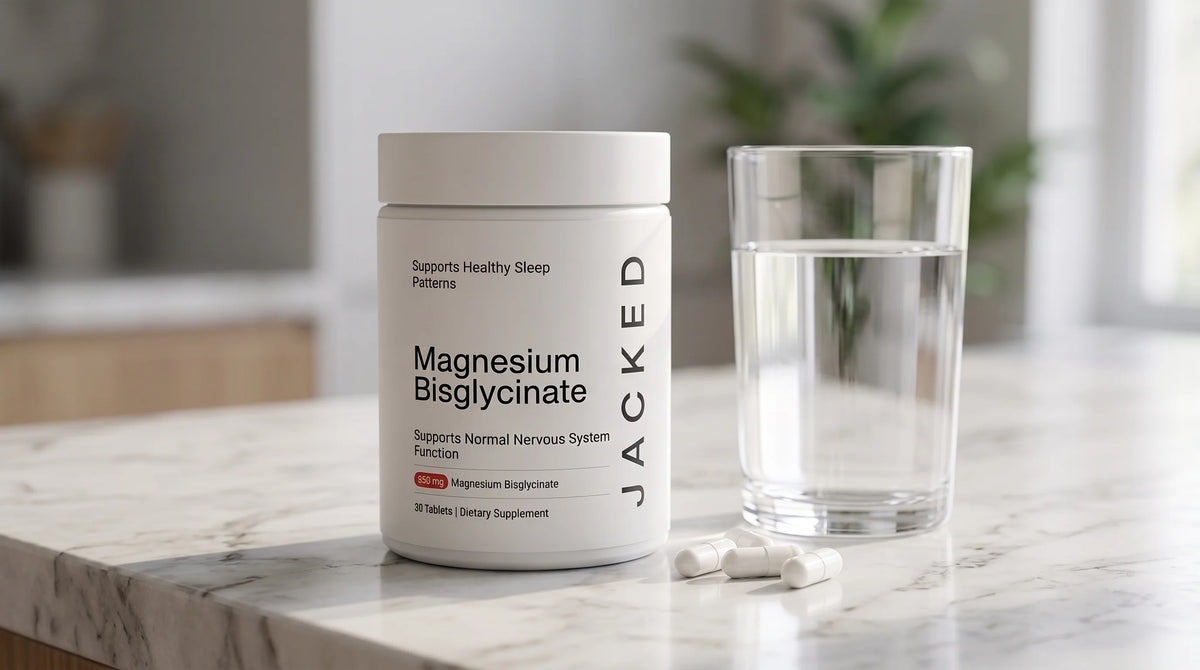
Each tablet is 850 mg magnesium bisglycinate, providing 120 mg elemental magnesium, both printed on the pack. It carries DRAP Enlistment Number 015421440768, made at Farma Labs, Rawat (M.E. 01542), with the full address on the label. Every batch has a QR code linking to its certificate of analysis, supplement facts appear as text on the product page, and it's halal certified with a visible returns policy.
We don't claim bisglycinate absorbs better than other forms; the evidence doesn't support that. A 1994 trial found magnesium chelate and magnesium oxide absorbed almost identically (23.5% vs 22.8%). The real difference was tolerability, not absorption; that's the only claim we make.
One tablet daily gives 120 mg elemental magnesium; two in the evening gives 240 mg, which is around 96% of the dose used in a 2025 clinical trial. A 30-tablet pack lasts 30 days at one a day, or 15 at two.
The Bottom Line
Before you buy a magnesium supplement, run every magnesium pack through the same seven checks from the checklist above. Compare price by elemental milligram, not by box size. Treat "imported" or "local" as a starting question, not a final answer.
Compare price by elemental milligram, not by box size, and let "imported" or "local" be your starting question, never your final answer. That one shift in how you shop puts you ahead of almost everyone else buying magnesium off a shelf.
Are you pregnant, nursing, or taking medication? Do you manage a medical condition? Talk to a healthcare professional first, before you add any magnesium supplement to your routine.
Frequently Asked Questions
What should I look for in a magnesium supplement in Pakistan?
Use the seven-point checklist in this guide. It covers the elemental magnesium figure, the named form, a visible DRAP number, full manufacturer details, a checkable batch, supplement facts as text, and a real returns policy. These seven points work whether the product is imported or made locally.
Are imported supplements better than locally made ones?
Not automatically. Imported products can offer a long manufacturing history, but they travel through longer supply chains. That means more room for fakes. Local products made under a DRAP-approved facility have shorter supply chains. You can also reach the manufacturer directly. The specific product still matters more than its country of origin.
How much does magnesium cost in Pakistan?
Price varies widely by form, tablet count, and elemental content, so one figure is not useful. Compare cost per elemental milligram rather than the price on the box. That is the number that shows what you are actually paying for.
What is a DRAP Product Enlistment Number?
It is a registration number from Pakistan's drug regulator, DRAP. It confirms the product is enlisted with them. It should be printed clearly on the pack, not only inside a photo. It is different from the manufacturer's establishment number.
How do I check if a magnesium pack is genuine?
Look for a batch number linked to a certificate of analysis, usually through a QR code on the pack. Check that the batch number on the report matches the one printed on your box. Be cautious of any seller who cannot show you this on request.
Is magnesium bisglycinate available in Pakistan?
Yes. You can find it as an imported product and as a locally made one under DRAP-approved facilities. Run the same seven-point checklist either way.
How many tablets are in a pack and how long does it last?
This depends on the specific product, but a common pack size is 30 tablets. At one tablet daily, that lasts 30 days. At two tablets daily, it lasts 15 days. Check your intended routine before you compare pack sizes across products.
What is the difference between an enlistment number and an establishment number?
The enlistment number is for the specific product. It shows the product is registered with DRAP. The establishment number is for the factory itself. A genuine product should carry both. You can look up each one separately if you want to check further.
Share:
Jacked Nutrition Flavored Brown Rice Protein – Plant-Based Protein Innovation
Does Flavored Protein Powder Affect Results or Just Improve Taste?