

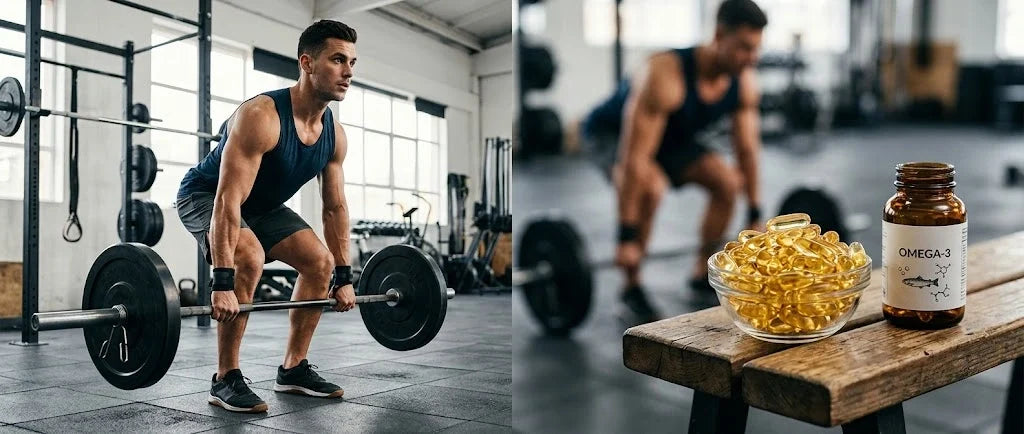

Does omega-3 build muscle? Based on the current evidence, no, not on its own. A 2025 overview of systematic reviews looked at 33 studies and found no consistent benefit for lean mass, strength, or physical function in healthy adults. That doesn't mean fish oil is useless. It means the muscle growth claim doesn't hold up the way marketing suggests.
If you're taking omega-3 hoping it'll add size to your frame, you're better off putting that money into protein or just training harder. But if you're taking it for joint health, recovery, or your heart, keep reading. There's a real case for that.
Why people believe omega-3 builds muscle
Walk through the supplement aisle, and you'll see fish oil pitched next to creatine and whey, all bundled under one label: gains. The idea isn't baseless. It just gets stretched further than the science supports.
The mechanism argument and its limits
Some early lab work found that omega-3 fatty acids can increase muscle protein synthesis, the process your body uses to build new muscle tissue. That's a legitimate finding. A few small trials even showed omega-3 improved how muscles respond to insulin and amino acids after a meal.
But a mechanism working in a lab setting doesn't guarantee real-world muscle growth over months of training. Many things can increase protein synthesis without actually leading to more muscle. The gap between "this pathway lit up" and "you got bigger" is often wider than it looks.
How a promising lab finding becomes a marketing claim
Here's roughly how it happens. A study shows a small mechanistic effect. A brand picks it up, drops the caveats, and turns it into a bullet point on a label. Over time, enough brands repeat the claim that it starts to sound settled. It never was.
What an overview of reviews is, and why it carries weight
A single study can be wrong, biased, or too small to trust. A systematic review pulls together many trials on one question and gives you a clearer picture. An overview of reviews goes one step further. It gathers all the systematic reviews on a topic and asks: what do they collectively say?
That's exactly what researchers did here. They pulled 33 systematic reviews covering thousands of participants across healthy adults, older adults, and clinical populations. When this many reviews point in the same direction, it's worth paying attention.
The findings
Lean mass
Across reviews in healthy, non-oncologic populations, not one found strong evidence that omega-3 increases lean mass. A handful showed weak, mixed signals, mostly in older adults, but the overall picture stayed flat.
Muscle strength
Strength fared slightly better, though still unimpressive. One high-quality review found a statistically real but tiny effect. A few others reported some benefit, again mostly limited to older adults. Most reviews, though, found no meaningful change.
Physical function
Function measures, things like walking speed or getting up from a chair, showed the same pattern. A couple of reviews found small improvements. Most didn't.
Here's a simple summary of what the reviews found across the three main outcomes:
|
Outcome |
Reviews checked |
Found meaningful benefit |
|
Lean mass |
16 (non-oncologic) |
0 with sufficient evidence |
|
Strength |
14 |
1 with sufficient evidence |
|
Physical function |
15 |
1 with sufficient evidence |
Put together, the pattern is consistent. Whichever outcome you look at, the reviews with the strongest methods tend to find the smallest effects, and the ones showing a benefit often have quality issues or small sample sizes. That's a common pattern in supplement research generally.
Weaker studies produce bigger, more exciting numbers. Stronger studies bring those numbers back down to earth. It doesn't mean omega-3 does nothing. It means the muscle-building story doesn't hold up once you control for study quality.
Where omega-3 does have support
Inflammation and post-exercise recovery
This is where fish oil actually earns its keep. Several trials found omega-3 reduced muscle soreness and swelling after hard training, especially in younger, healthy adults. That's a different outcome than "building muscle," but it's a real one, and it matters if you train often. We covered this angle in more depth in our article on omega-3 for muscle recovery, which is worth a read if soreness is your main concern.
General and cardiovascular health
Beyond the gym, omega-3's benefits for heart health are widely recognized. It supports healthy triglyceride levels and general cardiovascular function. That alone justifies a spot in most people's routine, muscle growth aside.
Reconciling the two: recovery is not the same as growth
It's easy to blur these two things together, but they're not the same. Reducing soreness helps you train consistently. Consistent training is what actually drives muscle growth over time. Omega-3 plays a supporting role here, not a starring one. Think of it as something that clears the path, not something that builds the road.
So, should omega-3 stay in your stack?
Who gets the most out of it?
If you train hard and deal with recurring soreness, omega-3 might help you recover faster between sessions. Older adults managing joint stiffness or general inflammation may also notice a difference. And if you're already dialing in other micronutrients, say zinc for hormone health, as covered in our zinc benefits guide, adding omega-3 rounds out a health-first stack rather than a muscle-first one.
Who can skip it without missing much?
If your only goal is packing on size and your diet is already solid, omega-3 won't move the needle much. Your money is better spent elsewhere.
However, "skip it" doesn't mean omega-3 is harmful or pointless for you. It just means your priorities lie elsewhere.
If your diet already includes fatty fish two or three times a week, you're likely getting enough omega-3 for general health anyway. Supplementing on top of that mostly helps if your diet is low in fish or if you want a more consistent daily dose without tracking meals.
What actually drives muscle growth
Progressive overload
Nothing replaces this. Your muscles grow when you consistently challenge them with more weight, more reps, or better form over time. No supplement substitutes for this.
Total daily protein
Protein intake matters more than almost anything else you can control through diet. If you haven't nailed this down yet, our guide on how much whey protein you need per day breaks down the numbers by body weight and training goal.
Sleep and recovery
Muscle repair happens largely while you sleep. Cutting back here can hold you back, even if your training and diet are on point.
Frequently asked questions
Is fish oil a waste of money for lifters?
Not necessarily. It's a waste of money if you're expecting muscle growth from it alone. It's a reasonable addition if you value recovery, joint comfort, or heart health.
Does omega-3 help with fat loss?
There's no strong evidence that omega-3 directly burns fat. Some studies suggest it may support a slightly better body composition when paired with a calorie deficit and training, but it's not a fat-loss tool on its own.
How much omega-3 do I actually need?
Most research on muscle-related outcomes used doses between 2 and 4 grams of combined EPA and DHA daily. For general health, lower doses around 1 to 2 grams are commonly recommended. Check with a doctor before starting any new supplement, especially if you're on blood thinners.
The bottom line
Omega-3 isn't a muscle-building supplement, at least based on the evidence we have so far. It does support recovery, joint health, and your heart, and that's reason enough to keep it around if those matter to you. Just don't expect it to replace the basics: training hard, eating enough protein, and sleeping well. Those three still do the heavy lifting.
Share:
Protein After 40: What a 6-Month Trial Found About Preserving Muscle
Omega-3 for Muscle Recovery: What a 2025 Fish Oil Trial Found