

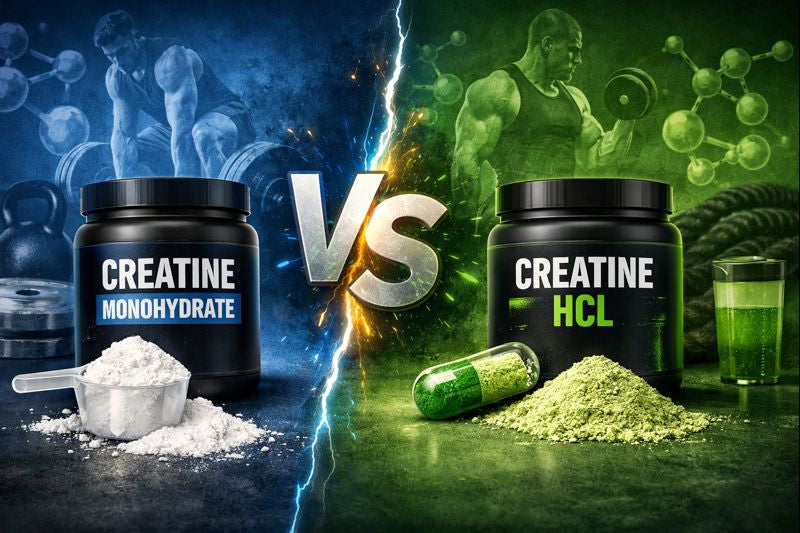

Creatine is a natural muscle fuel. It creates quick-burst energy and increased strength during high-intensity exercise. Athletes use creatine supplements (powders, capsules, etc.) to boost workout performance and recovery. The two main forms are creatine monohydrate and creatine hydrochloride (HCl). Both raise muscle creatine stores, but they differ in dosage, solubility, and side effects. This article will directly compare how creatine monohydrate compares to creatine HCL in terms of absorption, strength gains, muscle building, and side effects.
What Creatine Is and Why It Matters for Performance
Creatine is made by your body and also found in foods (meats, fish). It supplies energy to skeletal muscles during intense lifts or sprints. Having more creatine in muscles means you can lift heavier or sprint faster in short bursts. Studies show that creatine supplements help athletes in power sports.
For example, bodybuilders and sprinters often use creatine to gain strength and enhance recovery. Importantly, creatine mainly improves strength and power, not endurance. It helps muscles perform short, explosive efforts by replenishing ATP, the cell’s energy currency.
Creatine supplements come in various forms, but creatine monohydrate has been the gold standard for decades. It’s the most studied type and reliably increases muscle performance in high-intensity exercise. Other forms, like creatine HCl, are newer, aiming to improve solubility or dosing. Understanding these differences can help you choose the best supplement for your training goals.
SEE ALSO: Health and Performance Benefits of Creatine
Understanding Creatine Monohydrate and How It Works
Think of creatine monohydrate as plain creatine plus water. It dissolves moderately well in liquid and is absorbed in the intestines. It is the most researched form and has a proven track record of boosting strength and lean mass.
Research finds that adding creatine monohydrate to a training program increases weight lifted in squats, bench press, and leg press. In long-term use, typical doses (around 3–5 grams per day) are safe and effective for most people.
Once ingested, creatine monohydrate raises muscle creatine/phosphocreatine levels, which extends the muscle’s ability to regenerate ATP between bouts of intense exercise. This leads to higher power output and more work done in the gym.
Understanding Creatine HCL and How It Works
Creatine hydrochloride (HCl) is creatine bonded to hydrochloric acid. This creates a salt form that dissolves much more easily in water than monohydrate. You can mix HCl with less water or liquid, and it doesn’t leave grit. Because it dissolves so well, smaller doses of HCl (around 1.5–3 grams daily) are often enough to raise muscle creatine. This is about one-third to one-half the typical monohydrate dose.
Once dissolved, the body processes creatine HCl similarly to monohydrate; muscles convert it to phosphocreatine for energy. However, some users find HCl gentler on the stomach. The high solubility means it’s less likely to sit in the gut and cause bloating.
Key Differences in Absorption and Solubility
|
Aspect |
Creatine Monohydrate |
Creatine HCl |
|
Solubility |
Less soluble in water; may leave grit if not mixed well |
~10× more soluble; dissolves completely with no residue |
|
Absorption / Bioavailability |
Well absorbed; delivers effective creatine to muscles |
Comparable absorption; muscles receive similar creatine levels |
|
Typical Daily Dosage |
Maintenance: 3–5 g/day |
Maintenance: ~1.5–3 g/day |
|
Loading Phase |
Commonly used (≈20 g/day for 5–7 days) |
Usually not required; taken at maintenance dose from the start |
|
Digestive Tolerance |
May cause bloating or GI discomfort at high doses or if poorly dissolved |
Generally easier on digestion due to high solubility |
|
Water Retention / Bloating |
More noticeable intramuscular water retention and weight gain |
Often, less noticeable bloating and subcutaneous puffiness |
Performance Comparison for Strength and Power
Which creatine works best for strength? Creatine’s main benefit is improving strength, power, and short-term training capacity. Both monohydrate and HCl help here by the same mechanism (more ATP for muscles). When it comes to raw performance gains, studies show both forms raise strength, but neither has a clear edge.
Many strength athletes, therefore, consider monohydrate the go-to option. It’s the most studied form and consistently shows improvements. Athletes using creatine monohydrate lift more weight in squats, leg presses, and bench presses than those who don’t.
That said, creatine HCl does produce similar power gains when used properly. To sum up: neither form magically makes you stronger on its own; both will boost high-intensity performance about equally when you take the recommended dose.
If you ask, “Does creatine HCL improve performance more than monohydrate?”, the answer from research is no: improvements are comparable. Choose monohydrate for a proven track record, or HCl if you need gentler dosing, but don’t expect one to vastly outperform the other in your lifts.
Muscle Building Comparison During Training Cycles
Creatine supplements are also known to support muscle gain when paired with resistance training. By allowing harder workouts and better recovery, both creatine monohydrate and HCl can contribute to greater lean mass over a training cycle. Again, studies confirm that creatine + training = more muscle.
Which creatine is best for muscle building? Generally, creatine monohydrate is preferred because of its extensive evidence. When young adults supplemented with monohydrate and lifted weights, they gained more fat-free mass than without creatine.
Creatine HCl can also build muscle. It may reduce fat mass and slightly increase lean mass with training.
Is creatine monohydrate better than creatine HCL? The overall consensus is that both forms help with muscle growth, but monohydrate has the stronger research support.
If your goal is maximizing muscle size, focus on progressive overload and nutrition, then use creatine (monohydrate is a solid choice). Either form will help your muscles grow when you train hard, but don’t expect HCl to build more muscle than monohydrate simply because of its name.
Side Effects Comparison, Including Digestion and Bloating
|
Aspect |
Creatine Monohydrate |
Creatine HCl |
|
Digestive Effects |
May cause bloating, cramps, or diarrhea in some users, especially at high doses |
Generally easier on digestion |
|
Dose Size |
Higher dose; the loading phase can stress the stomach |
Lower dose; usually no loading |
|
Water Retention |
Noticeable intramuscular water retention and weight gain |
Less noticeable bloating or puffiness |
|
Best for Sensitive Users |
May require dose splitting or skipping loading |
Often preferred if the monohydrate causes GI issues |
Final thoughts
Creatine monohydrate and creatine HCl are both effective for boosting strength and muscle when used properly. Monohydrate is the tried-and-true gold standard; it’s inexpensive, backed by decades of research, and proven to increase power and lean mass. Creatine HCl is a fine alternative for people who have difficulty with monohydrate (for example, those who get stomach upset or dislike loading). HCl’s advantages are convenience: it mixes easily, requires a smaller daily dose, and usually causes less bloating.
No single form is universally superior. Both forms will help you train harder and build muscle as long as you take them consistently with your workouts.
FAQs
Which form of creatine improves performance more?
Both monohydrate and HCl produce similar improvements in strength and power. No form has been proven to significantly outperform the other once equivalent doses are used.
Does creatine HCL absorb faster than monohydrate?
Creatine monohydrate absorption versus creatine HCl often comes down to solubility rather than effectiveness. Creatine HCl dissolves faster due to its solubility, but once absorbed, both deliver comparable amounts of creatine to muscles. Total uptake into muscle is about the same.
Is creatine monohydrate still the best option for strength training?
Yes. Creatine monohydrate is the most extensively studied form and reliably increases performance in high-intensity exercise.
Can creatine HCL reduce bloating or stomach discomfort?
Generally, yes. HCl’s better solubility and lower dose often lead to fewer digestive issues and less bloating compared to monohydrate.
Is creatine monohydrate more studied and safer long-term?
Absolutely. Monohydrate has been tested for decades and is confirmed safe for long-term use in healthy adults. It has no known serious side effects at normal doses.
Should beginners start with monohydrate or HCL?
Beginners usually start with creatine monohydrate due to its proven effectiveness and low cost. You can always switch to HCl later if you experience any GI issues with monohydrate.
Share:
What to Take After a Workout for Faster Gains - Muscle Recovery
How ISO Jacked Whey Protein Helps You Stay Lean During Muscle Growth