

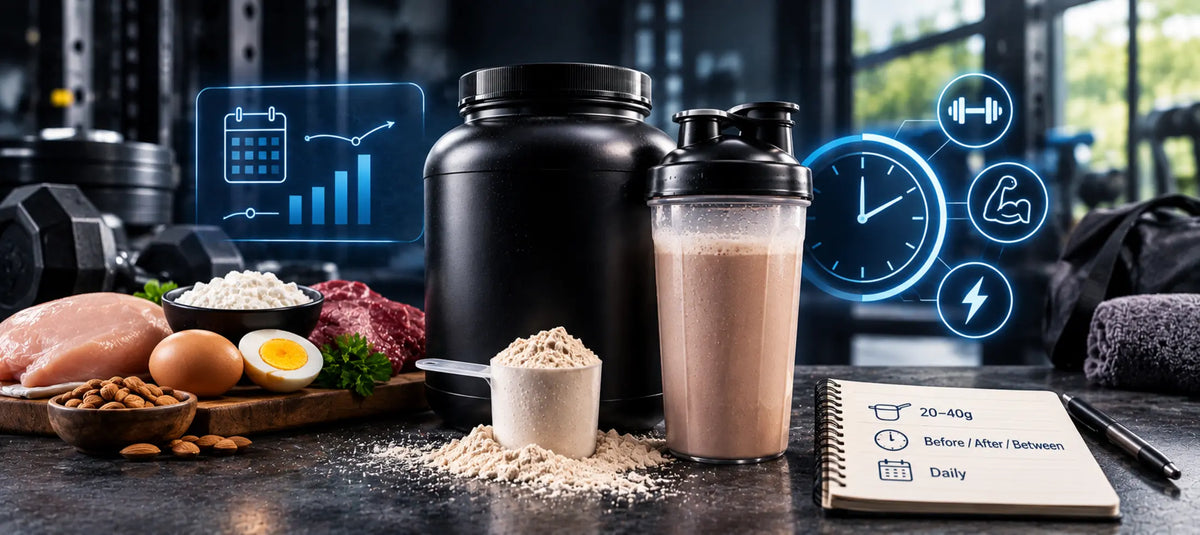

If you've typed "how much whey protein per day" into Google, you've probably landed on ten different answers. Some sites say 20 grams. Others say 40. A few just tell you to "listen to your body," which helps nobody. A 2025 meta-analysis pooling 21 clinical trials finally gives a clearer picture, and it's more specific than most of the generic advice floating around.
The short answer: 20 to 40 g per serving, taken around your training
Research on whey protein dosage points to a working range of 20 to 40 g per serving, taken close to your workout. Below that range, you leave some muscle protein synthesis on the table. Above it, the extra grams don't seem to do much more for that single dose. Timing matters too. Whey taken shortly before resistance training seems to hit harder than the same dose taken after.
That's the short version. The rest of this article discusses where these numbers come from and how to apply them.
What the 2025 meta-analysis actually measured
21 randomised trials, one question: does whey plus training beat training alone?
The study, published in Nutrients in August 2025, pooled 21 randomized controlled trials on whey protein and exercise. Researchers wanted to know one thing: does adding whey to a workout produce more muscle protein synthesis than training alone, and if so, how much and when.
How researchers measure muscle protein synthesis (MPS)
Most of the included trials measured myofibrillar fractional synthetic rate, or FSR, through muscle biopsies. This is the gold standard for tracking how fast your body is actually building new muscle tissue, rather than relying on scale weight or tape measurements, which are affected by water, food, and a dozen other things.
The dose response: why 20 to 40 g is the working range
Across the pooled trials, doses ranged from 10 g up to 60 g per session, and researchers saw a dose-dependent rise in FSR within that range. Here's roughly how the individual studies contributed to the overall analysis:
|
Dose |
Effect on FSR (vs. placebo) |
|
10 g |
~1.2x increase |
|
20 g |
~1.4x increase |
|
40 g |
~1.5x increase |
What happens below 20 g
A 10 g dose still produced a small bump in FSR, so it's not useless. But the response was noticeably smaller than what 20 g or more produced. If you're only sipping half a scoop after a workout, you're probably underdosing.
Is anything above 40 g wasted?
Not entirely wasted, but the returns shrink. One trial in female participants found 30 g outperformed both 15 g and 60 g, suggesting that more isn't always linearly better and that there may be an individual sweet spot rather than a single magic number. Most people don't need to chase 60 g in a single sitting.
Bodyweight-based dosing (g per kg) vs. fixed scoops
A flat "one scoop" recommendation ignores body size. A 55 kg person and a 95 kg person don't have the same needs. As a general guide, aim for about 0.25 to 0.4 g of protein per kilogram of body weight at each meal. For most people, that works out to roughly 20 to 40 g per meal.
Timing: pre-workout, post-workout, or does it not matter?
The 45-minute pre-workout finding
One trial in the review stood out. Participants who took whey 45 minutes before eight sets of leg extensions saw FSR increase 2.5-fold compared to placebo, the largest single effect in the whole review. That's a meaningfully bigger jump than what post-workout dosing produced on its own.
The post-workout response: 1.3 to 1.6x muscle protein synthesis
Most of the trials looked at whey taken immediately after training, and here the effect was still solid: a 1.3-to-1.6-fold increase in FSR compared to placebo. This is the more commonly cited number, and it holds up well across different training styles.
What the "anabolic window" means in 2026
The old idea of a tight 30-minute window after training has mostly been retired. The evidence in this review suggests the opposite. Whey appears to work well whether you take it before or after exercise, and the window for protein intake may be longer than previously thought. So, if you miss the "window," you haven't ruined your gains. You just have some flexibility in when you drink your shake.
Your daily protein total still beats any single dose
Recommended daily protein for people who lift
Your total daily protein intake matters more than any single serving. Sports nutrition bodies generally recommend 1.4 to 2.0 g of protein per kilogram of bodyweight for people training regularly, and whey is simply one convenient way to help hit that number. We've covered this in more depth in our guide on how much protein you need to build muscle, including how age and activity level shift your target.
How to split whey across the day
Rather than one huge shake, spreading protein across three to five meals or servings tends to work better for keeping muscle protein synthesis elevated throughout the day. A shake in the morning, one around training, and normal meals filling the gaps usually covers it without needing to force anything down.
Applying this to your training split
Strength and hypertrophy blocks
During heavier training phases, staying near the top of your daily protein range and hitting 20 to 40 g around your main lifting session gives your body what it needs to recover between sessions.
Cutting phases and higher protein days
When calories drop, protein needs actually go up, not down. Higher protein intake helps protect lean mass while you're in a deficit, so this is not the time to skimp on your shakes.
Rest days
You still need protein on rest days. Muscle repair doesn't stop just because you didn't train. Keep your daily total consistent, even if you drop the pre- or post-workout dose since there's no session to time it around.
Choosing a whey that actually delivers the dose
Isolate vs. concentrate: protein per scoop
Isolate typically runs 90 percent or higher protein by weight with very little fat or lactose, while concentrate sits closer to 70 to 80 percent and carries more of the extras. Neither is objectively "better" for MPS, but isolate makes it easier to hit a precise 25 to 30 g dose without extra carbs or fat tagging along. We go deeper into how isolate supports recovery in this breakdown of whey protein isolate.
What to check on the label before you buy
Look at grams of protein per scoop, not just the front-of-tub claims. Check how the number compares with the 20 to 40 g range supported by this research, and look for third-party testing where available. Our ISO Jacked whey protein isolate delivers 27 g of protein per 31 g scoop, which falls within the 20 to 40 g range supported by this study.
Five common mistakes with whey dosing
-
Taking a tiny half scoop and expecting big results. Ten grams isn't nothing, but it's well below the range with the strongest evidence behind it.
-
Obsessing over the exact minute you drink your shake. The old 30-minute anabolic window myth causes more stress than it's worth.
-
Ignoring your daily total. One good shake doesn't cancel out a day of under-eating protein overall.
-
Doubling up "just in case." Two scoops back-to-back aren’t dangerous for most healthy adults, but it also isn't necessary for muscle protein synthesis in a single sitting.
-
Skipping rest day protein. Recovery happens on days off too, not just training days.
Frequently asked questions
Can I take whey on rest days?
Yes. Your muscles are still repairing on rest days, so keeping your daily protein consistent matters more than only supplementing on training days.
Are two scoops at once too much?
Not dangerous, but likely more than your body needs for muscle protein synthesis in one sitting. You're probably better off splitting that second scoop into a later meal or snack.
Do I still need whey if I already eat enough protein?
Not necessarily. If your meals already hit your daily target, whey is a convenience tool rather than a requirement. It's simply an easy way to close a gap if you're falling short.
Does whey work without resistance training?
The strongest effects in this research came from whey paired with resistance exercise. Without training to stimulate muscle protein synthesis in the first place, whey alone has far less to work with.
Is 20 g different from 40 g in isolate vs concentrate?
Not really; the gram count matters more than the type. Isolate just makes it easier to hit a clean 20 to 40 g dose without extra carbs or fat. If you're using concentrate, check the label since a "scoop" might only give you 18 to 24 g of actual protein, not the full 30 g some people assume.
The bottom line
The research points to a simple takeaway: aim for 20 to 40 g of whey per serving around your training session. Keep your total daily protein intake between 1.4 and 2.0 g per kilogram of body weight. Beyond that, consistency across the day matters more than nailing the exact minute you drink your shake.
Share:
Caffeine Before a Workout: How Much, and Does It Really Help?