


You finish your first set of bicep curls and check the mirror, but nothing has changed. Your arms look the same as they did when you walked into the gym, and you start to wonder if the session even counted.
Don't stress about it. A flat day happens to every lifter, and it rarely means you wasted your time. Most of the time, a weak pump comes down to what you ate, how much you drank, and how you trained, not how hard you tried.
In this guide, you will learn what a muscle pump really is, which ingredients have real evidence behind them, how water, salt, and carbs help, how to train for a fuller pump, and how to build a simple pre-workout routine.
Let's dive in!
The Short Answer: Hydration, Carbohydrates, Citrulline, and Smart Training
Four things decide how your pump feels before you even touch a weight.
-
Hydration: Your muscles hold water, so if you show up dry, you get a flat pump.
-
Carbohydrates: Carbs fill your muscles with glycogen, and glycogen pulls water with it.
-
Citrulline: This amino acid has better evidence than most of the pump ingredients you see on the shelf.
-
Smart training: Moderate reps, short rests, and slow, controlled sets keep blood inside the muscle for longer.
That's the whole game. You don't need ten different powders or a secret trick from a gym influencer. You just need to get these four right, in the right order, before your first working set.
What Is a Muscle Pump? Understanding the Science Behind It
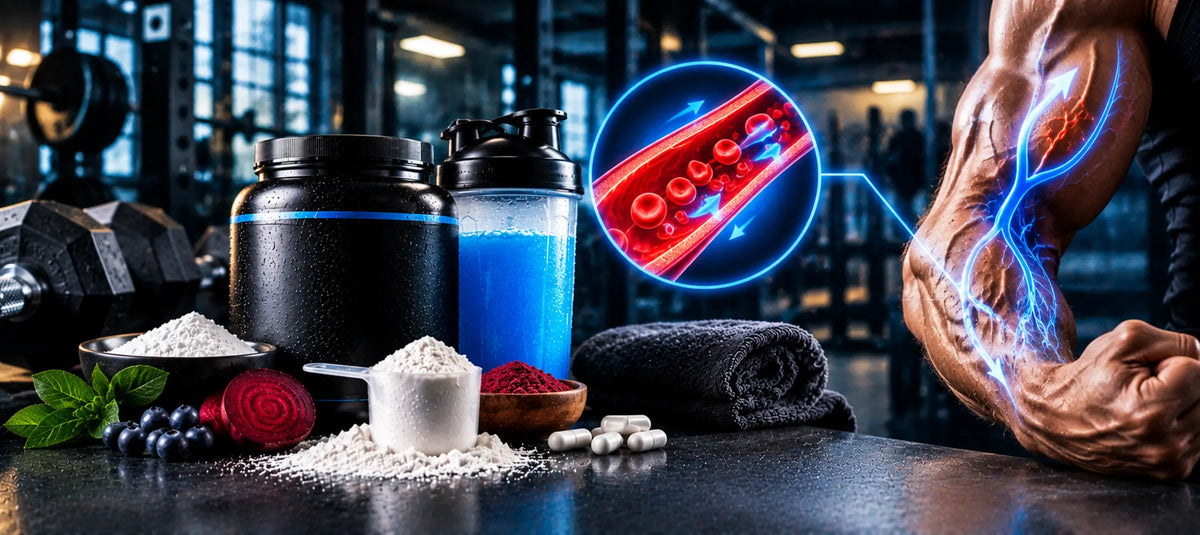
A muscle pump is the tight, full, swollen feeling you get while you train. It happens when blood and fluid rush into the muscle you are working. Your muscle needs more oxygen and fuel during a set, so your body sends extra blood to it. At the same time, the contracting muscle squeezes the veins that carry blood away, so blood flows in faster than it flows out, and the muscle swells.
Lifters often call this "transient hypertrophy." Transient simply means temporary, because the swelling fades within a few hours after you finish.
So does a bigger pump mean bigger muscles? Not directly. One classic review explains that mechanical tension, which means lifting challenging weights, is the main driver of muscle growth. Metabolic stress and cell swelling may add a small boost, but they are not the main event.
That's good news for you. You don't need to chase the pump at the cost of heavy, progressive training. Think of the pump as a bonus that shows your muscles are getting blood and nutrients, and one that makes your session feel great.
L-Citrulline vs. L-Arginine: Which Ingredient Has Better Evidence for Muscle Pumps?
Nitric oxide is a molecule that relaxes your blood vessels and lets more blood flow through them, so many people assume that more arginine means more pump.
The research tells a different story. Your body turns citrulline into arginine, so taking citrulline can raise your arginine levels as well. A 2019 systematic review looked at 38 studies on these two amino acids and physical performance. The authors judged L-citrulline to be the more effective option, and they linked it with lower perceived effort, less muscle pain, and lower lactate levels.
So what should you do with this? If you want to try one ingredient, citrulline is the smarter pick. Always follow the directions on the label, and talk to your doctor first if you take blood pressure medicine.
Citrulline also comes in two forms, plain L-citrulline and citrulline malate. Check which one your product uses, because the labels list different amounts for each.
How Water, Sodium, and Carbohydrates Affect Muscle Pumps
Now let's talk about the part most people skip. Your food and drink do more for your pump than any scoop of powder ever will.
Water
Muscle is mostly water, so when you train dehydrated, you have less fluid available to fill it. Pakistan's summer heat makes this worse, because you start sweating before you even finish your warm-up.
Sip water throughout the day instead of waiting until you reach the gym and chugging a litre in five minutes. A simple check is to aim for pale yellow urine by the time you start warming up. That's so easy, and it really works.
Sodium
Sodium helps your body hold on to the fluid you drink. Some lifters add a small pinch of salt to their water or nimbu pani before training. Current evidence on salt and pump size is limited, so keep the amount small, and ask your doctor first if you have high blood pressure.
Carbohydrates
Carbs matter far more than most lifters think. Your body stores carbs inside your muscles as glycogen, and glycogen holds water. One lab study in the European Journal of Applied Physiology took muscle samples from nine trained cyclists, and it supported the long-standing estimate that muscle stores about 3 g of water for every 1 g of glycogen.
In simple words, more glycogen means more water in the muscle, and that means a fuller look and feel when you train.
How to Train for a Better Muscle Pump
Even with perfect food and water, your training style decides how much blood stays inside the muscle. The good news is that small changes work fast. Treat the numbers below as practical coaching guides, not strict rules.
Best Rep Ranges for Pump-Focused Training
Heavy singles and triples build strength, but they don't create much of a pump. Moderate and higher reps do a much better job of keeping the muscle under load long enough for blood to build up.
-
8 to 12 reps work well on your main muscle-building lifts.
-
12 to 20 reps work well on isolation moves like lateral raises, curls, and cable flyes.
Pick a weight that makes your last two or three reps hard. That's where the burn and the swelling really show up.
How Rest Periods Affect Muscle Pump
Short rests keep blood trapped in the muscle, while long rests give it time to drain away. Try 30 to 90 seconds between sets on your pump work, and save the longer rests for heavy compound lifts at the start of your session. And yes, that means putting your phone down between sets.
Why Training Tempo and Time Under Tension Matter
Time under tension is the total time your muscle works during one set. When you rush, you use momentum and the muscle gets small breaks between reps. When you slow down, it never gets a chance to relax.
Use this simple tempo on every rep:
-
Lift for about two seconds.
-
Squeeze hard at the top for one second.
-
Lower the weight for two to three seconds.
Aim for 30 to 60 seconds per set, and don't fully lock out your joints at the top, because that takes tension off the muscle. Stay in the working range and keep the squeeze going from the first rep to the last. It's that simple, and it works with any weight.
Do Pump Supplements Work? Comparing MEGALITH Powder and MEGALITH RTD
So, do pump supplements work? They can support your routine, but they work best on top of good food, enough water, and smart training. Think of a supplement as the final step, not a shortcut.
If you choose one, MEGALITH gives you two easy options. Both fit the same routine, so you can pick the one that suits your day.
MEGALITH Powder
-
Mix it with water in your shaker.
-
Choose it if you like to prepare your drink at home or in the gym.
-
It fits well if you train at the same time every day.
MEGALITH RTD
-
Open it and drink it. There is no mixing or measuring.
-
Choose it if you go straight from work or university to the gym.
-
It fits well if you want a quick, no-fuss option.
Both options work the same way in your routine. Pick the format that makes it easier for you to stay consistent.
Common Mistakes That Reduce Your Muscle Pump
Don't be scared if you recognise yourself in this list. Almost every lifter has made these mistakes at some point, and each one is easy to fix.
1. Skipping Carbs Before Training
Mistake: You train fasted or on a low-carb day, so your muscles hold less glycogen and less water.
Solution: Eat a carb-rich meal two to three hours before you lift.
2. Drinking Water Only at the Gym
Mistake: You chug water right before your first set and expect it to reach your muscles in time.
Solution: Sip water through the day so you walk in already hydrated.
3. Chasing the Pump and Dropping Heavy Lifting
Mistake: You do endless light sets because the swelling feels so good.
Solution: Lift heavy first, then finish with pump work, because tension builds muscle and the pump adds the finish.
4. Rushing Your Reps
Mistake: You swing the weight up and drop it fast, so the muscle gets a rest between reps.
Solution: Slow down, squeeze at the top, and keep tension on the muscle the whole time.
5. Resting Too Long Between Sets
Mistake: You scroll your phone for four minutes between curls, and the blood drains out of the muscle.
Solution: Keep your rests between 30 and 90 seconds on pump work.
6. Expecting a Supplement to Do Everything
Mistake: You take a scoop, skip your meal, and expect a miracle.
Solution: Treat supplements as the last step in your routine, not the first.
How to Build a Pre-Workout Routine for a Better Muscle Pump
Now let's put it all together. Here is a simple timeline you can follow.
-
Sip water steadily through the day, and add a small pinch of salt if your doctor is fine with it.
-
Eat a balanced meal with carbs and protein two to three hours before training, such as daal chawal with chicken.
-
Take your citrulline or pre-workout 30 to 45 minutes before training, as the label directs.
-
Try Jacked Citrulline, a plain L-citrulline powder with no proprietary blend and no added sugar.
-
Warm up with light sets about 10 minutes before your first working set.
-
Sip water between sets, and keep your reps moderate, your rests short, and your tempo slow.
-
Eat a proper meal with protein and carbs after your session to refill your glycogen.
Give this routine two full weeks before you judge it, and change only one thing at a time so you know what works for your body.
Ready for a Better Pump? Build Your Pre-Workout Routine Today
A better muscle pump is not luck. It comes from enough water, the right carbs, a smart ingredient like citrulline, and training that keeps blood inside the muscle. Get those basics right, and your pump will follow.
So what's holding you back? Plan your next meal, fill your water bottle, and pick your pre-workout. If you want to start with citrulline, explore Jacked Citrulline, or browse our pre-workout collection to find the option that fits your routine. Then walk into your next session ready to crush it.
Share:
How Much Whey Protein Per Day? What the Latest Research Says About Dose and Timing