

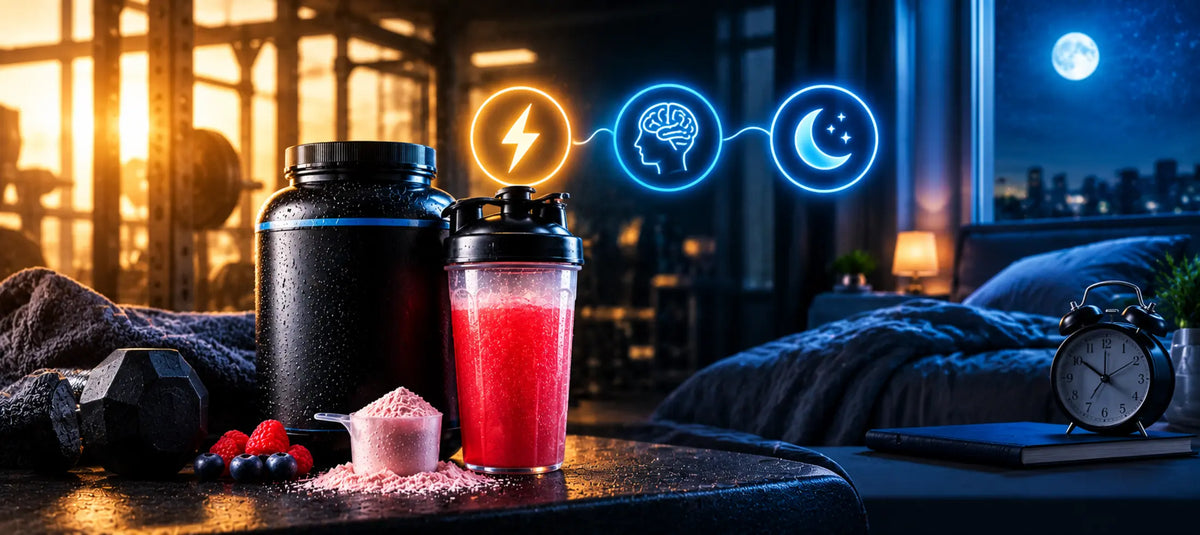

Most of us can’t get a specific time to do workouts, and that’s totally okay. Everyone has different life schedules; that’s why some people prefer morning workouts, and some prefer evening workouts. Regardless of timing, we need pre-workout supplements to improve our workout quality. Most of the pre-workouts contain caffeine and other stimulants, so if you do workouts in the evening, they can affect your sleep quality. But you shouldn’t skip pre-workouts just for this reason.
You can choose a low-caffeine or stimulant-free formula with citrulline, beta-alanine, and taurine. And if you do take caffeine, keep it to a half serving and finish it at least six hours before bed.
In this blog, you will learn how long caffeine stays in your body, where to draw your cutoff, which ingredients help without the buzz, and what to do after your workout so you actually sleep.
Let's dive in!
Why Evening Pre-Workout Can Disrupt Sleep: Understanding Caffeine's Half-Life
Caffeine doesn't leave your body the moment its effect fades. Its half-life is about five hours for most adults, meaning half your dose is still circulating in your blood five hours after you drink it, and for some people, it lasts even longer.
Let's do the math. If your pre-workout contains 200 mg of caffeine and you take it at 6 PM, you still have about 100 mg in your system at 11 PM, roughly one strong cup of tea, while you try to fall asleep.
Now here comes the sneaky part. In a sleep study published in the Journal of Clinical Sleep Medicine, researchers gave healthy adults 400 mg of caffeine three hours before bed or six hours before bed. All three timings disturbed sleep, and the six-hour group lost more than an hour of it, even though many of them never noticed the loss.
So you may wake up feeling fine and still be under-recovered, and that's the real cost of consuming caffeinated pre-workout too late.
How Late Is Too Late? Setting a Caffeine Cutoff for Evening Workouts
The research points to one simple rule: stop your caffeine at least six hours before you go to bed. Count backward from your bedtime, not from the start of your workout.
Here is how that looks if you usually sleep at 11 PM:
-
Before 5 PM: A normal serving is fine for most people.
-
Between 5 PM and 7 PM: Take a half serving, or pick a low-caffeine formula.
-
After 7 PM: Skip the caffeine and go stimulant-free.
Is this rule perfect? No, because some people drink tea at 9 PM and sleep like a baby, while others toss and turn after a single morning coffee, since your genetics, your daily habits, and your body size all influence how quickly you process caffeine.
So treat the six-hour rule as your starting point, and then run a simple test. For one week, write down the time you took caffeine and how well you slept that night, and after seven days you will see your own pattern clearly enough to adjust your cutoff time.
Don't worry if you miss the mark once or twice, because it's a skill and you will get better with practice.
Now let's look at what you can put in your scoop instead.
Best Pre-Workout Ingredients for Evening Training
Caffeine gets all the attention, but a well-designed pre-workout contains other ingredients that support your performance during training without the late-night stimulation. Check your label for these three.
Citrulline for Blood Flow and Workout Performance
Your body converts citrulline into arginine and then into nitric oxide, a molecule that helps your blood vessels relax and widen. When your vessels widen, more blood can reach the muscles you're working, which is where the famous "pump" comes from.
Some studies also suggest that citrulline may help you squeeze out a few extra reps, although the results vary from person to person, so don't expect magic. The best part for evening lifters is that citrulline isn't a stimulant, so it won't raise your heart rate the way caffeine does, which makes it a comfortable fit for late sessions.
Beta-Alanine for High-Intensity Exercise
Ever feel that deep burn in your legs during the last few reps of a hard set? Beta-alanine helps your muscles handle it because it raises your carnosine levels, and carnosine helps buffer the acid that builds up during intense effort.
A large review in the British Journal of Sports Medicine found a small but real benefit for efforts that last between one and ten minutes. That matches the length of most hard sets and short, intense rounds.
One thing to know is that beta-alanine can cause a harmless tingling feeling on your skin, which doctors call paresthesia. Don't be scared, because it usually fades within an hour, and a smaller serving can reduce it. Like citrulline, beta-alanine isn't a stimulant, so it won't keep you awake at night.
Taurine and Its Role in Exercise Performance
Taurine is an amino acid that appears in many energy drinks, so people often assume that it works like a stimulant, but it doesn't.
Early research suggests that taurine may support endurance and help your muscles cope with the stress of exercise. The evidence is still growing, so think of it as a helpful extra rather than a game changer. For evening training, the upside is clear, because taurine adds to your formula without adding to your caffeine count.
How Much Caffeine Should You Take Before an Evening Workout?
Caffeine does improve performance, and the International Society of Sports Nutrition position stand says that doses of 3 to 6 mg per kg of body weight reliably help. It also notes that the lowest effective dose may be as low as 2 mg per kg.
For evening training, aim for the low end, and keep your whole day in mind. Health authorities such as the US FDA suggest that most healthy adults stay under 400 mg of caffeine per day, so count your coffee and chai before you decide on your scoop. If you are pregnant, have a heart condition, or take regular medication, talk to your doctor first.
Low-Stimulant Pre-Workout Options
A low-stimulant pre-workout gives you a mild lift with a smaller caffeine dose, so look for a formula with a modest amount of caffeine per serving and check that it still contains citrulline, beta-alanine, or taurine. Stack…
This option suits you if you train around 5 to 7 PM and still want to feel switched on, because you get a gentle push without paying a high price at bedtime.
Half-Serving vs. Full-Serving Doses
A half serving is the easiest option, because it cuts your caffeine in half while your other ingredients still show up. Take it about 30 to 60 minutes before you train, since the ISSN position statement lists 60 minutes as the most common timing for caffeine.
So which one is better? There isn't a single answer. If you train at 5 PM and sleep at midnight, a full serving may be fine, but if you train at 8 PM, even a half serving may be too much. It depends on your bedtime, your body size, and how sensitive you are to caffeine. Start with half, watch how you sleep, and move up only if you need to.
Is Stimulant-Free Pre-Workout a Better Choice?
Yes, it’s better for those who are sensitive to caffeine and a very small amount can trigger them. Stimulant-free formulas have no timing limits, so they work well for late sessions, and you can take one at 9 PM and still sleep soundly, but some people miss the sharp mental focus that caffeine gives them, and after a long day at your desk, a stim-free scoop can feel flat.
Again, it comes down to you. If you train late, react strongly to caffeine, or already struggle with sleep, go stimulant-free, but if you train early in the evening and sleep well, a low dose may work just fine. You can also mix it up by using stim-free on late days and a low dose on early ones.
Caffeine-Free Pre-Workout Options for Evening Training
If you want a caffeine-free option you can use at any hour, we have two on our website.
Blade Strike by Blade Sport is a caffeine-free pre-workout in Mango Maracuja flavour. Mix it with water before you train, and stay within the dose on the label. With no stimulants in it, you can use it for a late session without counting back six hours.
Fury Pump by Galvanize Nutrition also leaves out caffeine. One 11 g scoop lists 2,000 mg of citrulline malate, 1,500 mg of beta-alanine, and 600 mg of taurine, the three ingredients we covered above, plus 3,278 mg of creatine monohydrate. Mix one scoop with 300 ml of water and take it 15 to 30 minutes before you train. The product page lists it as DRAP-registered and GMP-certified.
Not sure which one fits your evening? Browse our full pre-workout collection and compare the labels side by side.
How to Maintain Energy During Evening Workouts Without Extra Stimulants
Sometimes the best energy boost isn't in a scoop at all, so try these simple habits first.
-
Eat a smart snack.
Have some carbs 60 to 90 minutes before you train, such as a banana with a few dates or a small plate of rice, because your muscles run on carbohydrates and you don't need caffeine to use them.
-
Drink water early.
Even mild dehydration can make you feel tired, so sip water through the afternoon instead of waiting until you reach the gym.
-
Take a short break.
A 15-minute walk or a quick nap before you leave can reset a tired brain.
-
Warm up well.
Ten minutes of light movement wakes your body up better than you'd think.
-
Stay consistent with creatine.
Creatine monohydrate isn't a stimulant, and you don't need to time it around your workout, because daily use is what counts.
And don't forget your 5 PM tea. If you want it, have it earlier in the afternoon or switch to a decaf or herbal cup on training days, because these habits cost you nothing and they work alongside any pre-workout you choose.
Post-Workout Habits That Support Better Sleep and Recovery
You've trained hard, so now let's protect your sleep, because your muscles recover while you rest rather than while you lift, and a good night's sleep is part of the program.
-
Cool down for five to ten minutes.
Walk slowly and stretch, so your heart rate comes down, and your mind follows.
-
Take a warm shower.
It tells your body that the day is ending.
-
Eat a balanced dinner.
Pair protein, like chicken or daal, with carbs, like roti or rice, and try to finish at least an hour before bed.
-
Dim the lights and drop the screen.
Bright light tells your brain that it's still daytime, so put your phone down 30 minutes before sleep.
-
Keep a steady bedtime.
Your body loves a routine, even on weekends.
-
Think about your magnesium.
Evening is a common time to take it, and Jacked Magnesium Bisglycinate is a form that sits gently on the stomach. If you take medication, ask your doctor first.
Which one is good for you?
Evening training doesn't have to cost you your sleep. Count back six hours from your bedtime, keep your caffeine low or skip it, and let citrulline, beta-alanine, and taurine do some of the work. Add a simple wind-down after your session, and you protect both your performance and your recovery.
So don't wait for the perfect schedule. If you're ready to pick your formula, start with our caffeine-free options, Blade Strike or Fury Pump, or compare every label in our pre-workout collection. Jacked Nutrition products carry a Certificate of Analysis that you can check through the QR code on the pack, so you know exactly what goes into your scoop.
Share:
What Happens Inside Your Body After Taking a Pre-Workout? Understanding Energy, Pump & Focus Response
How Long Before a Workout Should You Take Pre-Workout?