

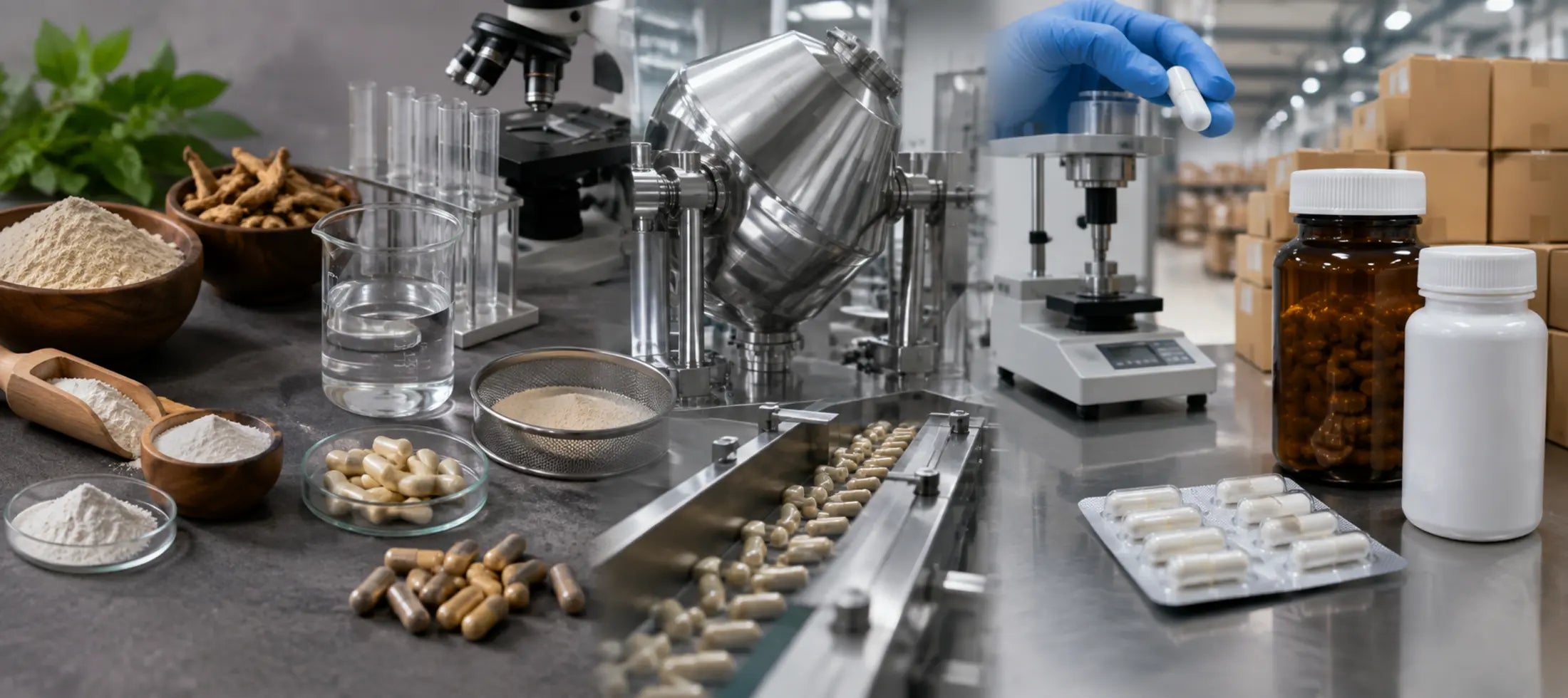

Most people scoop their protein or swallow their multivitamin without asking how it got there. If you're curious about how supplements are made in Pakistan, here's the honest answer: a lot happens before that tub gets sealed. Raw powder gets tested. It gets weighed. It gets blended. Then it gets checked again, and again, and every step gets written down. None of it looks exciting. But it decides whether what's on the label actually matches what's inside the scoop.
Let’s cover the eight stages that turn raw material into a finished, DRAP-compliant product.
The Eight Stages at a Glance
|
Stage |
What Happens |
Why It Matters |
|
1. Raw Material Sourcing |
Suppliers are checked and approved before any order is placed |
Stops low-quality ingredients from entering the process |
|
2. Intake Testing and Quarantine |
New material is tested and held separately until it passes |
Catches fake or contaminated ingredients early |
|
3. Formulation and Blending |
Ingredients are weighed and mixed to an exact recipe |
Makes sure every scoop has the same dose |
|
4. In-Process Quality Checkpoints |
Samples are tested while the line is still running |
Fixes problems before the batch is finished |
|
5. Batch Documentation and Traceability |
Every batch gets a unique number linked to its full history |
Makes recalls and complaints easy to trace |
|
6. Final Product Testing |
The finished product is tested one more time before release |
Confirms the label matches what's inside |
|
7. DRAP Facility Inspection |
Regulators check the plant, records, and staff training |
Verifies daily practice matches written rules |
|
8. Farma Labs in Practice |
The full process runs inside one DRAP-licensed facility |
Shows the process instead of just claiming it |
Stage 1: Raw Material Sourcing
Every supplement starts as a raw ingredient sitting in a warehouse, long before it reaches a factory in Pakistan. Whey concentrate might come from a dairy processor in Europe. Creatine monohydrate often comes from a specific producer in China or Germany. Vitamin blends travel from ingredient houses that also supply pharma companies.
A serious manufacturer doesn't just buy from whoever offers the lowest price. They check suppliers first. That means reviewing the supplier's own manufacturing licence and checking past batch history. It also means asking for a Certificate of Analysis, or CoA, with every shipment. A CoA lists purity, identity, and any contaminant tests the supplier already ran. Without it, a factory has no starting point for its own checks.
Supplier approval isn't a one-time thing either. Facilities usually re-check suppliers on a set schedule. Ingredient quality can drift over time, especially with farm-based inputs like herbal extracts.
Stage 2: Intake Testing and Quarantine
Raw material doesn't go straight into production, even after it clears customs. It sits in quarantine first. This means it's kept apart from approved stock and clearly labelled until quality control finishes its checks. Why? Because a supplier's paperwork is a claim, not proof.
Identity testing confirms the ingredient is actually what the label says. A lab technician might use infrared testing, a method that identifies a substance by how it absorbs light, or a simpler colour reaction test. Purity testing checks how much of the active ingredient is really there. Contamination screening looks for heavy metals, microbes, and pesticide residue.
If a batch fails any of these checks, it doesn't get a second chance just because the supplier's paperwork looked fine. It gets rejected or sent back. Only material that passes moves out of quarantine and into the approved store.
Stage 3: Formulation and Blending
This is where the recipe comes together. A formulation is written down as a batch record before production even starts. It lists every ingredient and its exact weight for that batch size. Operators weigh each part on calibrated scales. A second person usually checks the weight before it goes into the blender. This double check catches simple mistakes early.
Blending sounds simple, but getting an even mix is harder than it looks. Take a multivitamin as an example. Some ingredients are needed in milligrams. Others are needed in grams. If the blend isn't even, one scoop from the top of the tub could carry a different dose than one from the bottom. To check this, manufacturers pull samples from different points in the mix. Then they confirm the active ingredient levels match across all of them.
Every step gets logged. Weighing, blend time, mixer speed, all of it goes into the batch record. That document becomes the paper trail for that exact batch. Nobody throws it away once the product ships.
Stage 4: In-Process Quality Control Checkpoints
Production doesn't run on autopilot from start to finish. Quality checks happen while the line is still running, not just at the end. Operators pull samples at set points and check things like moisture, particle size, and fill weight, depending on the product.
These checkpoints exist to catch problems early, while they're still cheap to fix. If fill weight starts drifting outside its allowed range, that's usually a sign something upstream needs adjusting. Maybe the room got too humid. Maybe a filling machine setting slipped.
When a checkpoint fails, the batch goes on hold. Nobody on the production floor can override that decision. A quality assurance manager has to look into the cause, write it up, and decide whether the batch can be fixed, adjusted, or has to be scrapped. This hold power sits outside production management on purpose. It removes the pressure to keep a line running at the cost of quality.
Stage 5: Batch Documentation and Traceability
Every batch gets a unique batch number before it leaves the facility. That number becomes the thread that connects the finished tub back to everything that happened during production.
|
What the Batch Number Traces Back To |
Why It Matters |
|
Raw material lot numbers used |
Confirms exactly which supplier shipment went into that batch |
|
Equipment and line used |
Helps investigate if a machine-specific issue comes up |
|
Operators and QC staff involved |
Supports accountability at each step |
|
In-process test results |
Shows the product passed checks the whole way through |
|
Date and time of manufacture |
Ties the batch to one production run for recall purposes |
This system is what people mean by batch traceability. If a customer reports an issue, or a raw material recall happens somewhere in the supply chain, the batch number lets the manufacturer trace the problem to its source.
Record retention rules under GMP usually require these documents to be kept well past the product's shelf life, often for years. Farma Labs has covered this before too, including how HPLC testing verifies every batch of Jacked Creatine, a method that checks how pure a compound is. Worth a read if you want to see how one specific test fits into this chain.
Stage 6: Final Product Testing Before Release
Before a finished product gets packed and shipped, it goes through one more round of testing. This time, it's the completed formula being checked, not just the raw ingredients. This usually includes a potency check to confirm the labelled dose is really there, a microbial test, and a check on taste, solubility, and appearance. All of these results go into a Certificate of Analysis, the document that lists the finished product's test results against its spec.
Release isn't automatic just because testing is done. A quality assurance officer, usually someone separate from the production team, reviews the full batch record and the Certificate of Analysis together. Only after that review does the batch get signed off for release.
Without that sign-off, the batch can't legally be sold, no matter how good it looks. This split between production and release approval is one of the simplest but most effective safeguards in the whole process.
Stage 7: What a DRAP Facility Inspection Covers
DRAP inspections don't just look at the finished product on a shelf. Inspectors walk through the whole facility. They check three broad areas: the physical plant, the paperwork, and the people.
On the facility side, they look at things most consumers never think about. Air handling systems. Pest control records. Whether raw materials and finished goods are stored apart to avoid cross-contamination. On the paperwork side, inspectors pull random batch records and check them against raw material CoAs.
They're checking whether what's written down actually matches what happened. On the people side, they check training records, since GMP rules require staff to be trained on their specific job, not just given a general welcome talk once.
Inspectors also check complaint handling. A facility that gets a customer complaint and can show how it investigated and fixed the issue looks very different from one with no system for tracking complaints at all. This is one of the clearest signs of a facility's daily discipline, whether or not a real product defect ever happened.
Stage 8: How Farma Labs Executes Each Stage
Everything above sounds fairly abstract until you see it applied inside a real, DRAP-licensed facility. Farma Labs runs the full process, from checking suppliers to final release testing, inside one site. Raw material comes in, sits in quarantine, gets tested, and only then moves to production. Every batch carries documents from the first weighing step to the final sign-off.
Want the fuller picture? Our docuseries shows the facility floor directly. You can also read more about how Jacked Nutrition built our manufacturing facility from scratch. The goal has always been the same: make the process something we're willing to show, not something we'd rather keep behind closed doors.
It's worth being honest about something else here. Plenty of Pakistani supplement brands mention GMP, ISO, or DRAP on their packaging. That's a fair baseline to expect. But fewer actually explain what happens between raw material and finished tub, or invite customers to see the facility itself. That gap is exactly what this article, and the wider docuseries, tries to close.
Frequently Asked Questions
How are supplements manufactured in Pakistan?
Supplements go through raw material testing, formulation, blending, in-process checks, and final product testing before release. A DRAP-licensed facility documents every stage, and a quality assurance team approves the batch before it can be sold.
What does GMP mean in supplement manufacturing?
GMP stands for Good Manufacturing Practice. It's a set of rules covering hygiene, equipment, documentation, and staff training. The goal is simple: make sure every batch is produced the same safe way, not just the ones that happen to get inspected.
What is batch traceability and why does it matter?
Batch traceability means every finished product can be linked back to its raw materials, equipment, and staff through one unique batch number. It matters because it lets a manufacturer handle a complaint or a recall fast and accurately, instead of guessing which products might be affected.
How are supplement raw materials tested?
Raw materials go through identity testing to confirm what they are, purity testing to check active ingredient levels, and contamination screening for things like heavy metals and microbes. Only material that passes these checks leaves quarantine and enters production.
What does a DRAP facility inspection check?
DRAP inspectors look at the physical facility, including storage and hygiene, review paperwork like batch records and training logs, and check staff training. They're checking whether daily practice on the floor actually matches what's written down.
Final Thoughts
Manufacturing standards for dietary supplements aren't unique to Pakistan either. If you want to compare how this looks elsewhere, the FDA publishes its own current good manufacturing practices for dietary supplements, which covers similar ground on documentation, testing, and facility controls.
None of this replaces medical advice. If you have a health condition or take medication, check with a doctor before starting any new supplement.
Curious about what DRAP approval actually means for the products you buy? We've covered what DRAP approval actually means in more detail separately. And if you want to see this process reflected in an actual product, you can shop the range based on these principles.
Share:
Pakistan's First Sports Nutrition Manufacturing Facility: The Farma Labs Story
Pakistan's First Sports Nutrition Manufacturing Facility: The Farma Labs Story