

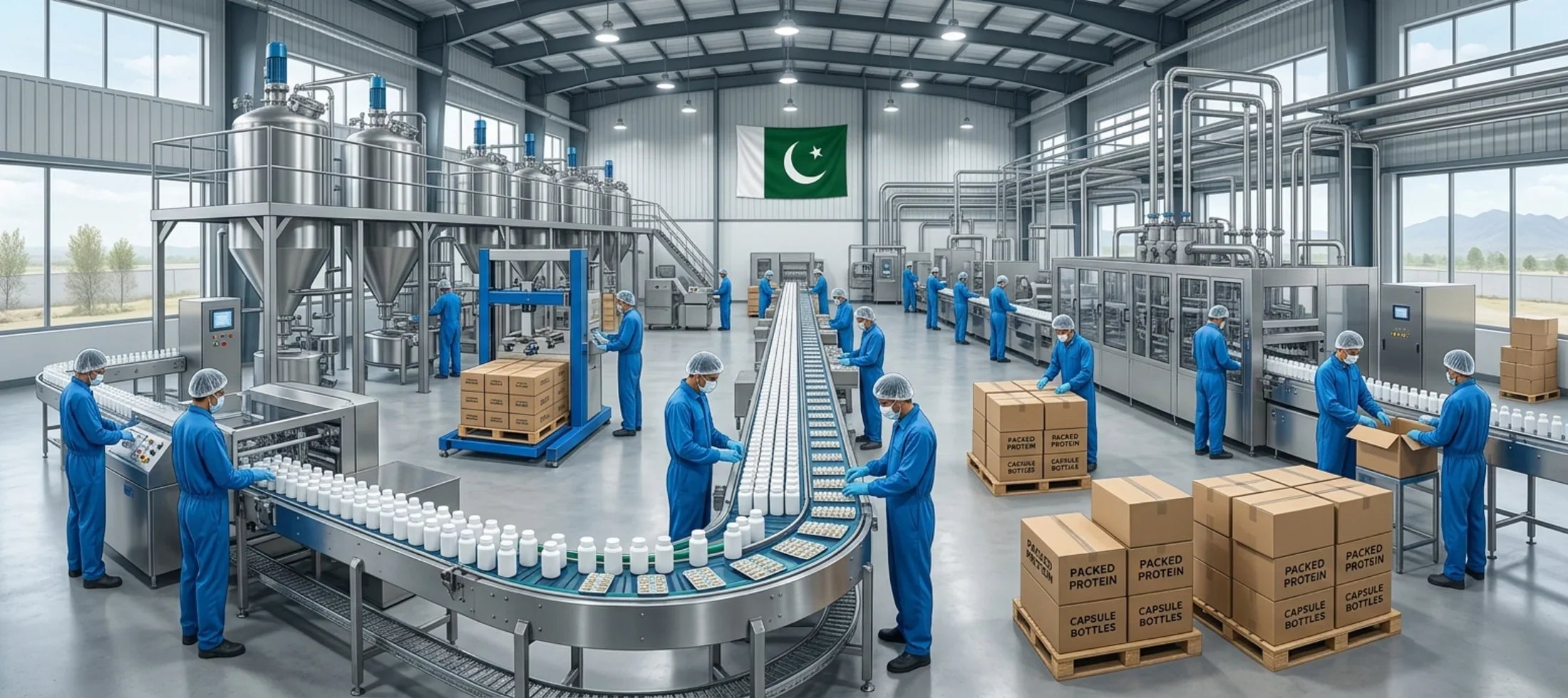

Farma Labs Pakistan is the country's first sports nutrition manufacturing facility. The team behind Jacked Nutrition built it. It runs under DRAP Manufacturing Licence 01542. Every batch is manufactured, quality-checked, and packed at the facility in Pakistan, using approved raw materials sourced through its supply chain. That one fact changes what "local supplement brand" really means here.
For 14 years, Jacked Nutrition sold products made elsewhere. We packed boxes. We answered customer questions. We stood behind formulas we hadn't made ourselves. It worked, up to a point. But it also meant we couldn't promise what we couldn't check.
Farma Labs answers a question we kept asking during those years. Why should Pakistani athletes trust a supply chain they can't see? This is the story of how that question turned into a licenced factory, and what it took to get there.
The Problem Farma Labs Was Built to Solve
Pakistan's supplement market runs almost entirely on imported stock. A tub of protein or a bottle of pre-workout usually crosses two or three borders before it lands on a gym shelf here. Once an imported product is already in the supply chain, the local brand has far less control over how it was manufactured, handled, and stored before it reached Pakistan. By the time a product arrives, the seller is trusting people they've never met.
We spent fourteen years on the retail side of this business. That gave us a front row seat to the problem. Shipments got delayed for months. Formulas changed without warning between one batch and the next. Some batches showed up with broken seals, or old stock mixed in with new. Customers blamed us, and honestly, they often had a point. We were selling products we couldn't fully vouch for, simply because we hadn't made them.
Most sports nutrition brands in Pakistan still work this way. They import finished goods, repackage them, or resell them under a deal with a distributor. It's a model that can work fine. But it puts a limit on how much control a brand really has over quality. If an overseas supplier compromises on quality, the local seller usually finds out only after customers start complaining.
|
Category |
Import and resell model |
Farma Labs manufacturing |
|
Quality control |
Set by the overseas supplier |
Set and checked on site |
|
Batch tracking |
Limited, often missing |
Full, from raw material to finished product |
|
Formula consistency |
Can shift between shipments |
Fixed and written down |
|
Supply chain length |
Crosses several borders |
Made and packed locally |
That gap between what customers expected and what an import model could offer is the real reason Farma Labs exists. It wasn't a marketing move. It came from years of watching Pakistani buyers get let down by a system that wasn't built with them in mind.
From PKR 2,000 to a Manufacturing Facility
Jacked Nutrition started in 2012 with PKR 2,000 and one simple idea. Sell real supplements to Pakistani gym goers who had almost no good local options at the time. There was no factory, no investor, and no safety net. Just a small retail shop and a lot of trial and error.
Those early years were tough, and we won't pretend they weren't. Stock ran out at bad times. Suppliers changed their terms without warning. We learned the business by making mistakes and fixing them one at a time. That's a slow way to grow. But it's probably a more honest one too.
Retail taught us more than any business course could. We saw which imported brands compromise on quality. We saw how difficult it could be to verify exactly what was behind a product's label. Customers would ask simple questions, like what's really in this scoop, and we often couldn't answer with full confidence. That bothered us more than we let on at the time.
By the mid-2010s, it was clear that importing alone would never fix the trust problem. If we wanted to guarantee quality, we had to control the whole process ourselves, from the raw materials to the final sachet. Importing meant depending on someone else's standards, whatever those turned out to be. Manufacturing meant setting our own standards, in the open, batch after batch.
That idea didn't turn into a factory overnight. It took years of saving, planning, and learning what strict manufacturing actually required in Pakistan. You can read more about that early period, and how the business grew from one small room to seven retail stores, on about Jacked Nutrition. That growth is what later gave us the means to attempt something as big as Farma Labs.
The DRAP Licencing Process: What It Actually Took
Getting a manufacturing licence in Pakistan isn't quick, and honestly, it shouldn't be. DRAP's manufacturing requirements cover the facility, equipment, personnel, documentation, and manufacturing controls before a facility can be authorized to manufacture regulated products. The Drug Manufacturing License requirements set by DRAP cover everything from site layout to quality checks. None of it is optional.
We had to design a facility from scratch that met strict pharma-level rules, not just food-level ones. That meant clean, controlled air. That meant checked and tested equipment. That meant separate zones so one product could never mix with another by accident. Every machine needed proof that it did what it was meant to do. Every process needed a written step-by-step guide before we could even ask for an inspection.
Then came the paperwork, and there was a lot of it. Step-by-step guides for every process. Batch records. Staff training logs. Quality manuals covering things like cleaning schedules and equipment checks. DRAP inspectors don't just take your word for it. They check the site against the paperwork, and the paperwork against the site. Any gap, even a small one, sends you back to fix it and try again.
We failed a few checks along the way. Not because we take shortcuts, but because strict pharma rules go into a level of detail that's easy to underestimate until you're deep in it. Every failed check meant weeks of fixes, retraining staff, and adjusting machines before we could ask for another look.
The whole process, from the first application to final approval, took more than three years. There were setbacks we didn't see coming and delays that tested our patience more than once. But Licence 01542 wasn't just handed to us. We earned it, one inspection at a time. That's exactly how it should work for anyone making sports nutrition products in Pakistan.
Inside the Facility Today
Farma Labs now runs several production lines under one roof. Each one is built for a different kind of product.
-
Powder blending: Protein powders, creatine, and pre-workout formulas get mixed in controlled batches. This keeps every scoop the same. Workers pull samples and test them at set points during the run.
-
Capsule production: Vitamins, minerals, and other ingredients get filled into capsules with careful, exact doses. What's on the label matches what's inside.
-
Tablet compression: Compressed tablets go through pressure and hardness checks. This makes sure they hold together, but still break down at the right speed once you take them.
-
Sachet packaging: Single-serve sachets get sealed for easy carrying. This works well for pre-workouts, travel packs, and trial sizes.
-
Custom formulation: Our in-house team can develop a formula from scratch. It's based on a brand's target buyer, budget, and label claims.
Recent testing inside the lab has focused a lot on checking raw materials. We cover this in more detail in our post on how Farma Labs verifies USP grade creatine, which covers the lab checks one single ingredient goes through before it gets approved. Each batch goes through documented quality checks before it moves to packaging. Nothing moves forward just because we assume it's fine.
What ties these lines together is tracking. Each batch carries a record from the raw material stage all the way to the finished product, including who handled it and when. If a question ever comes up about a specific tub or box, we can trace it back to the exact run, the exact shift, and the exact raw material lot. That kind of detail just isn't possible when you're importing finished goods from a supplier overseas. By the time the product reaches Pakistan, most of that history is already gone.
What Farma Labs Means for Pakistani Consumers
For most buyers, this comes down to two things: trust and freshness.
Batch tracking means the responsibility sits with us, not with a distributor three countries away who's hard to reach on a bad day. If something's wrong with a product, we know exactly which batch, which shift, and which raw material lot it came from. That kind of responsibility is hard to offer when you're just reselling someone else's work, no matter how good your customer service is.
There's also the supply chain itself. A shorter path from the factory to the shelf means less time in transit, fewer hands touching the product, and fresher stock by the time it reaches a customer. Imported supplements can spend weeks or months in transit and storage before reaching a customer. Local manufacturing can shorten that supply chain, which gives the manufacturer more control over how quickly finished products move from production to the market. That matters more than most buyers realize.
There's a trust side to this too, separate from the technical part. Pakistani buyers have grown used to being careful around supplements, and for good reason, given how many grey markets or wrongly labeled products are out there. A local, licenced facility with a public licence number gives customers something real to check, rather than just a brand's word.
None of this means every problem goes away overnight. Making products locally doesn't make a company perfect, and we're not claiming it does. But it does mean the people making the product are the same people who answer for it. That's a real change for a market that's dealt with a lot of shaky imports over the years.
Contract Manufacturing and Private Label for Other Brands
Farma Labs doesn't only make products for Jacked Nutrition. The facility also does contract manufacturing and private label work for other brands. These are brands that want a DRAP-licenced, locally made product instead of an imported one.
This side of the business grew on its own. Once other people in the fitness and nutrition space heard we'd built a licenced factory, we started getting enquiries. Smaller brands wanted quality control but couldn't afford their own factory. Some gyms wanted their own private label line. Some distributors were tired of import delays that were hard to plan around.
We can make protein powders, capsules, tablets, and sachet formats for other brands. We can use their existing formula, or develop one from scratch with our formula team. Minimum order sizes, packaging choices, and timelines change depending on the product. So, every enquiry gets looked at on its own, instead of forced into one fixed plan that doesn't fit anyone well.
The process usually starts with a chat about what the brand needs. Then comes a check to see what's possible, followed by a sample run before full production begins. We're upfront if something isn't possible at a certain budget or size, rather than promising a result we can't deliver. Brands that want to explore this can reach out through our B2B partnership enquiries page. Our team will discuss the details from there.
What Comes Next
Farma Labs isn't a finished project, and we don't treat it like one. We're growing the product line, with new formulas in testing and older product lines getting refined based on customer feedback and lab results.
There's also a bigger goal behind all of this: export. A facility with DRAP Manufacturing Licence 01542, and the paperwork to back it up, puts Pakistan in a spot to sell sports nutrition products abroad, not just bring them in. That's a shift for an industry that's spent decades moving in one direction only, bringing products in rather than sending them out.
We won't promise a set timeline here. Export markets have their own rules, and each country has its own version of what DRAP does for Pakistan. We'd rather get that right than rush it and hurt the trust we've spent years building.
But the goal is clear, and it shapes how we're planning the next stage of the business. Farma Labs was built to be more than a local supplier. Our plan going forward reflects that.
Frequently Asked Questions
What is Farma Labs?
Farma Labs is Pakistan's first sports nutrition manufacturing facility, built by Jacked Nutrition. It makes protein powders, capsules, tablets, and sachet products under DRAP Manufacturing Licence 01542. It handles everything from getting raw materials to final packaging, all in-house. The facility grew out of fourteen years of retail work and a choice to stop depending on imported supply chains.
Where is Farma Labs located and what does it manufacture?
Farma Labs is a licenced manufacturing facility in Pakistan. It makes powder blends, capsules, compressed tablets, and sachet formats. It handles both Jacked Nutrition's own product line and contract manufacturing for other sports nutrition brands that want a local, quality-controlled option.
What is Farma Labs' DRAP manufacturing licence number?
Farma Labs holds DRAP Manufacturing Licence 01542. The licence reflects the facility's authorization to manufacture under DRAP's applicable requirements. Product-level approvals or enlistments are separate.
Is Farma Labs connected to Jacked Nutrition?
Yes. Farma Labs was built by the team behind Jacked Nutrition. After fourteen years of retail work, it became clear that Pakistan needed a locally made, quality-controlled option instead of relying only on imported sports nutrition products.
Does Farma Labs do contract manufacturing for other brands?
Yes. Farma Labs offers contract manufacturing and private label work for other sports nutrition brands. This covers powders, capsules, tablets, and sachets, with formula support available for brands that need it.
Share:
What Goes Into a DRAP-Compliant Supplement: From Raw Material to Final Product
What Goes Into a DRAP-Compliant Supplement: From Raw Material to Final Product