

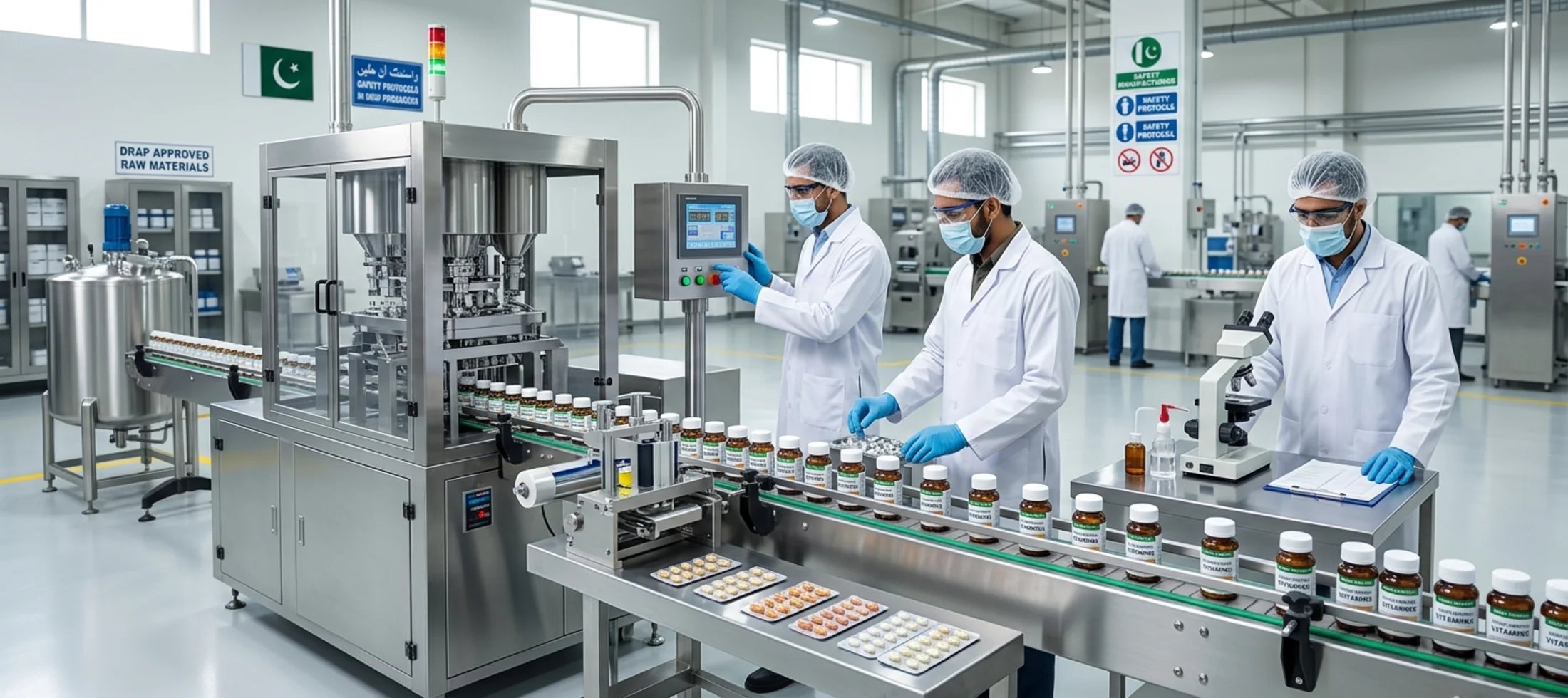

DRAP-approved supplements in Pakistan are a phrase you see on almost every protein tub and creatine jar sold here. But it hides something most buyers never question. There are two separate DRAP requirements people often confuse: product registration and manufacturing licensing.
A manufacturing licence applies to the facility that makes the products. Product registration applies to the individual product. It's easy to mix the two up. A lot of marketing copy does exactly that.
This article explains both types of approval. We'll look at product registration, manufacturing licensing, and why the difference actually matters if you care about what you're putting in your body.
What Is DRAP? The Drug Regulatory Authority of Pakistan Explained
The Drug Regulatory Authority of Pakistan was set up under the DRAP Act of 2012. Its job is to regulate drugs, medical devices, and a category called alternative medicines and health products. Most sports nutrition and dietary supplements fall under this last group.
In simple terms, DRAP decides what can legally be sold in Pakistan and under what rules. It checks product safety. It checks labeling claims. In some cases, it also inspects the facilities that make these products.
Supplements sit in an interesting spot here. They're not classed as drugs. But they're not left unregulated either. They fall under the Division of Health and OTC. This division handles enlistment and registration for nutraceuticals, vitamins, and similar products. That's why you often see the term DRAP nutraceutical used for protein powders, multivitamins, or pre-workout formulas.
DRAP Product Registration: Form 6 and Form 7
This is usually what people mean when they call a supplement DRAP approved. It works through two forms. Which one applies depends on where the product comes from.
Form 6 covers imported products. If a brand imports finished supplements into Pakistan from another country, the importer must submit the required documents. These often need notarization. In many cases, they need embassy attestation too. Only then does DRAP issue this enlistment.
Form 7 covers locally made products. A Pakistani brand making its own supplements at home registers each product under this route.
Here's what matters. Form 6 or Form 7 registration identifies the product within DRAP's regulatory framework and allows it to be marketed through the applicable registration route. It checks things like labeling accuracy, ingredient declarations, and basic safety paperwork.
What it does not confirm is where the product was actually made. Product registration and manufacturing licensing are separate regulatory processes. A product registration number alone doesn't tell you the full compliance status of the facility that manufactures it. And it's the part most people skip over.
Registration also doesn't tell you how consistent a product is from batch to batch. Two tubs from the same brand could come from different production runs. The sourcing might not match exactly. Form 6 or Form 7 alone won't catch that gap. This is one reason buyers who care about consistency look past the registration number. They ask about the facility itself instead.
DRAP Manufacturing Licensing: A Completely Different Approval
A manufacturing licence works differently. Instead of reviewing one product, DRAP looks at the whole facility where products get made.
This process checks the physical site itself. Inspectors look at the layout. They check the equipment. They confirm the space meets basic hygiene and safety standards used in pharmaceutical settings. They also review the standard operating procedures, or SOPs. These cover everything from raw material handling to batch testing and record keeping.
A facility applying for this licence must show a documented quality system. That means written steps for nearly every part of production. A general promise that things are done properly isn't enough. DRAP also usually asks for a Site Master File. It wants proof of Good Manufacturing Practice compliance too.
Because of this depth, the process often takes years, not weeks. Product registration can move fairly fast once the paperwork is ready. Facility licensing means physical inspections, corrections, re-inspections, and ongoing checks. Few companies in Pakistan's supplement industry go through this. It takes serious money and technical work up front.
There's also a side to this that people rarely think about. A manufacturing licence isn't a one-time achievement. Facilities must keep meeting the same standards over time. DRAP can revisit a site if concerns come up later. So, the licence isn't just proof of one good inspection day. It reflects a system meant to hold up over time, at least in principle.
Product Registration vs Manufacturing Licence: Side by Side
These two approvals get confused often. Here's a direct comparison.
|
What It Covers |
Product Registration (Form 6/7) |
Manufacturing Licence |
|
Scope |
A single product |
An entire production facility |
|
What's inspected |
Labeling, ingredients, basic documentation |
Site layout, equipment, SOPs, quality systems |
|
Time to obtain |
Weeks to months |
Often years |
|
What it proves |
The product is legally cleared for sale |
The facility meets manufacturing standards |
|
Where it shows on packaging |
Form 6 or Form 7 number |
Manufacturing licence number |
Most Pakistani supplement labels only show the product registration number. That's not unusual. It's not a red flag either. It simply reflects how the industry works here. A manufacturing licence number is far less common to see. Few facilities actually hold one. If you compare two products side by side, checking for both numbers gives you a fuller picture than checking for just one.
Why Most Supplement Companies in Pakistan Only Hold Product Registration
If facility licensing is so thorough, why doesn't every brand get one? The honest answer comes down to cost, time, and skill.
Building or upgrading a facility to meet DRAP's manufacturing standards costs a lot. It needs special equipment, trained quality control staff, and ongoing compliance work that doesn't stop once the licence is granted. For a smaller or mid-sized brand, that kind of spending rarely makes sense.
There's also a practical reason for this gap. Most supplement brands in Pakistan don't make their own products. They outsource production to third-party facilities, whether local or abroad. Then they register the finished product under Form 6 or Form 7. This model works fine within the current rules. It lets brands sell supplements without needing their own manufacturing licence.
If you're curious about what actually happens once a brand hands production over to a facility, our article on how supplements are actually made explains the process step by step.
This isn't a criticism of that approach. Many well-known brands, both local and international, work this way. They hold valid product registration for their supplements. It's simply a different business model, and one most of the industry follows. You can browse our product range to see how registration numbers usually appear on supplement packaging in Pakistan.
Farma Labs and DRAP Manufacturing Licence 01542
Jacked Nutrition took a different route. Instead of outsourcing production, the company built its own facility, Farmalabs. It went after a DRAP manufacturing licence directly. The facility holds DRAP Manufacturing Licence 01542. This is recognized as Pakistan's first such licence made specifically for sports nutrition manufacturing.
This licence lets Farma Labs produce supplements on-site under DRAP's facility-level rules. It doesn't rely only on third-party production. That means the same team that handles formulation also runs the manufacturing floor, batch testing, and quality checks, all under one roof.
It's worth being clear about what this licence covers. It confirms the facility meets DRAP's manufacturing rules. It doesn't replace the need for product registration, though. Each product still goes through its own Form 7 process as a locally made item. To see what that batch testing looks like in practice, you can read how Farma Labs verifies creatine purity in every batch.
Frequently Asked Questions
What does DRAP-approved mean for supplements?
DRAP approved usually means product registration under Form 6 for imports or Form 7 for local products. It means the product has been reviewed and cleared for legal sale in Pakistan. It doesn't automatically say anything about the manufacturing facility unless that's stated separately.
Is DRAP approval mandatory for supplements sold in Pakistan?
Yes. Dietary supplements and nutraceuticals fall under DRAP's Division of Health and OTC. Legitimate products need enlistment or registration before they're sold. Products sold without this approval sit outside the regulatory system, which raises real questions about safety and quality.
What is the difference between DRAP Form 6 and Form 7?
Form 6 applies to supplements imported from another country. Form 7 applies to supplements made locally in Pakistan. Both are product-level registrations. Neither one, by itself, confirms anything about manufacturing standards at the facility.
Does DRAP registration mean the supplement was made in Pakistan?
Not always. A Form 6 registered product was actually made outside Pakistan and then imported. Only Form 7 registration applies to products made inside the country. Checking which form appears on the label tells you the origin route, not the manufacturing quality.
How do I check whether a supplement is DRAP registered?
Look for a Form 6 or Form 7 number on the packaging. It's usually printed on the side or bottom panel. You can verify this number on DRAP's official portal. Check that the product name, manufacturer, and strength all match what's listed.
What is a DRAP manufacturing licence number and where do I find it?
A manufacturing licence number is separate from the product registration number. It confirms the production facility itself has been inspected and approved by DRAP. It's much less common on labels, since most brands use third-party manufacturing instead of holding their own licensed facility.
The Bottom Line
DRAP-approved supplements in Pakistan cover more ground than most labels show. Product registration confirms a supplement is cleared for legal sale. A manufacturing licence confirms the facility meets DRAP's production standards. These two things aren't the same. The difference helps you read a label with more context.
Most brands in Pakistan work through product registration alone. That's a normal, valid part of how the industry operates. Facility licensing is less common because of the additional requirements involved. The important thing is knowing what each number represents: a product registration number tells you about the product's regulatory status, while a manufacturing licence tells you about the facility behind the production.
Share:
USP-Grade Creatine in Pakistan: Inside Farma Labs’ Batch Testing Process
Pre-Workout Supplements in Pakistan: What Actually Works and What Is Just Hype