

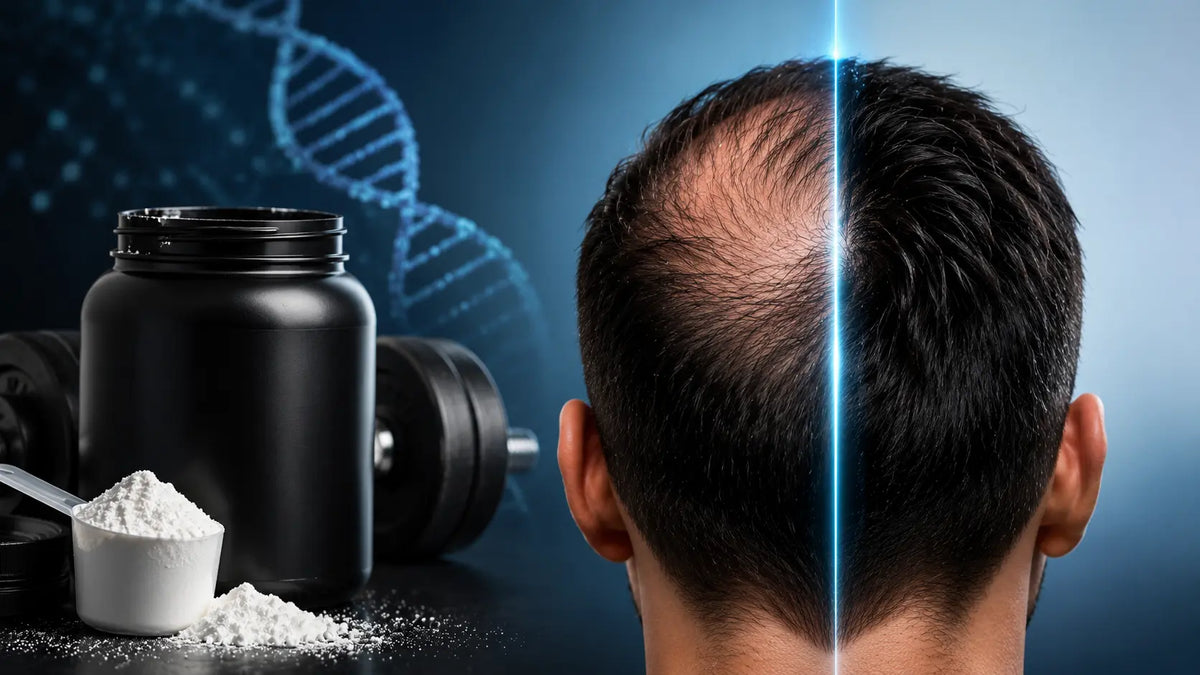

You scroll through a fitness forum. Someone swears creatine took their hairline. Another comment says their gym buddy went bald after one tub of powder. Sound familiar?
Don't throw out your creatine just yet. This whole scare traces back to one small study from 2009. The science since then tells a very different story. In this guide, you will learn where the creatine hair loss myth came from. You will also learn what the real research says about DHT. And you will learn whether you personally need to worry about it.
Let's dive in!
Creatine and Hair Loss Myth Explained
Why the Creatine Hair Loss Claim Went Viral
Creatine has one of the strongest safety records of any supplement on the market. Yet "creatine causes baldness" is still one of the most searched questions about it. The fear is loud. The evidence behind it is thin.
People remember scary headlines, not careful research. A single study showed a hormone bump. The internet ran with it. That's just how myths spread. They travel faster than facts ever do. Don't be surprised if you've heard this rumor from three different people who all swear it's true.
What Research Says About Creatine and Baldness
A 2021 review published in the Journal of the International Society of Sports Nutrition looked at every major creatine myth. This included the hair loss claim. A team of leading sports nutrition researchers combed through the data. They found that most of the evidence does not support a link between creatine and hair loss. That's the short version. Now let's look at where the fear actually came from.
The Study Behind the Creatine Hair Loss Debate
The 2009 Creatine and DHT Study Explained
Almost every hair loss claim about creatine traces back to one paper. College-aged rugby players took a high "loading" dose of creatine. That meant 25 grams a day for one week. Then they dropped to 5 grams a day for two more weeks. Researchers tracked their dihydrotestosterone, or DHT, the whole time.
DHT jumped 56 percent after the loading week. It stayed about 40 percent above baseline after three weeks total. That sounds alarming on paper. It's also the entire reason this myth exists today.
Did the Study Measure Hair Loss or Just DHT?
Here's the part most headlines leave out. This study never looked at hair. No follicle counts. No scalp photos. No thinning measurements. It only drew blood and measured hormones. Don't let that detail slip past you, because it changes everything about how seriously you should take the result.
The creatine group's DHT actually started 23 percent lower than the placebo group's DHT. That was true right at the very beginning. So part of that "spike" simply reflects catching up to normal. It wasn't rocketing past it. Every single number remained within normal clinical limits throughout.
How the Creatine Baldness Myth Spread Online
One small study. No hair data. A scary-sounding percentage. That's a perfect recipe for viral content. Bodybuilding forums picked it up. Fitness influencers repeated it. Within a few years, "creatine equals baldness" became gym folklore. Nobody mentioned that no other lab has ever managed to repeat that result.
Creatine, DHT, and Male Pattern Baldness
How DHT Contributes to Hair Loss
DHT is a byproduct your body makes naturally. An enzyme called 5-alpha reductase converts testosterone into it. Some people are genetically sensitive to DHT. In those people, DHT binds to receptors in scalp follicles. It shrinks those follicles slowly over time. That shrinking process is called miniaturization. It's the root cause behind male pattern baldness.
Can Creatine Increase DHT Levels?
The honest answer is "maybe, slightly, in some people, under specific conditions." Only one study has ever shown a real increase in DHT. It used an aggressive loading protocol most lifters skip anyway. Twelve other studies have measured testosterone and DHT after creatine use. None of them found a meaningful jump. So the entire case against creatine rests on one outlier result. Nobody else could reproduce it.
Why Genetics Matter More Than DHT Alone
DHT alone does not cause baldness. Your genes decide whether your follicles even react to it in the first place. Androgenetic alopecia is a polygenic condition with varying penetrance. Genes from both parents shape it. Sons whose fathers went bald carry five to six times the risk. That's compared to sons of fathers with a full head of hair. If your family tree is full of thick hair well into the 60s and 70s, a small hormone shift is unlikely to flip that switch.
What Current Research Says About Creatine and Hair Loss
No Direct Evidence Linking Creatine to Baldness
This is where the newest research really settles things. A 2025 randomized, double-blind, placebo-controlled trial studied healthy, resistance-trained men. Half took 5 grams of creatine daily. The other half took a placebo. The study ran for 12 full weeks. Researchers measured testosterone, DHT, and actual hair follicle health. They used trichogram testing and density scans, not just blood draws.
As a result, there was no difference between groups in DHT or testosterone after 12 weeks. There were no changes in any hair outcome either. This held whether researchers looked over time or compared groups directly. This is the first study to ever check real hair follicles. It didn't just guess from hormone numbers. And it found nothing to worry about.
Problems and Limitations in the Original Study
No replication. No hair measurements. A tiny sample of rugby players using an aggressive loading dose most people never actually take. Science depends on results holding up when other researchers repeat the same experiment. This one simply didn't hold up. That alone should lower your guard a little.
Expert Opinions on Creatine Hair Loss Risk
Sports nutrition researchers and dermatologists tend to land in the same place on this topic. Creatine isn't classified as an anabolic steroid. It doesn't reliably raise DHT in controlled studies. And it has never been tied to documented hair loss in a clinical trial. The fear around creatine simply outpaces the actual science by a wide margin. When in doubt, trust the people who actually measure follicles for a living over a comment thread you scrolled past at midnight.
Should You Stop Creatine Over Hair Loss Concerns?
Creatine Risk for People Without Baldness Genetics
If nobody in your family has a receding hairline, relax. There is no need to stress about a supplement that researchers have studied this closely for hair effects specifically, and still come up empty-handed. You can keep training, keep dosing, and keep moving forward. Thousands of people use creatine every single day, and the connection to hair loss has never held up under a microscope.
What People With Genetic Hair Loss Should Monitor
If your dad or grandfather went bald early, a little extra caution makes sense. That's simply because your follicles are already sensitive to DHT, with or without creatine in the picture. Watch for a widening part, more strands in the shower drain, or a hairline that's slowly creeping back. None of those changes are typical "creatine side effects," but they're still worth tracking either way. A simple photo on your phone every few months can help you spot real changes early, long before they become obvious in the mirror.
Tips to Minimize Any Potential Hair Loss Risk
1. Skipping the Loading Phase
Mistake: Jumping straight into 20 to 25 grams a day because you want fast results.
Solution: Start with a steady 3 to 5 grams daily instead. It saturates your muscles just as well over a few weeks, and it avoids the exact protocol used in that one outlier study.
2. Blaming Creatine for Unrelated Hair Changes
Mistake: Assuming any shedding you notice must be the supplement's fault.
Solution: Check your stress levels, sleep quality, iron intake, and protein intake first. These everyday factors influence hair far more often than creatine ever has.
Final Verdict on Creatine and Baldness
Creatine doesn't cause hair loss. The fear traces back to one small, unreplicated study from 2009 that never even measured hair, while the newest and most rigorous research checked actual hair follicles and found no difference at all.
If you have a strong family history of early balding, it's worth keeping an eye on your hairline, but for almost everyone else, this is one myth you can stop worrying about. Jacked Nutrition's Creatine Monohydrate is a clean, no-frills option if you're looking for a reliable daily dose without the gimmicks. Train hard, take your creatine, and leave the hair loss myth where it belongs.
FAQs: Creatine and Hair Loss
Does Creatine Directly Cause Hair Loss?
No controlled study has ever shown creatine directly causing hair loss. The fear comes from one small hormone study that never even measured hair.
Does Creatine Raise DHT Levels?
Only one study ever found a meaningful increase. It used an aggressive loading dose. Twelve other studies measuring testosterone and DHT found no significant change at all.
Should I Stop Taking Creatine If I Notice Hair Thinning?
Not automatically. Check your stress, diet, sleep, and family history first. If thinning continues anyway, talk to a dermatologist instead of guessing on your own.
Is Anyone Truly at Risk of Creatine-Related Hair Loss?
The closest thing to a risk group is people already prone to male pattern baldness. Even there, no direct link to creatine has ever been proven.
Can I Take Creatine and a DHT Blocker Together?
Many people do. DHT blockers target receptor sensitivity rather than creatine itself. Still, check with a doctor before combining any supplement with a medication that affects your hormones.
How Long Should I Take Creatine Before I See Results?
Most people notice strength and recovery improvements within three to four weeks of consistent daily use. Hair changes, if they ever happen at all, haven't shown up in any study within that same window.
Share:
Does Collagen Really Absorb? The Science Behind Collagen Supplements
Omega-3 Benefits: How Fish Oil Supports Your Heart, Brain, and Skin