

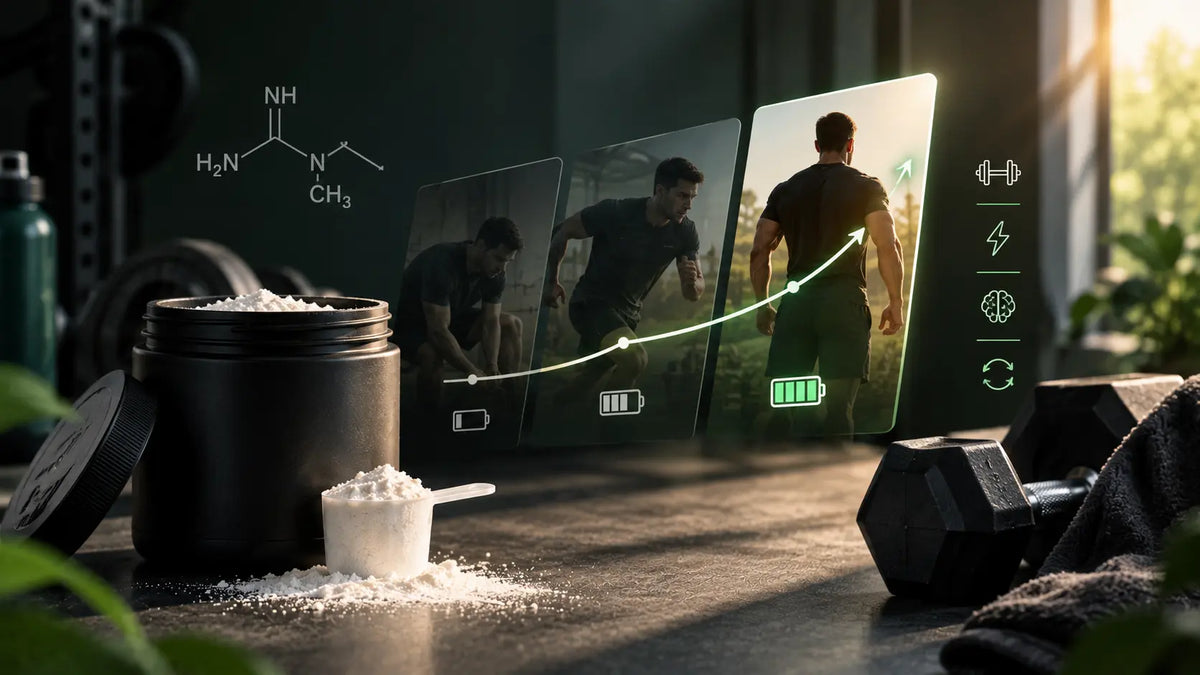

How fast does creatine work? Most people expect to wait weeks before noticing any changes. Traditionally, creatine loading has been used to raise muscle creatine levels faster, with results often assessed over several weeks. But a 2026 double-blind crossover trial in resistance-trained athletes found measurable changes after just three days of creatine monohydrate. So, what changed first, and what does this mean for your own creatine results timeline?
The short answer: days, not months
Full muscle saturation still takes time. That part of the old advice hasn't changed. But performance can shift well before your muscles are topped up.
A 2026 randomized crossover trial found that just three days of creatine monohydrate supplementation had the potential to boost strength performance, lower physiological stress, and speed up recovery in athletes. That's a much shorter window than most people expect.
Here's roughly how the timelines compare:
|
Approach |
Dose |
First noticeable change |
Full saturation |
|
Acute short-term (per 2026 trial) |
0.3 g per kg body weight, 3 days |
Within 3 days |
Not the goal of this protocol |
|
Classic loading phase |
20 g/day, split into 4 doses, 5 to 7 days |
5 to 7 days |
About 1 week |
|
Low and steady dosing |
3 to 5 g/day |
2 to 3 weeks |
3 to 4 weeks |
So, the question isn't really "does creatine work fast?" It's "how fast do you want it to work, and how much are you willing to dose upfront?"
What the 2026 crossover trial tested
Researchers recruited resistance-trained men and ran them through two testing sessions, one with creatine monohydrate and one with a placebo, in randomized order. Because it was a crossover design, ten participants with an average age of about 21 completed the full protocol after one dropout.
Each participant took either creatine monohydrate at 0.3 grams per kilogram of body weight per day, or a placebo, for three days. The first dose came two hours before testing, and later doses were split across the day. A seven-day washout separated the two conditions, so the same lifters served as their own control group.
Each test session included bench press and back squat performed at 60%, 70%, and 80% of one-rep max, along with heart rate variability tracking, jump tests, and muscle soreness ratings. That's a fairly thorough setup for something billed as a "short-term" study.
Why a crossover design is stronger evidence
In a normal study, one group gets creatine, and another gets a placebo. Individual differences between people can muddy the results. A crossover design skips that problem. Every lifter goes through both conditions, so their own baseline becomes the comparison point. That makes small, early effects easier to detect.
The participants were already resistance trained; why that matters
Most creatine research pulls from untrained or recreational participants, who tend to improve from almost any new intervention. Trained lifters have already wrung out a lot of that easy progress. So when a trained group shows a jump in three days, that result carries more weight for anyone reading this who already lifts seriously.
What improved, and how quickly
Strength
Bench press and squat performance across the sets improved during the creatine condition, even within the three-day window. This lines up with what a lot of lifters chase when they ask about short-term creatine benefits before a meet or a big training block.
Perceived fatigue
Heart rate variability, a marker of how much stress the body is under, responded better under creatine. In plain terms, the nervous system seemed less taxed by the same training load.
Recovery between sessions
Lower limb strength held up better after squats, and soreness ratings were lower in the creatine condition. That's the piece most relevant to creatine for recovery, since it points to less carryover fatigue into the next session.
Loading vs. maintenance dosing
The classic loading protocol
Take about 20 grams a day, split into four smaller doses, for five to seven days. Then drop to a 3-to-5-gram maintenance dose. This saturates muscle creatine stores fast and is the version most gym veterans grew up on.
The low and steady alternative
Skip the loading phase and just take 3 to 5 grams daily from day one. You'll reach the same saturation point as the loading protocol; it just takes three to four weeks instead of one. Nothing about the result changes, only the speed.
Which one suits your goal
If you have a competition or a specific training block coming up soon, loading gets you there faster. If you're not in a rush, or you'd rather avoid the mild bloating some people feel during loading, the steady approach works just as well over time. If you're new to creatine and want dosing guidance tailored to your situation, our creatine supplements guide for women covers both options in more detail.
Why creatine works: the phosphocreatine system in plain language
Your muscles run on ATP for quick bursts of effort, like a heavy squat or a sprint. ATP runs out fast during intense work. Creatine gets stored in muscle as phosphocreatine, and it acts like a backup battery that helps regenerate ATP on the spot. More phosphocreatine on hand means your muscles can keep firing at a high output for a bit longer before fatigue sets in.
Water weight vs. real gains: reading the scale correctly
Most people notice the scale move within the first week of taking creatine. That's usually water, not fat and not new muscle yet. Creatine pulls extra water into muscle cells, which is actually a good thing for performance and recovery, but it can throw off anyone judging progress by bodyweight alone.
There's also a popular myth going around gyms here that undissolved creatine in your water bottle means the product is fake. It doesn't. We covered this in detail in our piece on the creatine water test myth, which explains why a bit of grit at the bottom of your glass is completely normal for real monohydrate.
Monohydrate vs. "advanced" creatine forms
Plenty of newer creatine forms show up on shelves promising better absorption or less bloating. But creatine monohydrate is still the most researched form out there, and nothing else has consistently beaten it in head-to-head trials. If you're shopping for a simple, well-tested option, our Micronized Creatine Monohydrate is formulated on that same standard, with DRAP registration and third-party testing behind it.
A practical protocol
Daily dose and timing
Stick with 3 to 5 grams a day if you're not in a rush, or run a short loading phase if you want faster results. Timing around your workout isn't critical, but taking it close to training is a simple habit to build around.
Taking it with carbs or protein
Creatine uptake into muscle may get a small boost when taken alongside carbs or protein, likely due to the insulin response. A post-workout shake or a meal is a convenient way to pair it, though it's not a strict requirement.
Hydration, especially in hot weather
Creatine pulls water into your cells, so your overall fluid needs go up a bit. That matters even more if you're training through a Lahore or Karachi summer. Aim to drink water steadily through the day, not just around your workout, and don't skip water on rest days either.
Frequently asked questions
Do I need to load creatine?
No. Loading just gets you to full saturation faster. A steady 3-to-5-gram daily dose gets you to the same place within three to four weeks.
Can I take creatine on rest days?
Yes. Creatine works by building up your muscle stores over time, so daily consistency matters more than timing it only on training days.
Do I need to cycle off creatine?
Not based on current evidence. Long-term daily use has been studied extensively without signs that cycling improves results or safety.
Is creatine safe for kidneys?
This is the question that stops a lot of people from trying it, so it's worth answering directly. Large-scale, controlled studies have not found evidence that creatine monohydrate supplementation harms kidney function in healthy individuals.
The bottom line
Creatine doesn't need months to start doing something. The 2026 crossover trial showed strength, fatigue, and recovery markers moving in just three days, well before muscles are fully saturated. Full saturation still takes a week with loading or a few weeks without it, but you don't have to wait that long to feel a difference. Pick the dosing approach that fits your schedule, stay consistent, drink enough water, and give it a fair trial before judging the results.
Share:
How Electrolytes Support Hydration and Performance During Intense Workouts
Ashwagandha for Strength: What the 2026 Meta-Analysis Says