

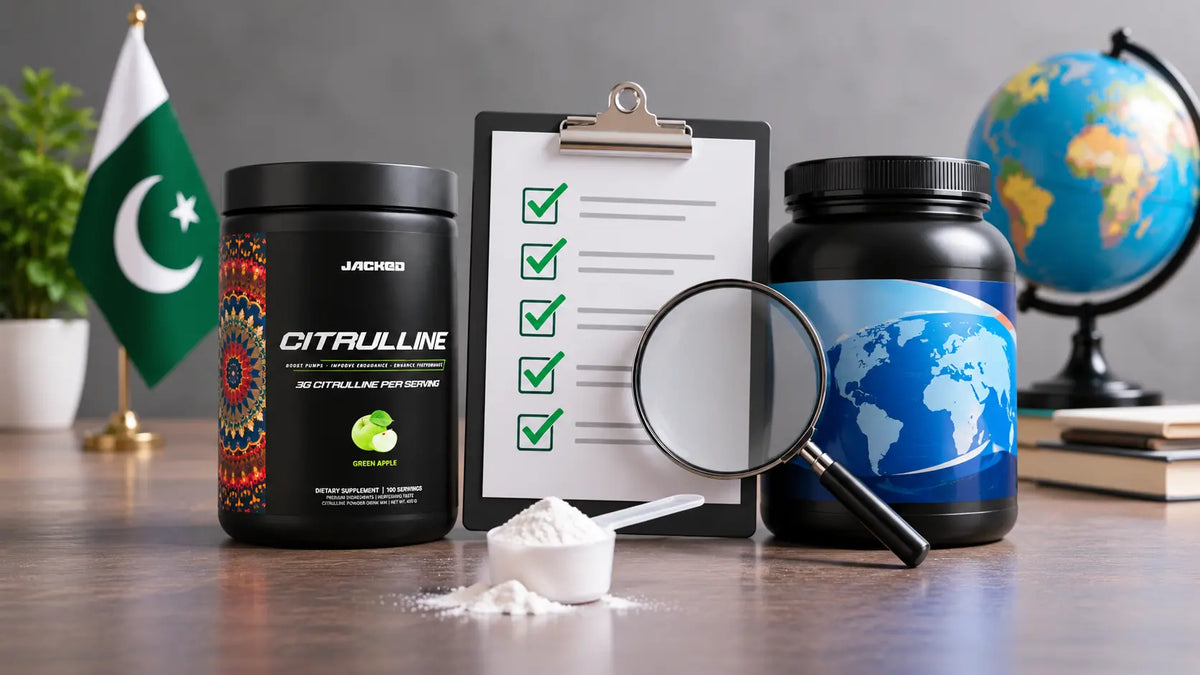

In Pakistan, citrulline is supplied both as imported and locally manufactured. Many people consider the imported one the standard of quality. But there are so many factors that you should consider before deciding.
In this guide, you will learn what origin means, which formula details matter, what proof to ask for, and how to apply one checklist to both options.
Let's dive in!
Ingredient Origin and Manufacturing Location
The word "origin" hides three different things. Mixing them up is the most common mistake buyers make.
-
Raw-material source: where the citrulline powder was first made.
-
Manufacturing location: where a factory blended, filled, and sealed the powder into your tub.
-
Brand ownership: who owns the name on the front and sells the product.
These three can come from three different places. A brand can belong to one country, fill its tubs in another, and buy its raw material from a third. So a foreign name doesn't tell you which factory filled a tub, and a Pakistani name doesn't tell you where the raw material came from.
Ask about each one separately. Start with the label and look for a "manufactured at" line with a factory name. If you only see "distributed by" or "marketed by," message the seller and ask which factory fills the tub.
It also helps to know how the paperwork is done. DRAP registration splits local manufacture and finished-product imports into two routes, and each route asks for different documents. Jacked's guide on what DRAP approval means for supplement manufacturing in Pakistan adds that a registration form alone doesn't confirm a factory's standards.
Compare the Formula Before the Country
Now look at what's inside the tub. Two tubs from the same country can hold very different formulas, so check four things:
-
Origin: Malate pairs citrulline with malic acid. So the scoop weight and the citrulline weight are not the same number.
-
Active content: Read the grams of citrulline per serving, not the size of the scoop. A 5 g scoop can hold less than 5 g of citrulline.
-
Grade: Some labels name a standard, such as USP. A named grade is a claim, so ask the seller how they back it up.
-
Other ingredients: Look at sweeteners, acids, flavours, salt and colours. Skip anything you avoid.
Why bother with the grams? Because the range is wide. A 2025 review of 21 trials described daily citrulline doses from 0.5 g to 10 g. That spread is exactly why you read the number on your label and ignore the flag on the front.
Don't worry if the label looks confusing. Jacked's guide on how to read supplement labels like a pro walks you through the Supplement Facts panel step by step.
Compare the Available Quality Evidence
Most buyers go easy on one side and hard on the other. Don't do that. Hold local and imported products to the same standard, and ask for the same five things on every tub.
A Registration or Enlistment Number
Look for a registration or enlistment number on the pack. Jacked's DRAP guide explains that Form 6 covers imported products and Form 7 covers locally made ones. It also says you can check the number on DRAP's official portal, where the product name, maker, and strength should match the listing.
A Batch Number and Expiry Date
Find the batch number and the expiry date printed on the tub. The batch number links your tub to one production run, so it is the key to every other check on this list. If the print is missing, smudged, or looks stuck on, treat that as a warning sign. Ask the seller before you buy. The same rule applies to a local tub and an imported one.
A Batch-Level Certificate of Analysis (CoA)
A CoA is a lab report for a specific batch. Ask for the one that matches the batch number on your tub, not a generic file for the whole brand. Check that the report names the lab and the batch, and that it lists what the lab tested. If a brand offers a QR code or a batch lookup on its website, scan it and match the numbers to your pack.
The Manufacturer's Name and Licence Number
Registration and manufacturing are two different records. Jacked's DRAP guide describes a manufacturing licence as a separate number from the product registration number, and says it appears on labels less often. So look for the factory name and a licence number. If the label lists only a brand or a distributor, ask the seller which factory made the tub.
A Clear Seller
Buy from the brand's official website or an authorised retailer. Jacked's verification guide warns buyers to avoid unauthorised online marketplaces and social media vendors, and to be careful with prices that look too good to be true. A clear seller also gives you someone to ask when a document doesn't match. That matters for imported tubs, where the trail from factory to shelf is longer.
Then apply one rule. A document you can't match to the tub in your hand proves nothing, and an imported tub with no batch number is no better than a local tub with none.
Understand What Can Influence the Price
Price tells part of the story, never the whole story. We can't see inside any brand's costs, so treat the points below as possible factors, not a breakdown.
Freight and Shipping
Moving goods across borders costs money, and so does moving them across Pakistan. Imported tubs may carry both costs, while local tubs mostly carry the second one. The size of that gap depends on the brand and the shipment.
Duties and Taxes
A March 2026 Karachi customs notice shows that customs officers file imported food supplements under a tariff heading. That heading can change which duty and tax rules apply. The notice covered the products it reviewed, so it doesn't set the price for any brand.
Exchange Rates
Imported goods are usually priced in foreign currency, so changes in the exchange rate can affect their cost in rupees. Locally made products can also be affected when a brand buys materials or packaging from abroad. Check the current price at the time of purchase instead of relying on an older quote.
Distribution and Retail Margins
Warehouses, couriers, and retailer margins add cost to every tub, local or imported. The same tub can cost different amounts on the brand's site and on a third-party shelf.
Local Costs Count Too
Local products carry their own costs, such as raw material, packaging, labour, and marketing. So a local tub isn't cheaper by default. Compare price per serving only after you confirm the grams of citrulline per serving match. That one check keeps you from comparing two different amounts.
Check Availability and Seller Support
A good tub is of no help if you can't get it or can't reach anyone. Check these before you pay:
-
Stock: Is it in stock today, with a clear delivery time?
-
Fulfilment: Who ships it, and from where?
-
Contactability: Can you reach a real person by phone or WhatsApp? Test it with one question.
-
Returns: Is the return or exchange policy written down?
Use the Same Checklist for Both Options
Here's the checklist in one place. Use it for every tub, from every country.
-
Find the raw-material source, the manufacturing location, and the brand owner.
-
Confirm the form, the grams per serving, the grade, and the other ingredients.
-
Check the registration number, batch number, CoA, and manufacturer details.
-
Remember freight, duties, exchange rates, and distribution.
-
Check stock, delivery, replies, and returns.
-
Save the replies so you can compare brands side by side.
Origin tells you where a tub came from. It doesn't tell you how well it was made. So run both tubs through the same list and let the answers decide.
Review Jacked Citrulline Manufacturing Details
Let's put the checklist to work on one real product. Here's what the product page for Jacked Citrulline Green Apple Powder states today:
-
Form and amount: L-Citrulline (USP), 3 g per 4 g scoop.
-
Pack: A 400 g tub with 100 single-scoop servings.
-
Other ingredients: Sodium as sodium chloride (98 mg per serving), sucralose, citric acid, xanthan gum, flavour, and apple green colour.
-
Manufacturer: The page prints the number 01542, and Jacked's own DRAP guide describes 01542 as the DRAP manufacturing licence number of Farma Labs.
-
Status: The page lists the product as DRAP-enlisted and describes manufacture under GMP-certified conditions.
These are the brand's own statements, so treat them as claims you can check against the label on your tub. So what's holding you back? Open the page, run the checklist, and see how it scores.
Conclusion
Origin is one detail on a citrulline label, not a measure of quality. A fair comparison looks at where the raw material, the factory, and the brand each sit, then checks the formula, the documents, the price factors, and the seller. Apply the same checklist to local and imported products, and let the evidence on the tub decide. If you want to test the checklist on a locally made option, start with Jacked Citrulline.
Frequently Asked Questions
Does a foreign brand name establish where a product was manufactured?
No. A brand name tells you who sells the product, not where a factory filled it. Look for the manufacturer's name and address on the label. If you can't find them, ask the seller. Many brands outsource production, so the name and the factory can sit in different countries.
Can a locally made product use imported ingredients?
Yes. "Locally made" describes where a factory blends and packs the product. The raw material can come from somewhere else. That's why you ask about manufacturing location and ingredient source as two separate questions.
Does local manufacture automatically mean a product is cheaper?
No. Local products carry their own costs, such as raw materials, packaging, labour, and distribution. The price depends on the brand and the seller, not on the flag alone. Check the grams per serving and the documents first, then look at the price.
Share:
Does L-Theanine Help With Sleep and Anxiety?
What Is L-Theanine? Benefits, Dosage, and Side Effects