

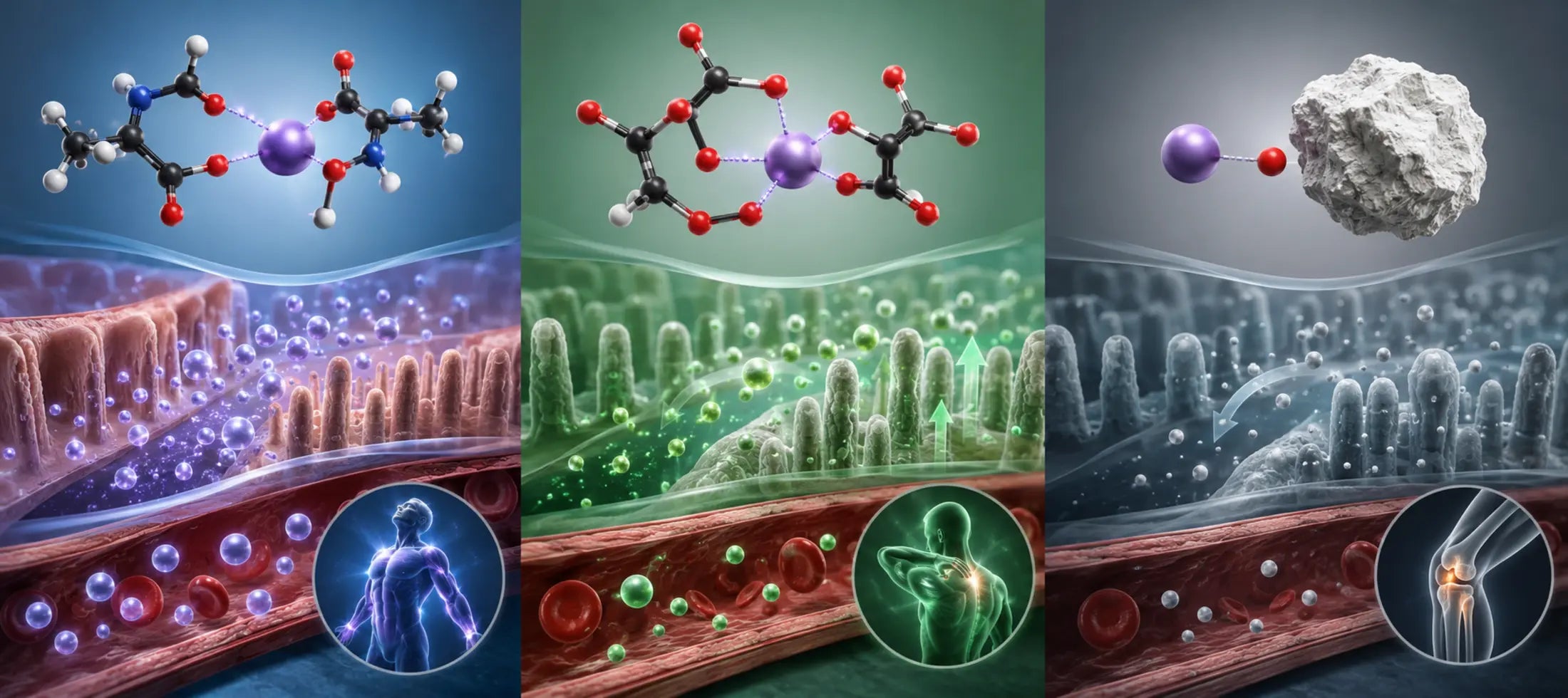

You walk into a supplement store in Pakistan. You ask for magnesium. The shopkeeper hands you a bottle. You look at the label. It says 500 mg Magnesium. You think that is a solid dose. But here is what most people miss. The number on the label does not tell you how much magnesium your body will absorb.
That depends on the form.
Not all magnesium forms work the same way. Magnesium bisglycinate, magnesium citrate, and magnesium oxide behave very differently in the body. Choosing the wrong form means paying for magnesium that never reaches your blood.
This guide breaks down how each form works. You will learn which one absorbs best. You will learn which one upsets your stomach. You will also learn which one gives you the most value per rupee.
Let us start with the most important concept in supplements: bioavailability.
Why Magnesium Form Matters More Than Magnesium Dose
Most people focus on the dose. They want 400 mg. They want 500 mg. But the percentage that actually enters your blood varies a lot between forms. A supplement with 500 mg of magnesium oxide may deliver far less than one with 200 mg of magnesium bisglycinate. The dose on the label is just the starting point. It is not the finish line.
Elemental Magnesium vs Salt Weight: The Number on the Label Is Not What You Absorb
Every magnesium supplement is a compound. Magnesium is always bound to something else. It binds to glycine, citric acid, or oxygen. That combined weight is what you see on the label. But your body only uses the elemental magnesium. That is the actual Mg2+ ion. Your body does not use the carrier molecule.
Here is how the numbers break down by form.
Magnesium oxide contains 60.3% elemental magnesium by weight. On paper, that looks like a lot. But almost none of it absorbs into your body.
Magnesium citrate contains 16.2% elemental magnesium by weight. It is a solid mid-range option.
Magnesium bisglycinate contains 14.1% elemental magnesium by weight. It has the lowest elemental content of the three. But it has the highest actual absorption. So, 700 mg of magnesium bisglycinate delivers roughly 100 mg of elemental magnesium your body can actually use.
This is why comparing supplements by label milligrams alone is misleading.
The 3 Absorption Pathways: Why Different Forms Enter the Body Differently
Magnesium enters the body through three main pathways. Understanding these pathways helps you see why some forms absorb far better than others.
Active transport works through TRPM6 and TRPM7 channels in the small intestine. Think of these as dedicated magnesium doors that pull magnesium into your body. This pathway becomes saturated at higher doses.
Passive diffusion works through concentration gradients. When magnesium levels are high in the gut, some of it crosses the intestinal wall on its own. Most inorganic salts, such as magnesium oxide, rely mainly on this slow and inefficient pathway.
Chelate-specific transport via PepT1 is the exclusive advantage of magnesium bisglycinate. PepT1 stands for Peptide Transporter 1. The intact chelate structure is absorbed directly through this peptide transporter. Neither citrate nor oxide can use this pathway at all.
That third pathway is why bisglycinate stands apart from all other forms.
Magnesium Bisglycinate: The Superior Form and Why It Wins
Magnesium bisglycinate is magnesium bound to two molecules of glycine. Glycine is an amino acid. That bond is called an amino acid chelate. The chelation creates a stable ring structure around the magnesium ion. This protects it as it travels through your digestive system. It also unlocks a faster and more complete absorption route.
The Chelate Advantage: How the Glycine Bond Unlocks a Private Absorption Pathway
When you swallow a magnesium bisglycinate capsule, the chelate ring stays intact in the stomach. Gastric acid does not break it apart. That is the first advantage. Most magnesium forms break apart in gastric acid. They then compete with food and other minerals for absorption. Magnesium bisglycinate stays whole throughout this process.
Once the intact chelate reaches the small intestine, PepT1 recognises the structure. It actively transports it across the intestinal wall. This is an energy-driven and highly efficient process. The magnesium arrives in the bloodstream intact and complete.
The result is bioavailability of about 80%. That means 80 out of every 100 mg of elemental magnesium you consume actually reaches your blood. Compare that to the other forms, and the difference is striking. (Schuette et al., 1994; Hartle et al., 2016)
GI Tolerance: Why Bisglycinate Never Causes the Diarrhoea That Oxide Does
Many people avoid magnesium supplements because they cause diarrhoea. That problem comes from unabsorbed magnesium reaching the colon. When magnesium sits in the large intestine, it draws water inward. The result is loose stools or diarrhoea.
Magnesium bisglycinate absorbs almost completely in the small intestine. Almost nothing reaches the colon. There is no osmotic laxative effect. There is no bloating. There is no rushing to the toilet. People with sensitive stomachs, IBS, or digestive issues tolerate bisglycinate very well.
This is a major practical advantage for daily and long-term use.
The Glycine Bonus: Sleep, Collagen, and Anti-Inflammatory Benefits Beyond Magnesium
Here is something most magnesium articles miss. The glycine in magnesium bisglycinate is not just a carrier molecule. Glycine is a functional inhibitory neurotransmitter in the central nervous system. Once absorbed, glycine reduces core body temperature. It also promotes sleep onset on its own, independently of magnesium.
Research showed that glycine supplementation improved sleep latency. It also reduced daytime fatigue. (Bannai and Kawai, 2012)
Beyond sleep, glycine supports collagen synthesis. That means better skin, joints, and connective tissue. Glycine also reduces inflammation, which can help the body recover from exercise and daily stress.
So when you take magnesium bisglycinate, you get two active compounds working together. Elemental magnesium supports enzymatic function, energy production, and nervous system regulation. Glycine supports sleep, tissue repair, and a calm mental state.
Best Use Cases: Sleep, Anxiety, Stress, Athletic Recovery, and Sensitive Stomachs
Magnesium bisglycinate is the best choice for sleep improvement. Magnesium blocks NMDA receptors. Glycine acts as an inhibitory neurotransmitter. Together they make bisglycinate the most effective form for nighttime use.
Bisglycinate helps with anxiety and stress by supporting the nervous system. It does this through magnesium, which acts as a glutamate antagonist at the NMDA receptor. This reduces neurological overexcitation. Neurological overexcitation is a key driver of anxiety and stress responses.
For gym athletes and anyone focused on muscle recovery, bisglycinate absorbs fast and effectively. It replenishes magnesium lost through sweat. It also supports ATP synthesis for energy production during and after training.
For anyone with a sensitive stomach, bisglycinate is the clear winner. There is zero osmotic laxative activity at standard doses.
Magnesium Citrate: A Solid Mid-Tier Option With One Major Caveat
Magnesium citrate is magnesium bound to citric acid. The result is an organic salt that dissolves well in water. It is widely available, affordable, and reasonably well absorbed. It sits clearly above magnesium oxide in effectiveness. But it sits below magnesium bisglycinate. For many purposes, that middle position makes it a good value option.
How Citrate Absorbs: Better Than Oxide, But the Osmotic Effect Limits Its Use
Magnesium citrate works through ionic dissociation. When it reaches the stomach and small intestine, it breaks apart into Mg2+ ions and citrate ions. These free magnesium ions then cross the intestinal wall. They do this through passive diffusion and some active transport.
The bioavailability of magnesium citrate is between 30% and 40%. That is roughly three to four times better than oxide. But it is still well below bisglycinate. A landmark randomised controlled trial by Walker et al. in 2003 confirmed that citrate significantly outperforms oxide. The study used urinary magnesium excretion as a reliable proxy for absorption. (Walker et al., 2003, Journal of the American College of Nutrition)
The limitation of magnesium citrate is its osmotic effect. At higher doses, the unabsorbed fraction reaches the colon. It then draws water inward. This typically happens above 300 to 400 mg of elemental magnesium. This causes the laxative effect that citrate is known for. At moderate doses, most people tolerate it fine. At high doses, expect loose stools.
When Citrate Is the Right Choice: Constipation, Kidney Stones, and Budget Repletion
Magnesium citrate is an excellent choice for people dealing with constipation. The gentle osmotic action at therapeutic doses stimulates bowel movement effectively and safely.
Citrate also has a unique benefit for urological health. Citrate ions bind to oxalate in urine. This prevents the formation of kidney stones. People with a history of calcium oxalate stones can benefit from magnesium citrate. It helps more than just replacing magnesium.
For general magnesium repletion on a budget, citrate is a solid choice. It absorbs meaningfully. It costs less than bisglycinate. It is also easy to find in Pakistan. If digestive concerns or sleep are not the priority, citrate gets the job done for basic magnesium deficiency correction.
Magnesium Oxide: High Label Numbers, Extremely Low Absorption, The Worst Choice for Most
Magnesium oxide is magnesium bonded to oxygen. It is an inorganic salt. It is cheap to manufacture. It packs a lot of elemental magnesium by weight at 60.3%. This is why budget supplement brands use it. The label number looks impressive. The reality is very different.
Why Oxide's 60% Elemental Content Is Almost Entirely Misleading
Magnesium oxide has very low aqueous solubility. In simple terms, it does not dissolve well in water or stomach acid. Poor solubility means poor ionic dissociation. Without dissociation, magnesium ions cannot cross the intestinal wall.
The Walker et al. 2003 trial measured urinary magnesium excretion as a proxy for absorption. Oxide performed dramatically worse than citrate. Broader studies on pharmacokinetics show magnesium oxide's bioavailability is about 4%. This means only a small amount is absorbed.
That means if a label says 500 mg of magnesium oxide, your body likely absorbs around 20 mg of usable elemental magnesium. You are paying for 480 mg that passes straight through your body. (Walker et al., 2003)
Yet magnesium oxide dominates the cheap supplement market in Pakistan and globally. The reason is pure economics. Oxide is a fraction of the cost to manufacture compared to bisglycinate or citrate. A brand can put 500 mg on the label at a very low cost. The consumer sees a big number and assumes great value. That assumption costs them in results.
Spotting Oxide in Cheap Pakistani Supplements: What to Look for on the Label
Reading a supplement label in Pakistan takes some practice. Here is what to check.
Look for the word Oxide next to magnesium on the ingredient list. It may also say Magnesium Oxide or list it as the only form. If no form is listed and the elemental magnesium per serving seems very high relative to the total capsule weight, that is usually oxide.
Check the elemental magnesium figure. If a 250 mg capsule claims 150 mg of elemental magnesium, that is a 60% elemental ratio. That is classic oxide math. For bisglycinate, the ratio should be around 14%. For citrate, around 16%.
Ask if the product has a Certificate of Analysis from a third-party lab. DRAP-approved supplements from manufacturers like FarmaLabs include this documentation. Budget products often do not have it.
Bisglycinate vs Citrate vs Oxide: The Complete Head-to-Head Comparison
Here is the full comparison across all the factors that matter.
|
Feature |
Bisglycinate |
Citrate |
Oxide |
|
Bioavailability |
~80% |
~30-40% |
~4% |
|
GI Tolerance |
Excellent |
Moderate |
Poor |
|
Elemental Mg |
14.1% |
16.2% |
60.3% |
|
Best For |
Sleep, anxiety, gym, sensitive stomach |
Constipation, bowel repletion, and kidney stones |
Antacid, constipation only |
|
Laxative Risk |
None |
Moderate at high dose |
High |
|
Value (per absorbed mg) |
Best |
Good |
Poor |
Bioavailability: Bisglycinate ~80% vs Citrate ~30-40% vs Oxide ~4%
Bioavailability is the single most important number. It tells you how much magnesium you actually get from what you swallow. Based on available clinical and pharmacokinetic data, the three forms perform very differently.
Magnesium bisglycinate has approximately 80% fractional absorption through the PepT1 chelate pathway. This is the highest of any common form available. (Hartle et al., 2016)
Magnesium citrate absorbs about 30 to 40% through ionic dissociation and passive diffusion. The Walker et al. 2003 randomised controlled trial confirmed it is superior to oxide.
Magnesium oxide has approximately 4% absorption. This is extremely low. It is due to poor aqueous solubility and limited ionisation in GI fluids. (Walker et al., 2003)
GI Tolerance: Bisglycinate Wins, Oxide Loses Why Your Stomach Thanks You
The osmotic laxative effect is a practical concern for daily supplement users. Unabsorbed magnesium in the colon draws water inward. This causes loose stools or diarrhoea.
Magnesium bisglycinate absorbs almost completely before reaching the colon. GI tolerance is excellent even at doses above the RDA. There is no laxative effect for most people.
Magnesium citrate causes moderate GI effects at higher doses. For general supplementation, moderate doses are well tolerated. For constipation treatment, the osmotic effect is actually the desired outcome.
Magnesium oxide causes significant GI distress. Because so little is absorbed, a large proportion reaches the colon. Diarrhoea is common, especially at doses marketed for general health.
Cost Per Absorbed Milligram: Why Bisglycinate Is Often a Better Value Than It Looks
Oxide looks cheap. Bisglycinate looks expensive. But the cost per absorbed milligram tells a completely different story.
Take a simple example. A bottle of magnesium oxide provides 500 mg per serving. At 4% bioavailability, you absorb 20 mg. If the bottle costs Rs 800, you are paying Rs 40 per absorbed milligram.
A magnesium bisglycinate product offers 100 mg of elemental magnesium per serving. With 80% bioavailability, you absorb 80 mg. If the bottle costs Rs 2,000 for 60 servings, you are paying Rs 0.42 per absorbed milligram.
The maths consistently favours bisglycinate. This is why premium forms offer genuine value and not just premium pricing.
The Goal-Based Decision Matrix: Which Form to Choose and Why
Choose magnesium bisglycinate. It helps with sleep, anxiety, and stress. It also boosts gym performance and muscle recovery. Use it if you have a sensitive stomach. It is also the best default choice for daily and long-term supplementation.
Choose magnesium citrate for constipation relief. It can also help prevent kidney stones. Use it if you’re on a budget and don’t have digestive issues.
Choose magnesium oxide only for short-term antacid use, such as heartburn or acute constipation treatment. Do not use it as a daily magnesium supplement if actual magnesium deficiency correction is the goal.
Clinical Evidence: What the Research Proves About Magnesium Forms
Good supplement decisions come from evidence. Here are the key studies that support the claims in this article.
Walker 2003: The Key Bioavailability Trial That Ranks the Forms
Walker et al. (2003) conducted a randomised controlled trial published in the Journal of the American College of Nutrition. The study measured urinary magnesium excretion as a proxy for fractional absorption.
The results confirmed that magnesium citrate was significantly better absorbed than magnesium oxide. Urinary excretion was substantially higher for citrate at the same doses. This study is one of the most cited in magnesium bioavailability research. It remains the foundation for the citrate vs oxide comparison.
Chelate forms, including magnesium bisglycinate, were not the primary comparison in Walker 2003. Separate pharmacokinetic data show that AUC analysis puts chelated forms above citrate. This is true for fractional absorption. (Schuette et al., 1994; Hartle et al., 2016)
Abbasi 2012: How Magnesium Supplementation Improved Sleep in Clinical Trials
Abbasi et al. (2012) published a double blind randomised controlled trial in the Journal of Research in Medical Sciences. The study tested magnesium supplementation in elderly participants with insomnia.
Participants who received magnesium showed significant improvements on the Insomnia Severity Index. They also had reduced sleep latency, which means they fell asleep faster. Sleep efficiency improved, and early morning cortisol levels fell. Serum magnesium and melatonin levels also increased.
This study supports the use of magnesium supplementation specifically for sleep improvement. It validates the biological mechanism behind the effect. Magnesium regulates NMDA receptors and promotes neurological calm. When combined with glycine from magnesium bisglycinate, these effects are reinforced further. (Abbasi et al., 2012)
Practical Guide: Dosage, Timing, Stacking, and Safety in Pakistan
Knowing the best form is step one. Taking it correctly is step two.
Best Time to Take Magnesium Bisglycinate: Night Wins for Most Goals
The RDA for magnesium is 310 to 420 mg of elemental magnesium per day for adults. The upper tolerable limit for supplemental magnesium is 350 mg. Above this level, laxative risk increases for most forms.
Magnesium bisglycinate is generally tolerated above this limit due to its complete absorption. But staying within 300 to 400 mg of elemental magnesium daily is a sensible starting point.
The best time to take magnesium bisglycinate is 30 to 60 minutes before bed. Glycine lowers core body temperature. Elemental magnesium activates GABA and reduces NMDA receptor activity. Both of these effects promote sleep onset and improve sleep quality.
For gym athletes, a split dose works well. Take one serving before the workout to support ATP synthesis and muscle function. Take one serving at night for recovery and DOMS reduction. DOMS stands for delayed onset muscle soreness.
The Sleep Stack: Combining Magnesium Bisglycinate with Ashwagandha at Night
In Pakistan, a good nighttime supplement stack has two main parts. It includes magnesium bisglycinate and ashwagandha. This combo works well together. Here is why the combination works so well.
Ashwagandha using KSM-66 or Sensoril extract reduces cortisol. Cortisol is the stress hormone that interferes with sleep. Magnesium bisglycinate activates GABA pathways and blocks NMDA receptor overexcitation. Glycine from bisglycinate lowers body temperature and promotes sleep onset.
The three mechanisms complement each other without competing. Cortisol comes down. Neurological excitation calms. Body temperature drops. Sleep follows naturally.
Jacked Nutrition offers both magnesium bisglycinate and ashwagandha as separate products. This makes it easy to build this stack from quality-verified sources in Pakistan.
Ramadan Timing and Diabetic Considerations: Pakistan-Specific Guidance
For Pakistani Muslims observing Ramadan, timing magnesium correctly makes a real difference. Taking magnesium bisglycinate with Sehri, the pre-dawn meal, boosts energy. It also supports muscle function during fasting. Taking an additional dose at Iftar helps replenish magnesium lost throughout the day. It also supports evening recovery.
Magnesium is important for Pakistanis with type 2 diabetes or insulin sensitivity issues. A review and meta-analysis in Diabetes Care found that magnesium supplements can help. They improve insulin sensitivity and lower HbA1c levels. This is especially true for patients with low magnesium. (Veronese et al., 2016) Pakistan has one of the highest diabetes prevalence rates globally. This makes it a highly relevant clinical consideration.
Pakistan's typical diet is heavy in rice, wheat bread, and processed foods. These foods are low in magnesium-rich nutrients. Soil depletion and cooking loss reduce dietary magnesium intake even further. Magnesium deficiency in Pakistan is likely underdiagnosed and underreported. Using a highly absorbable form, like magnesium bisglycinate, effectively fills this gap.
Jacked Nutrition Magnesium Bisglycinate: Pharmaceutical-Grade, DRAP-Approved, Pakistan
Jacked Nutrition is Pakistan's premium sports and health nutrition brand. The Jacked Nutrition Magnesium Bisglycinate supplement uses genuine amino acid chelated magnesium bisglycinate. It does not use a cheaper oxide or any undisclosed blend. Each HPMC capsule delivers a measured dose of elemental magnesium in the fully chelated bisglycinate form.
The product uses HPMC capsules. HPMC stands for hydroxypropyl methylcellulose. These are plant-based and halal certified. There is no gelatin. There are no pork-derived ingredients. The product is suitable for all dietary preferences.
FarmaLabs: The GMP Manufacturing Standard Behind Every Magnesium Capsule
Jacked Nutrition products are manufactured at FarmaLabs. FarmaLabs is a DRAP-licensed pharmaceutical manufacturing facility. DRAP stands for the Drug Regulatory Authority of Pakistan. The license number is 01542.
FarmaLabs operates under GMP standards. GMP stands for Good Manufacturing Practice. Each batch includes a Certificate of Analysis confirming identity, potency, and purity. This level of quality verification is standard in pharmaceutical manufacturing. But it is rare in the Pakistani supplement industry.
When you buy Jacked Nutrition Magnesium Bisglycinate, you are not guessing about the form or the dose. You are getting a verified and lab-confirmed product from a regulated facility.
Available online across Pakistan with cash on delivery. Order at jackednutrition.pk.
Frequently Asked Questions: Magnesium Bisglycinate, Citrate, and Oxide
Is magnesium glycinate the same as magnesium bisglycinate?
Yes. Magnesium glycinate and magnesium bisglycinate are the same compound. Both names refer to magnesium chelated with two glycine molecules. The word bis means two. It indicates two glycine ligands are attached. Some manufacturers use the shorter name glycinate for marketing purposes. The chemistry, the absorption mechanism, and the benefits are identical.
Why does magnesium oxide cause diarrhoea but bisglycinate does not?
The answer lies in where absorption happens. Magnesium oxide absorbs poorly. Only about 4% reaches the bloodstream. The remaining 96% travels to the colon. Once in the colon, unabsorbed magnesium draws water inward through the osmotic effect. This extra water triggers bowel movement and causes diarrhoea.
Magnesium bisglycinate absorbs almost completely in the small intestine via the PepT1 transporter. Almost nothing reaches the colon. There is no osmotic effect. There is no diarrhoea.
How much elemental magnesium is in a bisglycinate capsule?
Magnesium bisglycinate contains 14.1% elemental magnesium by weight. So a 700 mg capsule of magnesium bisglycinate salt delivers approximately 100 mg of elemental magnesium. Always check the elemental magnesium figure on the label. Do not just look at the total salt weight. The Jacked Nutrition Magnesium Bisglycinate label clearly states the elemental content per capsule.
Can I take magnesium bisglycinate with ashwagandha at night?
Yes, and it is one of the most recommended nighttime supplement stacks. Magnesium bisglycinate and ashwagandha work through complementary pathways. Ashwagandha reduces cortisol. Magnesium activates GABA and blocks NMDA receptor overactivity. Glycine from bisglycinate supports sleep onset. The three work together without any known negative interactions. Take both 30 to 60 minutes before bed for best results.
Is magnesium bisglycinate available in Pakistan with DRAP certification?
Yes. Jacked Nutrition Magnesium Bisglycinate is manufactured at FarmaLabs. FarmaLabs is a DRAP-licensed GMP facility with License No. 01542. The product includes a Certificate of Analysis verifying form, potency, and purity. It uses HPMC halal capsules and is available with cash on delivery across Pakistan at jackednutrition.pk.
Which magnesium form is best for gym athletes and muscle recovery?
Magnesium bisglycinate is the best choice for gym athletes. Magnesium is essential for ATP synthesis. ATP is the energy currency of every muscle contraction. Adequate magnesium levels support strength output. They also reduce muscle cramps and lower DOMS after intense training sessions. Magnesium bisglycinate absorbs about 80%. So, it quickly and effectively restores low serum magnesium levels. For gym athletes in Karachi, Lahore, and across Pakistan, bisglycinate is the top choice. It’s the best training supplement available.
Share:
Understanding Magnesium Bisglycinate 850 mg: Dosage, Elemental Content, and Benefits | Jacked Nutrition
How Long Does Magnesium Bisglycinate Take to Work? The Complete Timeline by Goal | Jacked Nutrition