

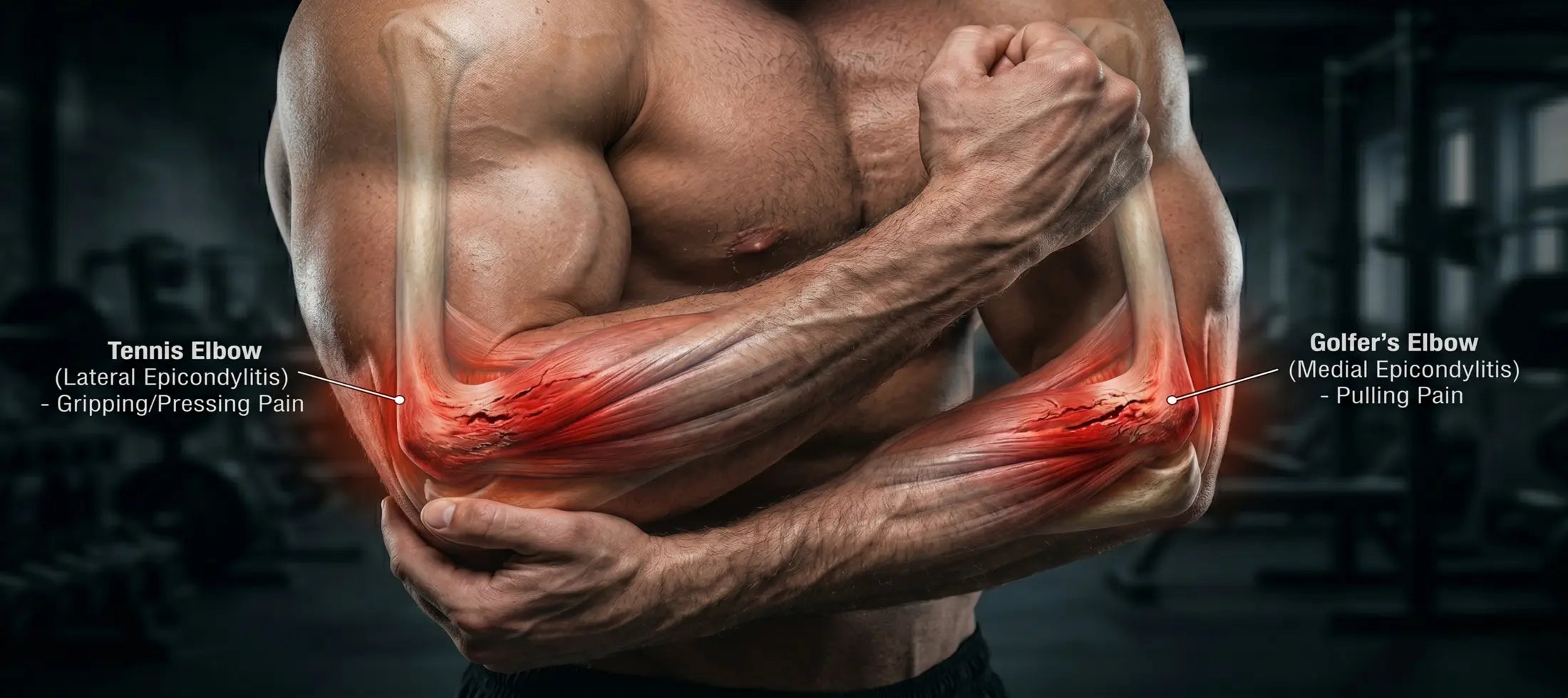

Heavy lifting often leads to tennis elbow or golfer's elbow. These are painful tendon injuries caused by the breakdown of collagen. Tendons have a very poor blood supply, so they heal extremely slowly. You can speed up this repair process using a clinically proven nutritional stack. Vitamin C powers the enzymes that build new collagen. Gelatin or hydrolyzed collagen provides the exact amino acids your body needs to rebuild the damaged tissue. Turmeric (Curcumin) directly blocks the specific pathways that cause tendon inflammation. Taking 15 g of gelatin with vitamin C about an hour before your workout is a proven method to double your collagen production and protect your joints.
The Lifter's Silent Injury: Understanding Tendonitis, Tennis Elbow & Golfer's Elbow
Every heavy lifter knows the deep, stubborn ache in the elbow that ruins a good training session. This is tendonitis. It is not just sudden inflammation. It is a condition built on cumulative micro-trauma. The physical stress of lifting weights simply outpaces your body's ability to recover.
Tennis Elbow vs Golfer's Elbow: What's the Difference and Why Do Lifters Get Both?
These two injuries feel similar but affect different parts of your arm.
-
Tennis Elbow (Lateral Epicondylitis): This causes pain on the outside of your elbow. It primarily damages the Extensor Carpi Radialis Brevis (ECRB) tendon. Lifters usually get this from heavy gripping and pressing movements.
-
Golfer's Elbow (Medial Epicondylitis): This causes pain on the inside of your elbow. It targets the Flexor Carpi Radialis (FCR) and pronator teres tendons. It frequently flares up from heavy pulling and back workouts.
What Actually Happens to Your Tendon During Tendonitis: From Micro-Trauma to Degeneration
Healthy tendons look like tightly woven, parallel ropes under a microscope. When you subject them to repetitive heavy loads, this structure breaks down. This leads to collagen disorganisation. If you ignore the pain, your body attempts a messy repair job. This results in angiofibroblastic degeneration, which is the buildup of weak scar tissue, and neovascularisation, which is the growth of abnormal and fragile new blood vessels inside the tendon.
The Cook & Purdam Continuum: Reactive, Disrepair & Degenerative Tendinopathy Explained
Tendon damage happens in three predictable stages known as the Cook & Purdam Continuum.
-
Reactive Tendinopathy: The tendon swells quickly in response to a sudden overload. It is painful but highly reversible with rest and nutrition.
-
Tendon Disrepair: The actual structural matrix begins to break down as your body struggles and fails to heal the tissue.
-
Degenerative Tendinopathy: The collagen fibers are severely damaged and disorganized. At this stage, the tendon has a very high risk of completely rupturing.
Why Tendons Are So Hard to Heal And Why Nutrition Is the Missing Variable
Muscles heal in a few days. Tendons often take months. The reason comes down to basic biology and how nutrients travel through your body.
Tendon Anatomy 101: Why Your Tendon's Poor Blood Supply Makes Recovery So Slow
Unlike muscles, tendons are hypovascular. This means they have a very poor blood supply. The specific cells responsible for repairing your tendon tissue are called tenocytes. These cells are trapped deep inside the extracellular matrix (ECM). Because the blood vessels delivering nutrients to these cells are so sparse, the healing process is incredibly slow.
Collagen: The Structural Foundation of Every Tendon in Your Body
Your tendons are primarily made of Type I Collagen. These tiny collagen fibrils group together into larger bundles called fascicles. They are wrapped in protective sheaths known as the endotenon and paratenon. Proteins like decorin and tenascin-C help bind these fibers together to give the tendon its strength. To fix a damaged tendon, your body must create new collagen.
Vitamin C: The Non-Negotiable Nutrient for Tendon Collagen Synthesis
You cannot build a strong brick wall without mortar. Similarly, your body cannot build strong collagen without Vitamin C, scientifically known as ascorbic acid.
The Enzyme Story: How Vitamin C Powers Prolyl and Lysyl Hydroxylase for Collagen Repair
To create strong tendon fibers, your body relies on two critical enzymes called prolyl hydroxylase and lysyl hydroxylase. These enzymes convert basic amino acids into hydroxyproline and hydroxylysine. These upgraded amino acids then cross-link the collagen fibers together, giving your tendons their immense pulling strength. These specific enzymes absolutely require Vitamin C to function. Without Vitamin C, collagen synthesis completely stops.
Vitamin C as an Antioxidant: Protecting Tenocytes from Oxidative Damage During Heavy Lifts
Heavy lifting creates intense metabolic stress. This generates reactive oxygen species (ROS), which are free radicals that cause oxidative stress. This stress physically damages your tissue and causes tenocyte apoptosis, meaning your tendon cells actually die. Vitamin C acts as a powerful antioxidant. It scavenges these free radicals and activates the protective Nrf2 pathway to keep your tendon cells alive and healthy.
Clinical Proof: What Shaw et al. 2017 Discovered About Vitamin C + Gelatin and Tendons
A landmark randomized controlled trial by Shaw et al. in 2017 proved this nutritional connection. The researchers discovered that taking Vitamin C alongside gelatin exactly 45 to 60 minutes before exercise opened a specific collagen synthesis window. This protocol successfully doubled the amino acid markers of tendon repair in the athletes' bloodstreams.
Gelatin: The Forgotten Food That Rebuilds Tendons from the Inside Out
If Vitamin C is the mortar, gelatin is the brick. Gelatin is essentially cooked collagen. It provides the exact raw materials your tendons need to rebuild themselves.
Gelatin vs Hydrolyzed Collagen: Which One Is Better for Tendon Repair?
Both are excellent for your joints, but they digest slightly differently. Gelatin thickens when mixed with liquid and is perfect for pre-workout protocols or cooking. Hydrolyzed collagen peptides have been broken down further for maximum bioavailability. This makes them incredibly easy to mix into a standard protein shake. Both supplements provide the building blocks required for Type I collagen.
The Shaw Protocol: 15g Gelatin + Vitamin C Before Training The Tendon Repair Hack
To maximize tendon healing, you need to use the Shaw Protocol. Consume 15g of gelatin or hydrolyzed collagen paired with 50mg of Vitamin C exactly 45 to 60 minutes before your workout. As you exercise, your blood flow increases to the tendons. This delivers the nutrients exactly when your fibroblasts are primed and ready to use them.
How Gelatin Amino Acids (Glycine, Proline & Hydroxyproline) Rebuild Tendon Collagen
Gelatin provides a massive, concentrated dose of glycine, proline, and hydroxyproline. These three specific amino acids form the tightly coiled triple-helix structure of collagen fibrils. They give your tendons the exact elasticity and strength required to handle heavy gym loads safely.
Turmeric (Curcumin): The Natural Anti-Inflammatory That Calms Tendon Pain Without Drugs
Vitamin C and collagen physically rebuild the tissue, but you still need to manage the painful inflammation. Turmeric, specifically its active compound Curcumin, is the perfect solution.
How Curcumin Blocks NF-κB and COX-2: The Molecular Mechanism Behind Turmeric's Power
Curcumin is a highly potent natural anti-inflammatory. It works by directly inhibiting NF-κB, which is the master genetic switch for inflammation in your body. It also suppresses COX-2, an enzyme that produces pain-causing prostaglandins. By lowering pro-inflammatory cytokines like IL-1β and TNF-α, curcumin calms the chemical fire inside your aching elbow.
The Bioavailability Problem: Why You Need Piperine (BioPerine) With Your Curcumin
Curcumin has one major flaw. It has terrible bioavailability. If you take it completely alone, your liver destroys most of it before it ever reaches your bloodstream. However, combining it with piperine, a specific black pepper extract known as BioPerine, boosts curcumin absorption by 2000%.
Curcumin vs NSAIDs for Tendon Inflammation: What the Research Actually Shows
Many lifters rely on common NSAIDs like ibuprofen for pain relief. However, these pharmaceutical drugs actually slow down tendon healing and harm your stomach lining. Clinical trials and meta-analyses show that curcumin provides the exact same level of pain relief as NSAIDs. It acts as a natural anti-inflammatory without halting your body's necessary tissue remodelling process.
The Tendon Repair Stack: Combining Vitamin C, Gelatin & Turmeric for Maximum Recovery
To permanently conquer tennis elbow or golfer's elbow, you need a highly synergistic approach. The Tendon Recovery Stack targets the injury from every possible angle.
Pre-Exercise Protocol: When and How to Take Your Tendon Supplements for Best Results
Timing dictates your success. Take your Vitamin C and Gelatin 45 to 60 minutes before training. This specific timing ensures peak amino acid levels are in your blood just as you start loading the tendon. Take your Turmeric daily with a fat-containing meal to maintain steady, round-the-clock anti-inflammatory control.
Prehab vs Rehab: Using the Stack to Prevent Tendonitis Before It Ruins Your Training
Do not wait for a muscle tear to start caring for your joints. Using this supplement stack alongside a proper tendon loading program, such as Heavy Slow Resistance (HSR) or eccentric exercise, acts as incredible prehab. It completely bulletproofs your joints against future cumulative micro-trauma.
Jacked Nutrition's Tendon Health Range: DRAP-Approved Vitamatic & Collagen Made in Pakistan
When dealing with medical recovery, ingredient purity is non-negotiable. As Pakistan's premier supplement brand, Jacked Nutrition offers a complete and science-backed tendon stack tailored specifically for heavy lifters. You can buy Vitamatic and collagen from our website.
Stop Letting Tendon Pain Limit Your Lifts Start Rebuilding Today
You no longer have to train through the pain, and you do not have to give up heavy pressing. By providing your body with the precise nutrients it needs, you can rebuild your tendons from the inside out. Vitamin C drives the synthesis, Gelatin provides the physical structure, and Turmeric eliminates the inflammation. Upgrade your recovery with Jacked Nutrition's Tendon Recovery Stack and get back to lifting heavy and pain-free.
Frequently Asked Questions: Vitamin C, Gelatin, Turmeric & Tendon Health
Can vitamin C and gelatin actually reverse tendonitis?
Yes. Clinical studies show that combining Vitamin C and gelatin directly stimulates collagen synthesis. This aids in reversing the physical structural breakdown associated with tendinopathy.
How long does it take for vitamin C and gelatin to help tendons heal?
Because tendons have a very poor blood supply, healing takes time. With consistent therapeutic doses and proper rehab exercises, you will see noticeable improvements in tendon structure and pain reduction within 6 to 12 weeks.
Is turmeric effective for tennis elbow and golfer's elbow?
Absolutely. The active compound curcumin is clinically proven to inhibit the NF-κB inflammatory pathway. This offers significant and measurable pain relief for both lateral and medial epicondylitis.
When should I take the tendon supplement stack before or after training?
For the absolute best results, take your vitamin C and collagen exactly 45 to 60 minutes before training. This timing ensures the nutrients are heavily present in your bloodstream during exercise-induced blood flow to the tendons.
Share:
The Mid-Set Seizure: Using Electrolytes to Stop Muscle Cramps in Their Tracks
The 30-Minute Anabolic Window Myth: What 2026 Research Actually Shows