

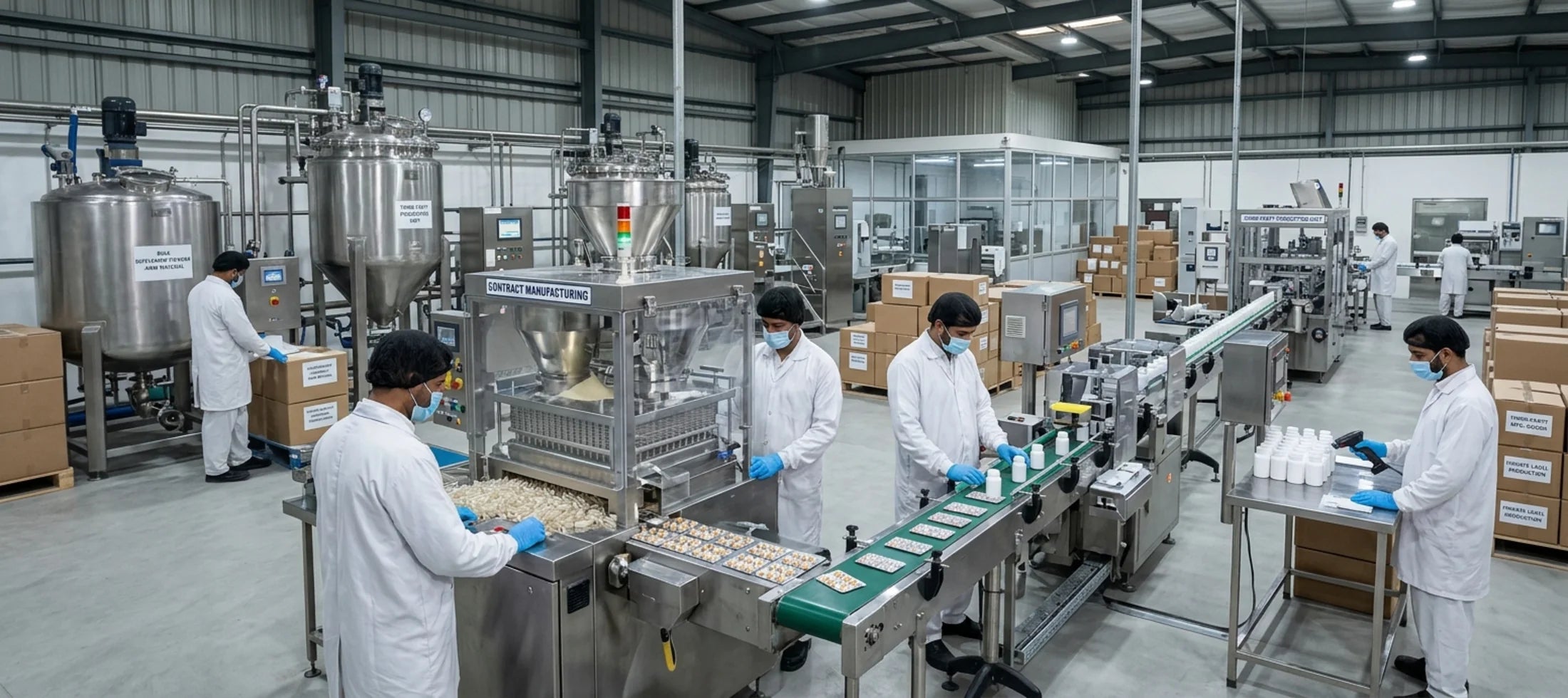

Walk into any gym in Lahore or Karachi. You'll see dozens of local supplement brands on the shelf. Most buyers think each one has its own factory. That's rarely true. Supplement manufacturing in Pakistan relies heavily on contract manufacturers. A significant number of supplement brands operate without owning their own manufacturing facility. They import bulk powder, add a label, and sell it as their own.
This isn't a scam. It's how the industry works almost everywhere. But if you're spending money on protein or creatine, you deserve to know who really makes what you take. Once you know how the system works, reading a label gets a lot easier.
How Supplement Brands in Pakistan Actually Work
Here's the part most people never see. A company wants to launch a whey protein or a pre-workout. Building a factory takes years and a lot of money. So instead, they contact a contract manufacturer. This could be overseas or local. They order bulk powder made from a standard formula.
The manufacturer makes the batch. The brand then handles packaging, labels, and marketing. This is called private-label supplements in Pakistan. It's a normal business model. Thousands of global brands work this way. Some very famous names do too.
The real problem is the messaging, not the model. Many local supplement brands in Pakistan act like manufacturers on their packaging and social media. In reality, they've never touched a production line. Some import finished, sealed tubs and just add their own sticker. Others import raw powder and pack it locally. That's closer to real private labeling, but it's still not manufacturing.
When a brand says "our own formula" or "made in our facility," that phrase can mean almost anything. It might mean a fully owned factory. It might just mean a formula sheet emailed to a supplier abroad. Buyers rarely get told which one it is.
Here's a simple way to spot the difference:
-
True manufacturer: owns or runs the factory, controls raw materials, and holds a license for that facility.
-
Private label brand: designs the product and packaging, then pays a licensed factory to make it.
-
Relabeler: buys a finished product and only changes the branding. They have little say in the formula or quality checks.
None of these models is bad on its own. What matters is honesty. A brand should be clear about which one it actually follows.
Why Building a Manufacturing Facility Is So Hard
If outsourcing is so common, why don't more brands build their own plant? Because the barriers are real, and they add up fast.
Money is the first wall. Mixing equipment, tablet presses, powder filling lines, and cold storage all cost a lot before a single product ships. Then there's the building itself. It must meet strict hygiene and layout rules before any inspection can even start. Utilities, staff wages, and maintenance keep adding up long before a single tub gets sold.
Licensing is the second wall. This one stops most people. In Pakistan, many sports nutrition products fall under DRAP's Health & OTC framework for nutritional products and food supplements. Any factory that wants to make these products must pass that authority's licensing and inspection process first. This covers facility design, equipment checks, written procedures, and staff skills. It's not something you finish in a few months.
Skilled staff is the third wall. Running a compliant factory means hiring people who understand formulas, quality checks, and batch records. That kind of staff is hard to find or train fast in Pakistan right now.
Then there's time. Most companies that go through this process talk about years, not months. Between paperwork, inspections, fixes, and re-inspections, a factory can take three to four years to get fully licensed. Each round of corrections can add months before the next inspection date even gets booked. That's exactly why most brands choose to outsource instead.
What DRAP Licensing for a Sports Nutrition Facility Requires
A sports nutrition license is not the same as a general nutraceutical license. Sports supplements often use stronger ingredients. They need tighter dosing accuracy and stricter checks against contamination. This matters most for athletes who may get drug tested.
Here's a simple look at what a facility usually needs to show:
|
Requirement Area |
What It Covers |
|
Facility design |
Separate areas for raw material, production, and packaging to stop cross-contamination |
|
Hygiene standards |
Air filters, clean surfaces, and staff hygiene rules |
|
Written procedures |
Clear steps for every stage of production, checked and approved |
|
Batch records |
Full tracking from raw material to finished product, batch by batch |
|
Equipment checks |
Proof that machines work the same way every time |
|
Staff training |
Proof that QC and production staff know their job |
Every one of these gets checked during inspection. A gap in any one area can cause delays. Inspectors often ask for the same document more than once, just in a different format, which slows things down further. This is why a real DRAP-licensed facility means something. It means someone passed real, documented checks. It's not just a quality claim printed on a label.
In-House Manufacturing vs Outsourcing: The Quality Control Difference
Outsourcing isn't always risky. Many good global brands outsource and still deliver solid quality. But there's a real difference in control when a brand owns the whole process.
When a brand makes its own product, it picks its own raw materials. It knows exactly which supplier the whey or creatine came from. It can test that material before production even starts. With outsourcing, a brand often has to trust whatever the factory sources. It may never see the full picture.
Batch tracking works the same way. In-house production means every batch can be traced from raw ingredient to sealed tub, using records the brand controls. Outsourced production depends on the factory's own records, which the brand may never fully see. Cost also plays a role here, since in-house testing adds expense that outsourced brands often skip.
Consistency between batches is where this really shows over time. A facility that tests every batch, using tools like HPLC to check real creatine or protein levels, can catch problems before they reach a customer. Jacked Nutrition explained this process in a recent article on how HPLC testing verifies every batch of creatine. It's worth a read if you want to know why lab checks matter more than trusting a label alone.
This doesn't mean outsourced brands are always inconsistent. It just means in-house manufacturing gives a brand more direct control over the things that affect what's actually in the tub.
What It Took to Build Farma Labs
Farma Labs didn't happen overnight. Going from an idea to a fully licensed, working factory took more than three years. The team worked through DRAP's process step by step. There were delays, fixes, and a fair bit of trial and error. Very few factories in Pakistan had gone through sports nutrition licensing before, so a lot of the process meant learning as they went.
The money went into equipment, construction, staff training, and the paperwork systems needed to pass inspection. It bought something that's hard to shortcut: a factory that makes sports nutrition products under direct quality control, instead of relying on someone overseas.
Today, Farma Labs runs under DRAP Manufacturing Licence 01542. It is Pakistan's first DRAP-licensed sports nutrition facility. You can see more about the plant itself on the Farma Labs page, including what it can produce.
Why Local Manufacturing Now Matters for Pakistani Consumers
Local manufacturing changes a few things that matter to everyday buyers, even if they never think about the supply chain.
Shorter supply chains usually mean fresher product. When a supplement doesn't cross borders and sit in a warehouse for months, it reaches the shelf faster. This matters for ingredients that break down over time, like some vitamins and probiotics. It can also help keep prices steadier, since local production isn't as exposed to currency swings and import costs.
There's also the question of accountability. If something goes wrong with an imported product, tracing the source can take weeks, if it happens at all. A local product means the factory is right here. It's checked under Pakistani rules, and someone is reachable if a customer has a problem. You can read more about the company's full story on the About Us page.
This kind of local accountability matters more as buyers get smarter about what they put in their bodies.
Frequently Asked Questions
Who actually manufactures supplements in Pakistan?
Most supplements sold in Pakistan come from a small group of contract manufacturers, both local and international. Many brands you see in stores don't own a factory. They design the product and pay someone else to make it.
Do Pakistani supplement brands make their own products?
Some do, but most don't. A large share of local brands import bulk powder or finished product and relabel it. Real in-house manufacturing, where a brand owns and runs its own licensed factory, is still rare in this market.
What is contract manufacturing and private labelling in supplements?
Contract manufacturing means a brand pays a separate factory to make its formula. Private labelling goes a step further. The brand designs packaging and branding around a base product made by that factory. Both are normal in this industry worldwide, and neither one means the product is lower quality.
Is there a DRAP-licensed sports nutrition manufacturer in Pakistan?
Yes. Farma Labs holds DRAP Manufacturing Licence 01542. It's known as Pakistan's first DRAP-licensed sports nutrition manufacturing facility, built to produce protein, creatine, and related products under regulated conditions.
How can I find out where a supplement was manufactured?
Check the label for a manufacturer name and license number, not just the brand name. If that's missing or vague, ask the brand directly. Or check if they name a specific licensed facility on their website.
Ready to Talk Manufacturing?
Choosing a supplement brand comes down to trust. Trust starts with knowing who actually made the product. If you're a brand looking into private label or contract manufacturing, Farma Labs offers DRAP-licensed sports nutrition production under one roof. Reach out through the B2B enquiry page to talk about formulation, packaging, and production timelines for your next product.
Share:
Pre-Workout Supplements in Pakistan: What Actually Works and What Is Just Hype
Creatine in Pakistan: Everything You Need to Know Before You Start