

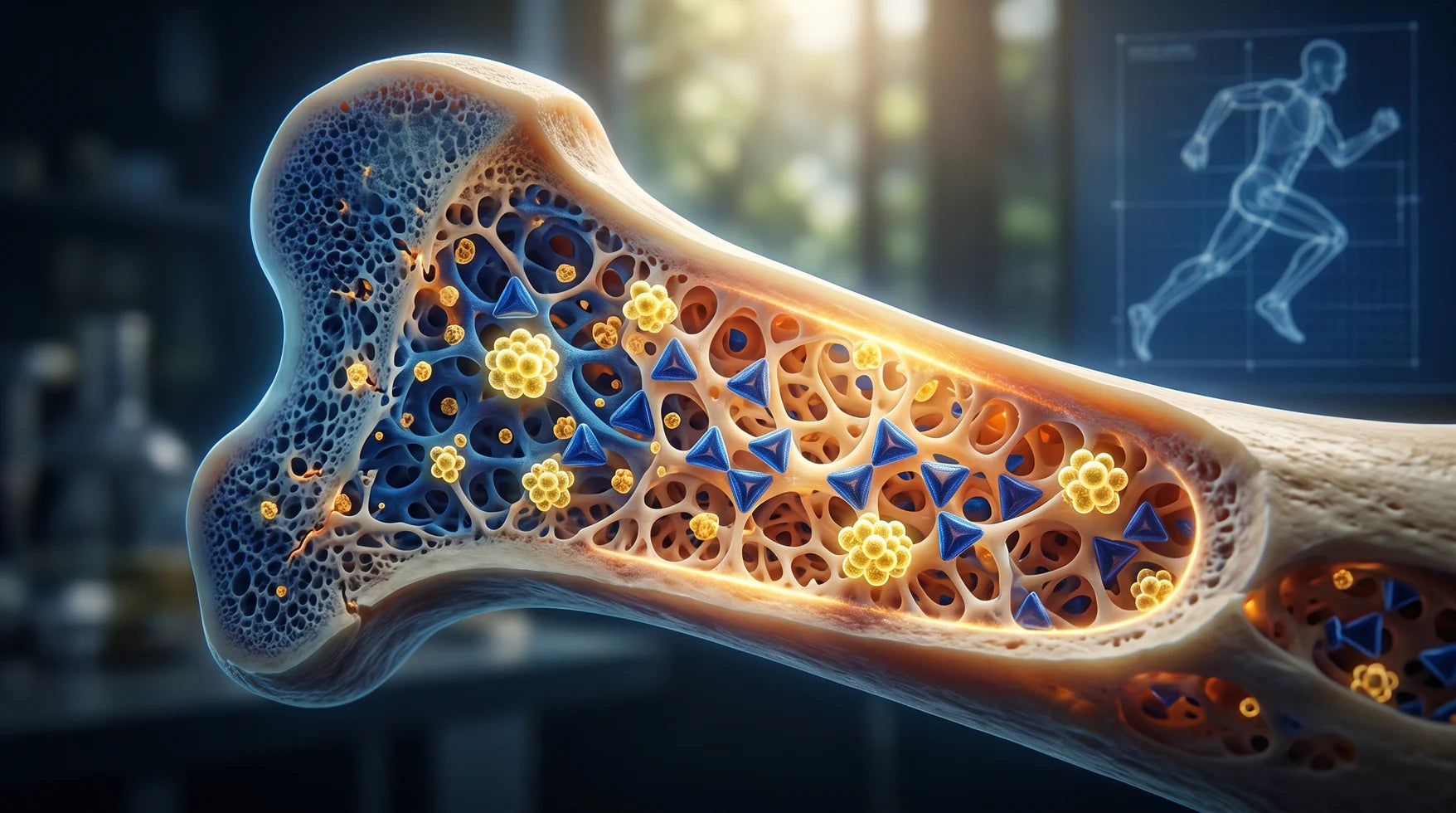

Serious athletes train hard. They lift heavier weights, run longer distances, and push their bodies to adapt. But sometimes the body sends a warning sign in the form of deep bone pain that does not go away with rest. This pain can be the early stage of a bone stress fracture.
Many lifters focus on protein, creatine, and pre-workouts but overlook nutrients that build and protect bones. Vitamin D3, vitamin K2, and calcium play a critical role in maintaining strong bones and preventing fatigue injuries. When these nutrients work together, they help bones adapt to heavy training and reduce the risk of stress fractures.
This article explains how stress fractures develop, how bones remodel under training, and why the combination of vitamin D3, K2, and calcium is essential for athletes.
What Is a Bone Stress Fracture and Why Should Every Serious Lifter Care?
A bone stress fracture is a small crack in the bone caused by repeated stress rather than a sudden injury. It develops when bones experience constant mechanical loading without enough recovery time.
Athletes often experience this type of injury because their bones are exposed to repetitive forces during training. Running, jumping, and heavy lifting create micro damage in the bone structure. Normally, the body repairs this damage through bone remodeling. However, if the stress continues faster than the repair process, a stress fracture can develop.
Stress fractures are common in runners, gym athletes, and military recruits who suddenly increase training volume. They can lead to weeks or even months away from training if not addressed early.
Stress Fracture vs Regular Fracture: How Bone Fatigue Silently Builds to Breaking Point
A regular fracture usually occurs from a sudden trauma such as a fall or impact. The bone breaks instantly due to a strong external force.
A stress fracture develops slowly. Repeated mechanical stress causes tiny microcracks in the bone. Over time, these cracks accumulate. When the repair process cannot keep up, the bone weakens and eventually fractures.
This process is often called bone fatigue. It is similar to bending a metal wire repeatedly until it finally snaps.

The High-Risk Bones: Metatarsal, Tibia, Femoral Neck and Navicular Stress Fractures in Athletes
Certain bones carry more mechanical load during exercise and are more vulnerable to stress fractures.
Common high-risk sites include:
-
Metatarsal bones in the foot, especially in runners
-
Tibia, the main weight-bearing bone in the lower leg
-
Femoral neck in the hip
-
Navicular bone in the midfoot
-
Lumbar pars in the lower spine for athletes who perform heavy back extensions
These bones absorb high levels of repetitive force during training.

Why Gym Athletes Get Stress Fractures: Overtraining, Low BMD, RED-S and Nutritional Gaps
Several factors increase the risk of stress fractures in athletes.
Overtraining is one of the most common causes. When training intensity increases rapidly, the body does not have enough time to repair bone tissue.
Another major factor is low bone mineral density (BMD). Bones that contain less mineral content are weaker and more likely to develop fractures.
Some athletes also experience Relative Energy Deficiency in Sport (RED-S). This condition occurs when calorie intake is too low to support intense training. Over time, it disrupts hormone balance and weakens bone structure.
Nutritional deficiencies also play a role. Low vitamin D, calcium deficiency, and poor mineral intake reduce the body's ability to maintain strong bones.
Inside Your Bones: The Biology of Bone Remodelling and What Makes Them Fracture-Resistant
Bones are not static structures. They constantly rebuild themselves through a process called bone remodeling.
During this process, old bone tissue is removed and new bone tissue is formed. This cycle allows bones to adapt to training stress and maintain structural strength.
Bone tissue contains hydroxyapatite crystals made from calcium and phosphate. These minerals give bones their hardness, while type I collagen provides flexibility.
Healthy bone remodeling requires balanced activity between cells that break down bone and cells that build it.
Osteoblasts vs Osteoclasts: The Constant Battle Inside Your Bones
Two main types of cells control bone remodeling.
Osteoclasts break down old or damaged bone tissue.
Osteoblasts build new bone by depositing calcium and forming fresh bone matrix.
Another cell type called osteocytes acts as sensors that detect mechanical stress.
The interaction between these cells is regulated by signaling molecules such as RANK, RANKL, and osteoprotegerin (OPG). When this system remains balanced, bones stay strong and adapt to exercise.
Wolff's Law and the Mechanostat: Why Weight Training Is Your Bones' Best Friend With the Right Nutrients
According to Wolff's Law, bones adapt to the loads placed on them. When mechanical stress increases through exercise, bones respond by becoming stronger and denser.
The mechanostat theory explains that bone cells detect mechanical strain and stimulate bone formation.
Weight training, therefore, helps improve bone mineral density. However, this adaptation requires adequate nutrients, especially vitamin D3, vitamin K2, and calcium.
Without these nutrients, bones may not respond properly to training stress.
Vitamin D3: The Master Regulator of Calcium Absorption and Bone Mineralisation
Vitamin D3, also known as cholecalciferol, is one of the most important nutrients for bone health.
It regulates how much calcium the body absorbs from food and supplements. Without sufficient vitamin D3, calcium absorption decreases significantly.
Vitamin D3 also influences osteoblast differentiation, helping the body build new bone tissue.
How Vitamin D3 Is Activated: From Cholecalciferol to Calcitriol in Your Kidneys
Vitamin D3 is produced in the skin when sunlight triggers UVB exposure. It can also come from supplements.
Once inside the body, vitamin D3 undergoes two activation steps:
-
The liver converts vitamin D3 into 25-hydroxyvitamin D (25(OH)D)
-
The kidneys convert it into calcitriol, the active hormone form
This active form interacts with the vitamin D receptor (VDR) to regulate calcium metabolism.
Vitamin D3 and Calcium Absorption: How the Calbindin Pathway Works
Vitamin D3 increases calcium absorption in the small intestine.
It stimulates the production of a protein called calbindin, which transports calcium through intestinal cells and into the bloodstream.
Without this pathway, the body cannot efficiently absorb calcium even if intake is high.
Vitamin D Deficiency in Athletes: Why Pakistani Lifters Are Especially at Risk
Vitamin D deficiency is surprisingly common in athletes, including those living in sunny countries like Pakistan.
Several factors contribute to this problem:
-
Training indoors in gyms
-
Limited sun exposure
-
Urban lifestyles
-
Air pollution reduces UVB radiation
Low vitamin D levels can lead to osteomalacia, reduced bone density, and a higher risk of stress fractures.
Clinical Evidence: Vitamin D3 Supplementation and Stress Fracture Prevention in Athletes
Research shows that adequate vitamin D levels improve bone mineral density and reduce fracture risk.
Studies involving military recruits and athletes found that individuals with optimal vitamin D levels experienced fewer stress fractures compared with those who were deficient.
Maintaining healthy 25(OH)D levels is therefore essential for bone resilience.
Vitamin K2: The Bone-Routing Vitamin That Makes Calcium Go Where It Belongs
While vitamin D helps absorb calcium, vitamin K2 determines where that calcium goes.
Vitamin K2 activates proteins that guide calcium into bones and prevent it from accumulating in arteries.
The most important forms of vitamin K2 are MK-4 and MK-7, both belonging to a group called menaquinones.
Osteocalcin Carboxylation: How K2 Activates the Protein That Anchors Calcium in Bone
One of vitamin K2's most important functions is activating osteocalcin, a protein produced by osteoblasts.
Vitamin K2 enables carboxylation, a chemical process that allows osteocalcin to bind calcium and integrate it into bone tissue.
Without vitamin K2, osteocalcin remains inactive and calcium cannot be effectively anchored in bone.
The Calcium Paradox: Why Taking Calcium Without K2 Can Harm Your Arteries
The calcium paradox refers to a situation where calcium intake increases but bone health does not improve.
Without vitamin K2, calcium may accumulate in soft tissues and arteries rather than bones.
Vitamin K2 activates matrix Gla protein (MGP), which prevents arterial calcification and protects cardiovascular health.
MK-4 vs MK-7: Which Form of Vitamin K2 Is Best for Bone Health?
Vitamin K2 exists in several forms.
MK-4 has a shorter half life and requires higher doses.
MK-7 remains in circulation longer and is commonly used in supplements due to its higher bioavailability.
Both forms support bone health, but MK-7 is often preferred for daily supplementation.
The D3 and K2 Synergy: Why These Two Vitamins Must Be Taken Together
Vitamin D3 increases calcium absorption. Vitamin K2 ensures calcium is directed into bone tissue.
When taken together, these vitamins support bone mineralisation while helping prevent unwanted calcium buildup in arteries.
This synergy makes the combination especially valuable for athletes focused on long term bone health.

Calcium: The Essential Mineral That Builds Bone But Only If D3 and K2 Are Present
Calcium is the primary mineral found in bones. About 99 percent of the body's calcium is stored in the skeleton.
Bone tissue contains calcium in the form of hydroxyapatite crystals, which give bones their rigidity.
However, calcium alone cannot build strong bones without vitamin D3 and vitamin K2.
Calcium Carbonate vs Citrate vs Malate: Which Form Should Athletes Supplement With?
Calcium supplements come in different forms.
Calcium carbonate contains a high percentage of elemental calcium but requires stomach acid for absorption.
Calcium citrate is easier to absorb and can be taken without food.
Calcium malate combines calcium with malic acid and may support better absorption.
Athletes often choose citrate or malate forms for improved bioavailability.
How Much Calcium Do Athletes Actually Need and Why Split Dosing Matters
Most adults require 1000 to 1200 milligrams of calcium per day.
The body absorbs calcium more efficiently when intake is divided into smaller doses throughout the day.
High single doses may reduce absorption because intestinal transport systems become saturated.
The Bone Fortification Stack: D3 + K2 + Calcium — The Science-Backed Triple Protection
A comprehensive bone support strategy combines vitamin D3, vitamin K2, and calcium.
Together, these nutrients support three critical processes:
-
Calcium absorption
-
Calcium transport into bone
-
Bone mineralisation and remodeling
This combination forms a powerful bone fortification stack for athletes.
Optimal Timing: When and How to Take Vitamin D3, K2 and Calcium for Maximum Absorption
Vitamin D3 and K2 are fat-soluble nutrients. They should be taken with meals that contain healthy fats.
Calcium supplements can be taken with meals and divided into smaller doses to improve absorption.
Some athletes also adjust vitamin D intake seasonally when sunlight exposure decreases.
Weight-Bearing Exercise and the Stack: How Wolff's Law and Supplements Work Together
Weight-bearing exercise stimulates bone formation through mechanical stress.
When combined with proper nutrition and supplementation, bones adapt by becoming stronger and denser.
This interaction between training and nutrition supports long term skeletal resilience.

Jacked Nutrition's Bone Health Range: DRAP-Approved Vitamin D3, K2, and Calcium Made in Pakistan
Athletes should choose supplements that meet strict quality standards.
Jacked Nutrition provides vitamin D3, K2 (blade sports), and calcium (vitamatic) formulations designed to support bone health for athletes in Pakistan.
These products are manufactured under regulated conditions and formulated with carefully selected ingredients.
Don't Wait for a Fracture Start Fortifying Your Frame Today
Strong bones allow athletes to train harder and recover faster.
Supporting bone health through proper training, balanced nutrition, and the D3, K2, and calcium stack can help reduce the risk of stress fractures.
Athletes who invest in bone health today build a stronger foundation for long term performance.
Frequently Asked Questions: Vitamin D3, K2, Calcium and Bone Stress Fractures
Can vitamin D3 and K2 actually prevent stress fractures in athletes?
Vitamin D3 and K2 support bone mineral density and proper calcium metabolism. Adequate levels of these nutrients can reduce the risk of stress fractures, especially in athletes who train intensely.
Why do I need vitamin K2 if I'm already taking calcium and vitamin D3?
Vitamin K2 activates proteins that direct calcium into bones. Without it, calcium may accumulate in arteries rather than strengthening bone tissue.
How much vitamin D3 should Pakistani athletes take daily?
Many athletes benefit from 2000 to 4000 IU of vitamin D3 daily, especially if blood tests show low vitamin D levels.
Which form of calcium supplement is best absorbed for bone health?
Calcium citrate and calcium malate are often easier to absorb than calcium carbonate, particularly for individuals with lower stomach acid levels.
Share:
Beyond the Bench Press: How Collagen and Glucosamine Shield Your Shoulders from Joint Wear & Tear
Repeated Injuries in One Spot: Your Body’s Response Explained