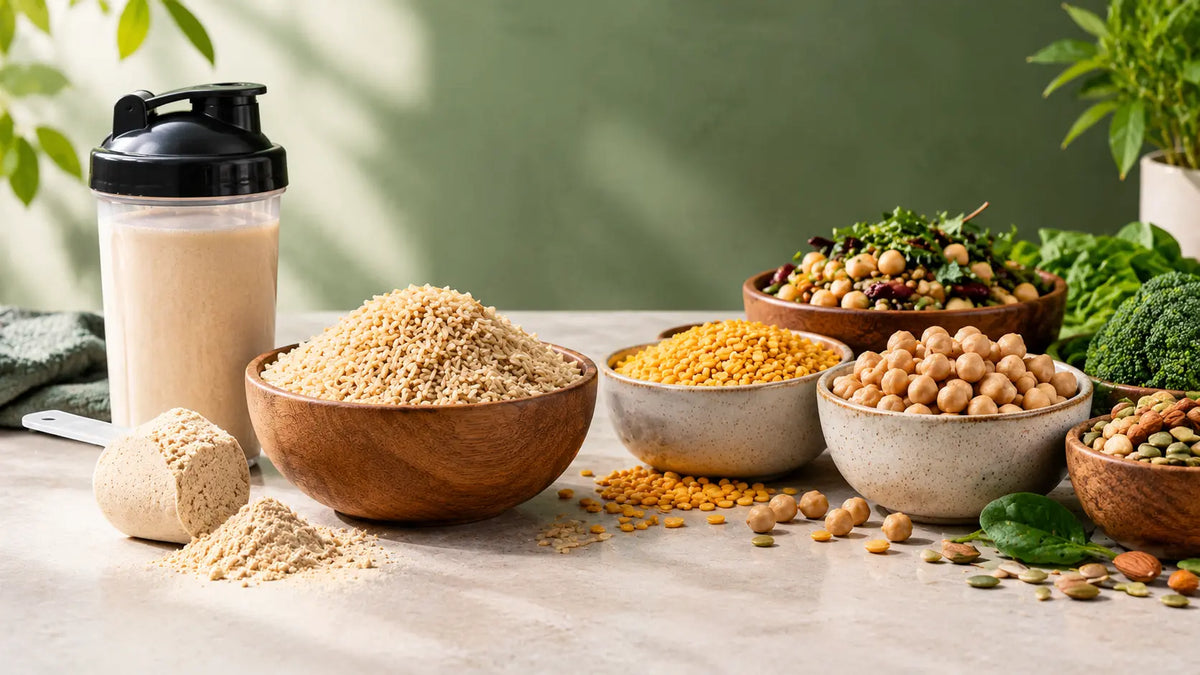

Walk into any gym in Pakistan, and you will see a shaker bottle in almost every other hand. Vegan protein powder has become a familiar name, but a fair question keeps coming up: do you actually need it, or can daal, chana, and dahi do the job on their own?
Here is the short answer. For most people, food comes first. Your everyday desi meals already carry a good amount of protein, and a powder is a handy add-on rather than a must. Where it shines is on the days when life gets in the way. It is quick to mix, easy to carry to work or the gym, free from dairy, and simple to measure, so you always know exactly how much protein you are getting. But wait, don't feel guilty if you own a tub, and don't stress if you don't.
In this blog, you will learn how much protein your everyday desi foods give you, when a powder really helps, and how to hit 130g a day without eating meat.
Let's dive in!
Food First: The Honest Starting Point
Let's be honest with each other. Real food should be your starting point, and powder should come second, because food gives you protein along with fiber, minerals, and a full stomach, while a scoop gives you protein and little else.
So how much protein do you need? For most adults, the RDA is 0.8g per kilogram of body weight, but that number goes up once you start training. This review from the International Society of Sports Nutrition says active people do well on 1.4 to 2.0g per kilogram each day, which works out to roughly 98 to 140g for a 70 kg person.
Now here's the good news. Pakistani kitchens already run on protein, since daal, chana, rajma, dahi, and paneer show up on your plate all week. There is no need to be a nutrition expert to use these foods well, because you just need the numbers, so let's get to them.
Protein Content of Common Pakistani Vegetarian Foods
Time for the nitty-gritty. The figures below come from USDA FoodData Central, and we rounded them, so your home recipe will differ a little depending on the water, oil, and portion size you use.
|
Food |
Serving |
Protein |
Calories |
|
Masoor daal (lentils), cooked |
1 cup |
18g |
230 |
|
Rajma (kidney beans), cooked |
1 cup |
15g |
225 |
|
Chana (chickpeas), cooked |
1 cup |
14.5g |
270 |
|
Moong (mung beans), cooked |
1 cup |
14g |
212 |
|
Milk, whole |
1 cup |
8g |
150 |
|
Dahi, plain whole milk |
1 cup |
8.5g |
150 |
Dal, chana and rajma per cooked cup
Daal protein content is better than most people think. One cup of cooked masoor gives about 18g, rajma and chana land around 15g, and moong sits near 14g. Two cups of daal in a day is already a handsome amount of protein, and you still have roti, rice and dahi on the side.
There is one small catch. Home-style daal is usually thinner than plain boiled lentils, so a cup of your daal can give you less protein than the table shows. Cook it thicker or eat a bigger bowl, and you fix that problem right away. That's so simple.
Dairy options for vegetarians
Dairy is the vegetarian's shortcut. One cup of milk or plain dahi gives about 8g of protein, and paneer gives roughly 18g per 100g, although brands differ. If you add a glass of lassi or a bowl of raita, you pick up a few more grams without any extra cooking. If you skip dairy completely, lean more on daal and chana and keep an eye on your daily total.
The Calorie and Volume Problem
Here is where food gets tricky. Daal and chana bring protein, but they also bring carbs and calories, so you have to eat a large portion to match one scoop of powder. That feels tough when you're cutting weight or when your appetite is small.
How much dal equals one scoop
Brown Rice Jacked gives you 24g of protein per scoop, according to its label. To match that with masoor, you need about 1.3 cups of cooked daal, which is roughly 300 calories. With chana, you need about 1.7 cups, which is close to 450 calories. A cup of cooked lentils also brings about 16g of fiber, and that's great for your gut, but it fills you up fast.
A scoop mixes with water in seconds and takes very little room in your stomach. So if you train hard and your plate is already full, a scoop lets you close the protein gap without another big bowl.
Amino Acid Completeness From Food Combinations
You may have heard that daal isn't a complete protein, and that's partly true. Legumes like daal run low in methionine, while grains like rice and wheat run low in lysine. When you put them together, each one fills the other's gap, which is why daal chawal and daal roti have worked for generations.
And you know what, you don't even need to eat them at the same meal. A dietetics position paper says a varied plant diet, eaten across the day, can cover your essential amino acids, and it adds that well-planned vegetarian diets suit athletes. So don't stress about perfect pairing at every meal.
Rice protein follows the same idea. On its own it runs lower in lysine, which is why Jacked adds some, and per the label each scoop has 2,452 mg of total lysine, including 912 mg of added lysine. Remember, that's a brand spec and not a study result.
When a Powder Genuinely Helps
Food first doesn't mean food only, because some days a scoop simply makes life easier.
High training volume
If you lift five or six days a week, your protein target sits near the top of that 1.4 to 2.0g range, and that's a lot of daal to cook and eat. In one trial, 24 resistance-trained men took either rice or whey protein isolate after workouts for eight weeks. Both groups improved their body composition and performance, and the researchers found no difference between them. Keep this in perspective, though. It was one small study, and the men took 48g doses, so it isn't a promise about any product.
Time, appetite and travel
Life isn't always a fresh plate of daal. Maybe you're on a long road trip, maybe you're fasting in Ramadan with a short eating window, or maybe you're just too tired to cook after a long day. On those days, one scoop in a shaker bottle gives you 24g of protein in under a minute, and that's the cherry on top for busy people.
Cost Comparison: Powder vs Food per 25g of Protein
Now let's talk money. Weekly price data from the Pakistan Bureau of Statistics for the week ended 24 September 2026 put washed masoor at about Rs 295 per kg, gram at about Rs 307 and washed moong at about Rs 387. The table pairs those prices with raw protein figures from USDA FoodData Central to work out the cost of 25g of protein.
|
Source |
Price basis |
Approx. cost per 25g protein |
|
Masoor daal |
Rs 295 per kg, dry |
About Rs 30 |
|
Chana (gram) |
Rs 307 per kg, dry |
About Rs 38 |
|
Moong daal |
Rs 387 per kg, dry |
About Rs 40 |
|
Brown Rice Jacked |
Rs 6,450 for the 2 lb tub, 28 to 30 servings |
About Rs 225 to 240 |
Food wins on price, and it isn't even close. But the table leaves out cooking fuel, oil, spices and your time, and it also skips the extra calories that come with daal. Powder costs more per gram of protein, yet it saves you time and gives you a clean, measured 24g in one scoop. So buy your daal in bulk and keep the powder for the gaps. Prices move every week, so check the current price on the product page before you plan your budget.
A Sample Day Hitting 130g of Protein Without Meat
Want to see how this looks on a real plate? Here is a meat-free day that adds up to roughly 130g, and we rounded the numbers, so treat them as a guide. Don't worry about copying this plate exactly, because you can swap foods to fit your budget and taste.
Breakfast: 100g paneer bhurji, two rotis and a cup of chai with milk. About 28g.
Mid-morning: A handful of roasted chana (40g) and a glass of milk. About 16g.
Lunch: 1.5 cups of masoor daal, two rotis and a cup of dahi. About 41g.
Evening: One scoop of Brown Rice Jacked in water. About 24g.
Dinner: A cup of chana or rajma curry, a roti and half a cup of dahi. About 22g.
That adds up to about 131g. Without the scoop you land near 107g, so you can still reach the number with food alone, but you would need extra dahi or another bowl of daal. And that's exactly where a powder earns its place.
How to Use Brown Rice Jacked as a Supplement, Not a Replacement
Think of Brown Rice Jacked as a gap-filler. Your meals stay the foundation, and the scoop tops up the days when food falls short. Here is how to use it well.
-
Mix one scoop with water or milk, or blend it into a banana shake, since rice protein has its own taste and many people enjoy it more that way.
-
Pick your flavor, because it comes in Chocolate and Strawberry.
-
Count the scoop in your daily total, and keep your meals as they are.
Now know what you're buying. Jacked Nutrition makes it at Farmalabs, it is DRAP-enlisted, and the brand shares a Certificate of Analysis with batch-specific test results. It is a rice product, so skip it if you have a rice allergy, and check with a healthcare professional first if you're pregnant, nursing, under 18 or on medication.
Common Mistakes to Avoid
1. Swapping Meals for Shakes Mistake:
You replace your daal and dahi with shakes because a powder feels easier.
Solution: Keep your meals first and use the scoop only for the gaps.
2. Forgetting to Count the Scoop Mistake:
You add a scoop on top of a full day without checking your total.
Solution: Count the 24g inside your daily target, so you know what you still need from food.
3. Judging the Taste Once Mistake:
You try it in plain water, don't like the taste, and quit.
Solution: Blend it with a banana or milk before you make your final decision.
Still choosing a powder? Our beginner buying guide walks you through the whole process step by step.
Final Verdict
So, do you need vegan protein powder? There isn't one answer that fits everyone, because it depends on your training, your appetite, your budget and your day. If you eat daal, chana and dahi often and hit your protein target, you don't need a powder. If you lift hard, travel a lot or struggle to finish big meals, a scoop can make life easier. Food comes first, and the choice is yours.
If you've decided a powder fits your routine, you can try Brown Rice Jacked. Jacked Nutrition makes it at Farmalabs; it's DRAP-enlisted, and every batch comes with a Certificate of Analysis you can check. Don't wait for the perfect plan. Grab a tub and use it on the days your plate falls short.
Frequently Asked Questions
Do vegetarians need protein powder?
Not by default. Most people can reach their targets with daal, chana, dairy, and grains. A powder helps when your training is heavy, your appetite is small, or your schedule is busy.
How much protein do vegetarians need per day?
It depends on your body weight and training. The RDA is 0.8g per kilogram for most adults, and active people do well on 1.4 to 2.0g per kilogram. Vegetarians can use the same ranges.
Is daal a complete protein?
On its own, daal runs low in methionine. But when you eat it with roti or rice, or with other foods across the day, it fills the gaps.
Can I build muscle on a vegetarian diet in Pakistan?
A well-planned vegetarian diet can support training. You need enough total protein and calories, and daal, chana, dahi, and paneer make that doable. Food comes first, and a scoop can help on busy days.
Is brown rice protein as good as whey?
In one eight-week trial, trained men who took rice or whey protein isolate after workouts saw similar results. That's one small study, so treat it as a hint and not a guarantee. The right pick depends on your body, your budget, and your taste.
Share:
Ashwagandha for Strength: What the 2026 Meta-Analysis Says
Jacked Brown Rice vs Soy Protein: Digestibility, Muscle Growth and Hormone Concerns