

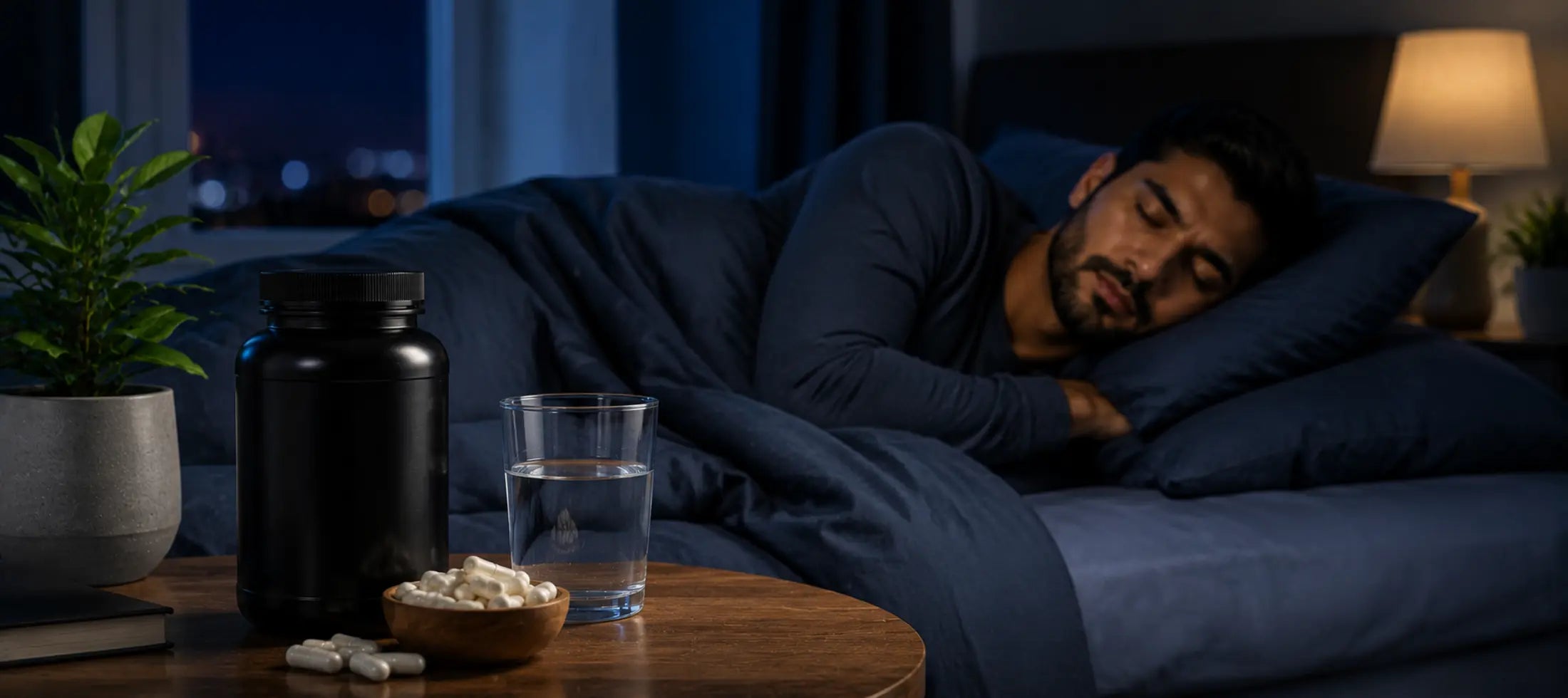

If you lie awake with a busy brain, wake up at 3 a.m. for no reason, or feel anxious without a clear cause, low magnesium may be part of the picture. Research suggests magnesium plays a direct role in two of the brain's most important calming systems. When your levels drop, those systems work less efficiently and you feel it most at night.
Magnesium bisglycinate, a highly bioavailable chelated form, targets sleep and mental calm through four distinct biological pathways. This guide breaks down each mechanism in plain language, reviews the key clinical trials, and gives you a practical protocol for using it effectively.
Why Sleep and Mental Calm Depend on the Same Brain Systems
Your brain has two systems that govern both sleep and anxiety. One is the NMDA receptor system, which drives brain excitation. The other is the GABA system, which drives brain inhibition the natural "off switch."
When these two systems are in balance, you fall asleep easily and feel mentally calm during the day. When excitation outpaces inhibition, your brain stays in a state of alert. You may notice racing thoughts at bedtime, difficulty switching off, or a low-level sense of tension that does not seem to have a source.
Magnesium acts directly on both systems. This is why its effects on sleep and anxiety are not separate benefits they come from the same underlying mechanism.
How Magnesium Bisglycinate Works: The 4 Key Mechanisms
Mechanism 1 Quieting the Overexcited Brain (NMDA Block)
NMDA receptors are channels in your brain cells that open in response to excitatory signals. When they fire frequently, your brain stays alert and activated. This is useful during the day. At night, it is a problem.
Magnesium acts as a voltage-dependent channel blocker on NMDA receptors. In simple terms, it physically sits inside the channel and prevents it from staying open too long. This reduces excessive neural firing without suppressing normal brain activity.
When magnesium levels are low, this blocking action weakens. NMDA receptors can over-activate a state researchers call excitotoxic stress. The result is a brain that struggles to downshift, even when you are tired.
By restoring magnesium levels, bisglycinate helps re-establish normal NMDA regulation. Studies on magnesium supplementation consistently show reductions in markers of neural overactivation, though most human research has been conducted in older adults and people with documented deficiency.
Mechanism 2 Amplifying the Brain's Natural Sleep Brake (GABA-A Potentiation)
GABA (gamma-aminobutyric acid) is your brain's primary inhibitory neurotransmitter. It slows neural activity and promotes relaxation. The GABA-A receptor is the specific receptor that mediates this effect.
Magnesium potentiates (increases the sensitivity of) GABA-A receptors. This means the same amount of GABA in your brain produces a stronger calming effect when magnesium levels are sufficient. It is not sedation it is more like turning up the volume on your brain's existing calm signal.
This mechanism is also why low magnesium is linked to higher anxiety and poor sleep quality. Without adequate magnesium, your GABA-A receptors respond less efficiently, and the brain's natural braking system loses some of its grip.
Mechanism 3 Glycine's Independent Sleep Effect
This is where bisglycinate stands apart from every other magnesium form. When magnesium bisglycinate is absorbed via the PepT1 transporter in your small intestine, it delivers both magnesium and glycine an amino acid with its own calming and sleep-specific properties.
Glycine acts as an inhibitory neurotransmitter in the brainstem and spinal cord. It also lowers core body temperature by expanding blood vessels near the skin surface. This is important: your core body temperature must drop slightly for deep sleep to begin. Glycine accelerates this process.
A randomised controlled trial by Inagawa et al. (2006), in a study of healthy adults, found that 3 g of glycine taken before bed significantly reduced the time it took to reach non-REM sleep and improved subjective sleep quality. A follow-up RCT by Bannai et al. (2012) found that glycine supplementation improved daytime alertness and reduced fatigue the morning after restricted sleep suggesting it improves actual sleep architecture, not just the feeling of sleep.
Keep in mind these trials used isolated glycine, not bisglycinate. However, the glycine delivered via bisglycinate follows the same biochemical pathway, and researchers generally consider the mechanism applicable.
Mechanism 4 Lowering Cortisol to Remove the Final Barrier to Deep Sleep
Cortisol is your primary stress hormone. It is meant to peak in the morning and fall through the evening. In many people, it stays elevated late into the night driven by chronic stress, irregular schedules, or poor magnesium status.
High evening cortisol keeps your HPA axis (hypothalamic-pituitary-adrenal axis your stress response system) activated. This directly opposes melatonin release and prevents the transition into deep, slow-wave sleep.
Magnesium acts as a physiological brake on the HPA axis. It reduces the release of corticotropin-releasing hormone (CRH), which is the signal that triggers cortisol production. Research suggests adequate magnesium lowers basal cortisol levels and reduces the cortisol response to stress, though most supporting studies are animal-based or in high-stress human populations.
By combining NMDA blockade, GABA potentiation, glycine delivery, and HPA suppression, bisglycinate addresses sleep from four angles simultaneously.
The Clinical Evidence: What Trials Actually Show
Abbasi et al., 2012 Faster Sleep Onset and Better Quality
A randomised, double-blind, placebo-controlled trial published in the Journal of Research in Medical Sciences studied 46 older adults with insomnia. Participants received 500 mg of elemental magnesium daily for 8 weeks.
The magnesium group showed significant improvements in sleep onset time (how long it took to fall asleep), total sleep time, sleep efficiency, and early morning waking. They also showed reduced serum cortisol and increased melatonin levels. Researchers noted that the study was limited to older adults, so results may differ in younger populations.
Inagawa 2006 and Bannai 2012 Glycine Deepens Sleep
As described above, these two RCTs established that glycine independently reduces the time to deep sleep onset and improves next-day alertness after restricted sleep. These findings are relevant because bisglycinate delivers a meaningful dose of glycine alongside magnesium no other magnesium form does this.
Boyle et al., 2017 Magnesium and Anxiety
A systematic review published in Nutrients analysed 18 studies examining magnesium supplementation and anxiety. Researchers found that magnesium appeared to benefit subjective anxiety in groups with mild-to-moderate anxiety, though they noted that most included studies were of low-to-moderate quality and that higher-grade trials are still needed.
Notably, the review found the effect was most consistent in people who were already low in magnesium suggesting that supplementation may correct a deficiency-driven deficit in GABA function, rather than acting as a drug.
Tarleton et al., 2017 Depression and Anxiety Outcomes
A randomised controlled trial published in PLOS ONE examined 126 adults with mild-to-moderate depression and anxiety. Participants taking 248 mg of elemental magnesium chloride daily for 6 weeks showed significant reductions in anxiety and depression scores compared to the control group. Improvements appeared within two weeks. Researchers noted the open-label design as a limitation, and that chloride was used rather than bisglycinate though the underlying magnesium mechanism is shared.
How to Use Magnesium Bisglycinate for Sleep and Calm
For Sleep: Evening Protocol
Take your dose 30 to 60 minutes before bed. This gives your body time to absorb the magnesium and glycine and for both to begin acting on NMDA receptors, GABA-A receptors, and core body temperature regulation before you lie down.
A dose of 300–500 mg of elemental magnesium from bisglycinate is typically used in sleep research. If your product is labelled by total compound weight (e.g., 850 mg of magnesium bisglycinate), check the label for the elemental magnesium amount per serving, as this is the active dose.
For Daily Calm: Morning or Split Protocol
For daytime anxiety relief without sedation, consider taking a portion of your dose in the morning. Magnesium's GABA potentiation and NMDA blocking effects support calm alertness not drowsiness during the day.
Splitting your dose (morning and evening) also allows for higher total daily intake without concentrating it all in one sitting.
Pairing With Other Ingredients
Health experts generally note that magnesium bisglycinate pairs well with certain evidence-backed compounds:
-
Ashwagandha (KSM-66 extract) A randomised controlled trial in Medicine (2019) found that 300 mg of KSM-66 twice daily significantly reduced cortisol levels and improved sleep quality scores in adults with chronic stress. Combined with magnesium's HPA-axis suppression, this pairing targets cortisol from two independent pathways.
-
L-theanine An amino acid found in green tea, L-theanine increases GABA and alpha brain wave activity without causing drowsiness. It complements magnesium's GABA potentiation during the day and may reduce the edge of caffeine if you drink coffee in the morning.
Always check with your healthcare provider before combining supplements, especially if you take any prescription medications.
Why Bisglycinate Specifically Not Just Any Magnesium
The sleep and calm benefits described above depend on two things: sufficient magnesium reaching the brain, and the co-delivery of glycine. Bisglycinate is uniquely positioned to provide both.
Its absorption via the PepT1 transporter means a much higher percentage of each dose reaches systemic circulation compared to less-absorbed forms. This matters because the brain mechanisms above require magnesium to actually enter cells not just sit in your gut.
What's more, the glycine attached to magnesium bisglycinate is released at absorption and becomes bioavailable for its own neurological effects. No other common magnesium form provides this dual benefit.
It is also worth noting that bisglycinate's gentle GI profile means you can take it at bedtime without worrying about it disturbing your sleep through gut discomfort. A supplement that keeps you up with cramps defeats its own purpose.
Sleep, Stress and Magnesium in the Pakistani Context
Sleep disruption and anxiety are increasingly common across Pakistan's urban population. Observational data from regional health surveys suggest that irregular sleep timing, high-stress working environments, Ramadan schedule changes, and diets that may not always meet micronutrient needs all contribute to widespread poor sleep quality though population-specific clinical trials in Pakistan are limited.
During Ramadan, the delayed Suhoor and late Iftar schedule shifts the circadian rhythm. Magnesium levels may also fluctuate due to changes in meal timing and food variety. Taking magnesium bisglycinate after Iftar approximately 60 minutes before your intended sleep time may help support sleep quality during the fasting month without any GI concerns. Health experts generally advise maintaining consistent magnesium intake during Ramadan rather than stopping and restarting, as consistent levels are needed for the neurotransmitter effects to be sustained.
Frequently Asked Questions
How does magnesium bisglycinate help you sleep if it is not a sedative?
It does not sedate you. Instead, it restores balance between your brain's excitation and inhibition systems. By blocking NMDA overactivity, potentiating GABA-A receptors, lowering cortisol, and delivering glycine to reduce core body temperature, it creates the neurological conditions your brain needs to fall and stay asleep naturally.
How long does it take to improve sleep?
The Abbasi (2012) trial saw significant improvements within 8 weeks of consistent supplementation. Some people notice changes in sleep onset and night waking within 2 to 3 weeks, particularly if they are restoring a deficiency. Consistent daily use produces better results than occasional doses.
Can I take magnesium bisglycinate with ashwagandha for sleep?
Research supports both individually for sleep and stress. The combination targets cortisol through complementary mechanisms magnesium via HPA-axis suppression, ashwagandha via adrenal adaptogen pathways. Health experts generally consider this pairing well-tolerated, though you should consult a healthcare provider if you have thyroid conditions, as ashwagandha may affect thyroid hormone levels.
Does magnesium bisglycinate help with anxiety as well as sleep?
Yes through the same pathways. NMDA blockade reduces neural overactivation in the amygdala (the brain's threat-processing centre). GABA potentiation increases the inhibitory tone that anxious brains often lack. The Boyle (2017) systematic review found consistent anxiety reduction in people with low-to-moderate anxiety and low magnesium status, though the evidence quality varied across studies.
Is it safe to take every night long-term?
Health experts generally consider magnesium bisglycinate safe for long-term daily use at recommended doses. The tolerable upper intake level (UL) for supplemental magnesium set by health authorities is 350 mg of elemental magnesium per day from supplements for adults. Always check the elemental magnesium content on your label and stay within this range unless advised otherwise by a healthcare provider.
The Bottom Line
Research suggests magnesium bisglycinate may support sleep and mental calm through four well-defined biological pathways NMDA channel blockade, GABA-A potentiation, glycine-driven temperature regulation, and cortisol suppression via the HPA axis. Clinical trials support improvements in sleep onset, sleep quality, and anxiety scores, particularly in adults with low magnesium status, though higher-grade trials in healthy general populations are still needed.
For most adults, taking 300–500 mg of elemental magnesium from bisglycinate 30 to 60 minutes before bed is a reasonable, evidence-informed starting point. If you have a diagnosed anxiety disorder, a sleep condition, or take prescription medications, speak with a registered dietitian or your doctor before adding any supplement to your routine.
Share:
How to Choose the Right Peanut Butter for Your Fitness Goals
Understanding Magnesium Bisglycinate 850 mg: Dosage, Elemental Content, and Benefits | Jacked Nutrition