

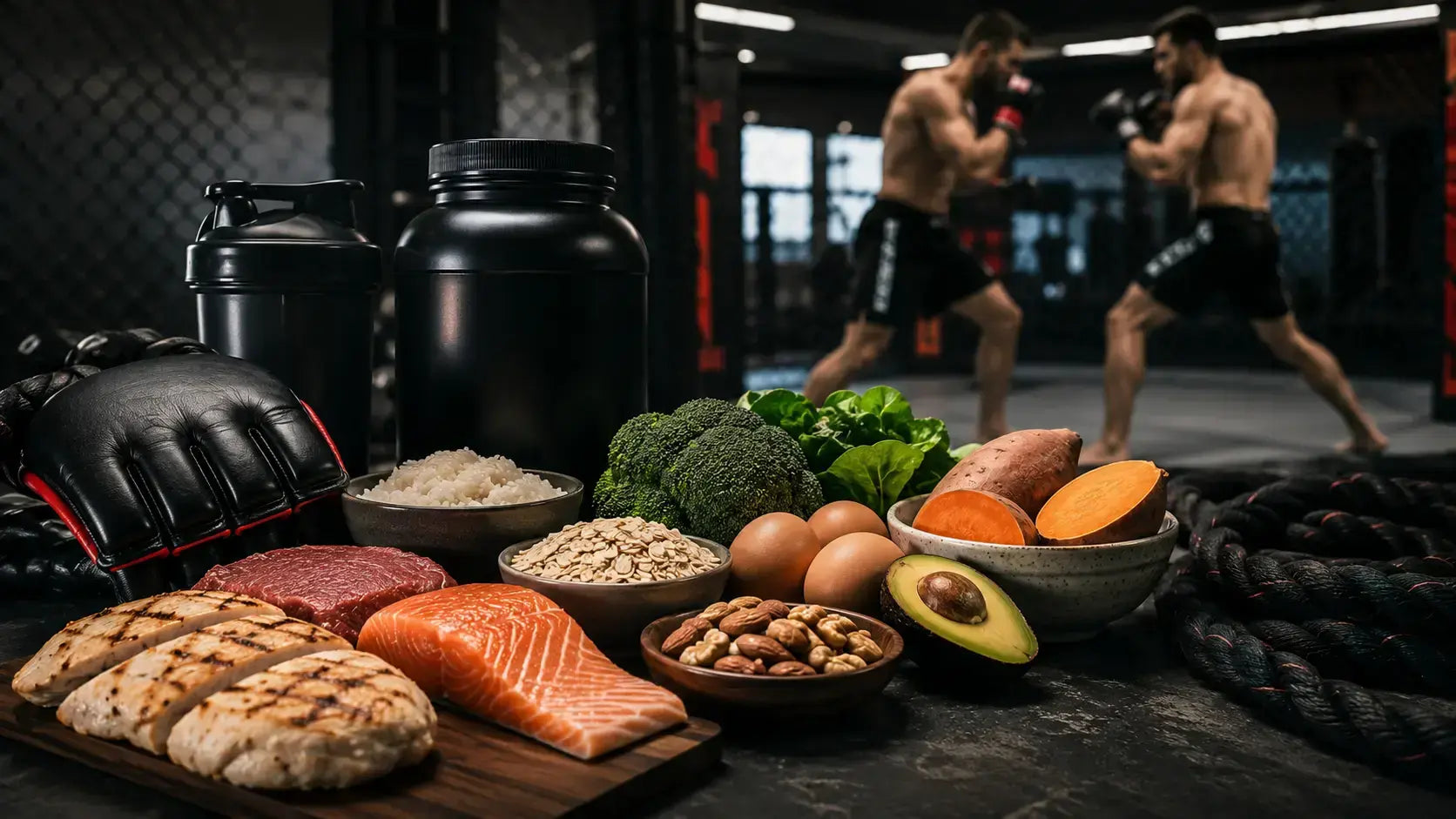

"My job isn't to build a bigger body. My job is to kill the guy in front of me." That's how MMA fighter Ahmed "Wolverine" Mujtaba describes his approach to training and food, and it flips the whole idea of a fighter's diet on its head.
If you’re new to fighting and getting overwhelmed by the strengths and powers of an advanced fighter, you should not do this. The only thing you should focus on is the best way of training and a good diet.
In this guide, you'll learn how fighters eat differently from bodybuilders. You'll see how their macros shift across training phases. And you'll learn how to cut weight in a safe way
Let's dive in!
Training Demands of an MMA Fighter
A week in Ahmed's life includes MMA sparring, boxing, kickboxing, wrestling, technical drilling, and strength and conditioning sessions. He also runs 5 kilometers twice a week. That's not a normal training split. It's a full-body demand that hits your energy systems from every direction.
Grappling burns through your muscle glycogen fast. Striking needs explosive power. Running builds the aerobic base that keeps you standing in round three. If you stack all of that together, your nutrition can't be an afterthought. It has to be planned around your training week, not the other way around.
Why Fighter Nutrition Is Different from Bodybuilding
A bodybuilder trains to look a certain way on stage. A fighter trains to perform under pressure, and that's a completely different job.
Ahmed put it simply: “An MMA fighter's task isn't to build size; it's to finish the fight.” It shows how strongly diet plays its role in a fighter’s life.
Bodybuilders always focus on muscle size and a lean look first. Fighters chase power, endurance, and the ability to make weight without losing strength. A bodybuilder might eat in a calorie surplus for months. A fighter has to focus on three things at once: fuel to train hard, controlled body weight, and cardio because they need to outperform the bodybuilders.
That’s how it works; we need to be aware of our goal before comparing with anyone.
Daily Nutrition Framework for Fighters
Daily nutrition intake and needs vary for different fighters depending on their training intensity. According to Ahmed, a few core principles guide his daily eating:
-
Enough carbohydrates to fuel high-volume training sessions
-
Controlled, gradual weight gain instead of rapid bulking
-
Protein intake that matches recovery needs, not just muscle-building goals
A study from the International Society of Sports Nutrition says that combat athletes need carbs matched to their training load. Low glycogen hurts high-intensity performance. That's why fighters like Ahmed don't remove carbs from their diet even when they're managing weight.
The result is a body that stays "fight-ready" year-round instead of just juggling between bulk and cut. No need to stress about chasing a stage-ready look. Your only job is staying prepared.
Macros for Different Phases: Maintenance, Gain, and Cut
Your macros shouldn't stay fixed all year, and neither do a fighter's. As we know, macros are the major part of our diet, and we need to manage them in order to fulfill our specific goals. And depending on your specific goals, either you want to maintain your weight, gain, or need a specific cut, your macros will vary depending on it.
A smart fighter always focus on keeping his weight in check instead of last moment rush. When a fight is five to six months away, Ahmed focuses on keeping his weight in check rather than making drastic last-minute cuts. Small, and steady cuts are always better than a drastic last moment cut. It can lead tp harmful effects on health as well.
As training intensity ramps up closer to fight camp, carbohydrate needs go up too. Your body simply can't sustain two-a-day sessions of sparring, wrestling, and conditioning on a low-carb plan. So instead of cutting carbs when training gets harder, fighters push them up to match the workload.
Here's the general shift:
-
Maintenance phase: balanced carbs, moderate protein, steady calories
-
Gain phase: slightly higher calories, controlled surplus, protein for recovery
-
Cut phase: protein and water intake go up, sodium and carbs come down gradually
That's the whole game, really. Match your fuel to your workload, not the calendar.
Smart Weight Cutting vs. Dangerous Shortcuts
Ahmed walks around at roughly 78 kg and cuts down to 70 kg for competition. That's a real, sizeable drop, but he does it the right way.
His approach cuts sodium a bit. It trims carbs slightly. It raises protein and water intake to drive slow, controlled fat and water loss. Nothing about it is sudden.
Many Pakistani fighters struggle here because they don't have this kind of structured plan. Eating heavy, carb-dense foods like parathas right up until a cut, then trying to drop weight fast, makes the whole process painful and risky. Don't let a bad habit like that undo months of good training.
Water Loading, Saunas, and Extreme Cuts
At the end, some fighters use a technique called water loading. They drink large amounts of water, sometimes up to around 8 liters a day, in the days before a weigh-in. Then they cut off water sharply and pair that with sauna or hot tub sessions.
This method can strip 7 to 10 kg of water weight quickly, and in some extreme cases, fighters have dropped 13 to 14 kg. That's a massive shock to your system.
A review found that rapid weight loss can hurt strength, power, and focus. This risk grows once athletes cut more than 5% of their body weight in a short window. Recent cases of fighters collapsing before weigh-ins show exactly what happens when this goes wrong.
Role of Professional Guidance in Weight Cuts
Weight cutting isn't something you should figure out through trial and error. It has to be managed by someone who understands water, sodium, and food intake as a system, not a guessing game.
One of the biggest issues in Pakistan is a lack of coaches who truly understand safe weight cutting. Without that guidance, fighters often copy whatever worked for someone else. That's a risky shortcut.
Individualized plans matter. Every body reacts differently to less sodium or less water. So work with a professional who can watch you through the process. Skip the generic plan you found online.
Nutrition Mistakes Fighters and Gym-Goers Make
1. Cutting Water and Carbs Too Early
Mistake: Fighters slash water and carbs weeks too early, leaving them drained during peak training weeks.
Solution: Keep carbs and water steady until the final, structured cut phase closer to weigh-in.
2. Dropping Overall Nutrition Suddenly
Mistake: Cutting whole food groups overnight shocks your body and drains your energy. Solution: Reduce your intake slowly over days or weeks, not overnight.
3. Relying on Heavy Traditional Foods During a Cut
Mistake: Eating parathas and other oily, salty foods right before a cut makes water cutting harder.
Solution: Shift to lighter, protein-forward meals as your cut phase gets closer.
Tuning the Body Gradually for Weight Loss
Ahmed describes this process as "tuning your body" rather than shocking it. That distinction matters more than people realize.
Cravings hit hard when food gets cut off all at once. Your body fights back with fatigue, irritability, and poor sleep. Gradual tuning avoids that spiral entirely.
Build small habits over time instead. Slowly lower your sodium. Slightly trim your carbs. This preps your body for a cut without the burnout that comes from crash approaches. And it really is that manageable when you plan.
Lessons from Top-Level Promotions (UFC Examples)
Even elite fighters like Islam Makhachev and Justin Gaethje cut around 10 kg for fight week. They do it safely, under expert supervision. Their process unfolds over roughly 24 hours. It uses structured water cutting, not desperate, last-minute measures. What separates them from fighters who collapse at weigh-ins isn't willpower. It's the system and the team behind them.
So structure beats grit here. Every single time.
How Jacked Nutrition Fits into a Fighter's Diet
This is where smart supplements support the framework Ahmed follows. Jacked Nutrition builds its protein, creatine, carb powders, electrolytes, EAAs, and multivitamins around real training demands. No quick-fix promises here.
On high-intensity training days, a stack might include a pre-workout for focus. Add intra-workout carbs to fuel long sparring sessions. Finish with post-workout whey for recovery. During a cut, high-protein options paired with low-sodium electrolytes help you stay hydrated without stalling your progress.
None of this replaces real food or expert guidance. It just fills the gaps that good supplements are actually good at filling.
Practical Nutrition Blueprint for Athletes and Gym-Goers
You don't need to train like a professional fighter to borrow this approach. Most gym-goers can realistically follow a scaled-down version.
A sample day inspired by Ahmed's principles looks like this:
-
Around training: higher carbs to fuel your session
-
Throughout the day: steady, spread-out protein intake
-
Overall: controlled fats and moderate sodium unless you're actively cutting
Do's and don'ts to keep in mind:
-
Do adjust carbs around training intensity, not randomly
-
Do increase protein and water gradually during a cut
-
Don't attempt extreme water loading without professional supervision
-
Don't remove entire food groups overnight
So keep these things in mind before you try adjusting your own nutrition around training.
Key Takeaways and Call to Action
Performance-first eating beats size-first eating for any fighter. Slow, gradual tuning beats sudden shocks. Expert guidance beats trial and error, especially during a weight cut.
And smart supplements fill the gaps that food alone can't cover on a demanding training schedule. That's the whole idea behind Jacked Nutrition's product range.
So what's holding you back from eating with this kind of structure? Reach out to the Jacked Nutrition team for a personalized diet and supplement plan built around your real training load, not a generic template. Share your goals and tag Jacked Nutrition. Let's build a community around safe, high-performance nutrition together.
Share:
What to Drink to Lower Blood Sugar Immediately
Protein Bars in Pakistan: Nutrition, Benefits and Buying Guide